How Do I Fix a Toilet A Practical Guide for Homeowners
- Luke Yeates
- Feb 8
- 14 min read

Before you start picturing a major plumbing disaster, take a breath. Most of the time, fixing a toilet comes down to a few straightforward checks. You can usually get to the bottom of common issues like that constant running sound or a weak flush just by understanding a few key parts inside the cistern.
You'd be surprised how many toilet troubles are simple enough to sort out yourself with just a few basic tools and a bit of guidance.
Your First Steps For Common Toilet Troubles
When your toilet starts acting up, it’s easy to feel a bit of panic, but a calm, methodical approach is your best friend here. Before you do anything else, the absolute first step is to prevent any potential water damage.
Grab a few old towels and place them around the base of the toilet. It’s a simple precaution that can save your flooring from a world of grief if things get a bit messy.
Next, you need to shut off the water. Look for the small isolation valve, which is usually on the wall or floor right behind your toilet. Give it a turn clockwise until it stops. This cuts off the water supply, letting you work in a much safer, drier environment.
Quick Diagnostic Checks
With the water off, you can start your detective work. Is the toilet clogged, constantly running, or flushing all by itself? Each symptom points to a different culprit.
A Persistent Running Sound: This is often the easiest fix. It usually means the flapper isn't sealing correctly or the fill valve needs a slight adjustment.
A "Phantom Flush": If you hear the toilet refill on its own every so often, you’ve likely got a slow leak from the tank into the bowl. Again, this points straight to a worn-out flapper.
A Blockage: Does the water rise dangerously high in the bowl after you flush? You’ve got a clog. Whatever you do, don't flush again!
This decision tree infographic is a great way to visualise the troubleshooting process based on what you’re seeing and hearing.
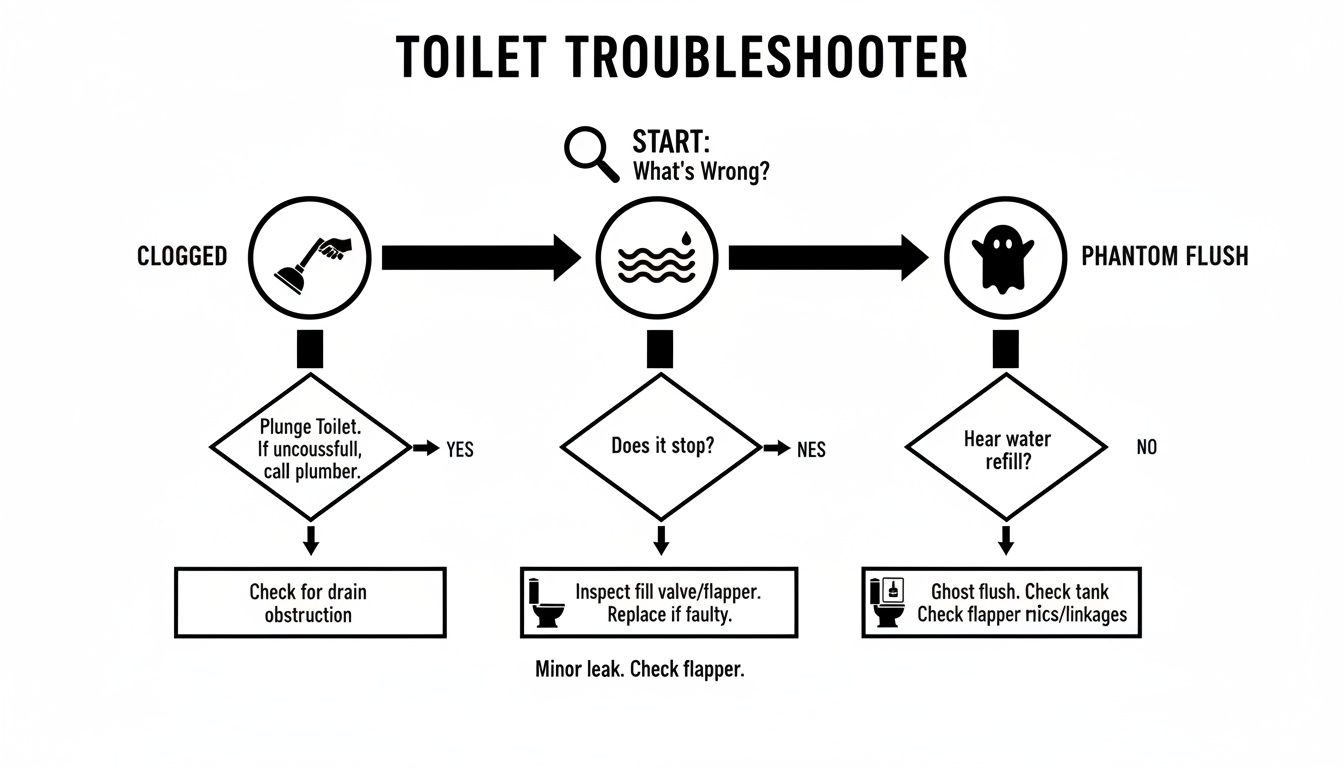
By following the branches, you can quickly narrow down the likely cause, whether it's a simple clog you can plunge away or a component issue inside the cistern.
Quick Toilet Problem Diagnosis
To make things even clearer, here’s a quick table to help you connect the dots between the symptom and what’s likely going on inside your toilet.
Symptom | Likely Cause | Your First Action |
|---|---|---|
Toilet runs constantly | Faulty flapper or fill valve | Turn off water, inspect the flapper for a good seal. |
Weak or incomplete flush | Low water level in the cistern | Check the fill valve and float to ensure the tank is filling properly. |
"Phantom" flush | Slow leak from a worn flapper | Perform the food colouring test to confirm the leak. |
Water rises in the bowl | Clog in the toilet or drainpipe | Use a plunger. Do not flush a second time. |
Water leaks at the base | Worn wax ring or loose bolts | Tighten the bolts at the base. If that fails, the wax ring needs replacing. |
This table should give you a solid starting point for most common issues, guiding you toward the right first step without having to guess.
The Eastbourne Hard Water Effect
Here in Eastbourne and across East Sussex, we deal with particularly hard water. Over time, this leads to limescale and other mineral deposits building up on the internal parts of your toilet, especially the rubber flapper. We see this at Harrlie Plumbing and Heating all the time; a customer in Meads will call about a running toilet, and the cause is nearly always a limescale-damaged flapper.
This buildup can make the flapper stiff and prevent it from creating a perfect seal, which is a very common cause of those annoying phantom flushes or a constant trickle.
A simple test is to gently press down on the flapper after the tank has filled. If the running sound stops, you've found your problem. A new flapper is an inexpensive and quick fix that often solves the issue immediately.
For landlords and property managers, staying on top of these small issues is key to avoiding bigger headaches. Beyond just fixing what's broken, having a robust rental property maintenance checklist can help you proactively spot and prevent future plumbing problems before they escalate.
If these initial steps don't resolve the issue, it might be time for a more thorough investigation. But more often than not, this initial diagnosis is all you need. Of course, if you're ever unsure, the team at Harrlie Plumbing and Heating is always ready to lend a hand.
How to Tackle a Blocked or Clogged Toilet
It’s a moment every homeowner dreads: the water in the toilet bowl starts rising instead of going down. Your first instinct might be to flush again, but whatever you do, don't. That’s the quickest way to turn a simple blockage into a messy overflow.
Instead, it's time to reach for the right tool. The most crucial item in your toilet-unblocking kit is a flange plunger, not the standard cup plunger you’d use on a sink. It has a soft rubber flap that extends from the bottom of the bell, designed specifically to form a tight seal in the toilet's drain. That seal is everything—it’s what allows you to build the hydraulic pressure needed to shift a blockage.
To get it right, make sure the plunger's bell is completely underwater. You want to be pushing water down the pipe, not just air. Give it several firm, sharp plunges straight down, then pull up on the last one to break the seal. More often than not, this is all you need to clear a simple clog.
When the Plunger Isn’t Enough
Sometimes, a blockage is just too stubborn for a plunger. We see this all the time in the older Victorian and Edwardian properties around Eastbourne, where decades of use have created more persistent problems. If the plunger isn't cutting it, your next port of call is a toilet auger, which you might know as a plumber's snake.
An auger is essentially a flexible cable made to navigate the toilet’s U-bend without scratching the delicate porcelain. You simply feed the cable into the drain until you feel it hit the blockage. Then, you turn the handle to either break up the obstruction or hook it so you can pull it out. It’s a much more direct approach for those tougher clogs that are out of a plunger’s reach.
In the UK, clogs are the number one plumbing headache, hitting about 39% of homeowners who tackled home repairs last year. This is especially true in older properties built before 1940, which house 53% of renovating homeowners. While fixing a clogged toilet yourself might seem tempting, it can often backfire. We've seen firsthand at Harrlie Plumbing and Heating how DIY attempts can worsen blockages, leading to more complex and costly repairs. You can explore more findings about UK home renovations from the 2025 Houzz & Home Report.
Knowing When to Call for Help
There's a fine line between a simple DIY fix and a serious blockage that needs a professional’s touch. If you've tried both a plunger and an auger without any luck, it’s time to stop. Pushing the issue could damage your pipes or turn a manageable clog into a major plumbing emergency.
Here are a few tell-tale signs that you need an expert:
The blockage comes right back after you think you’ve cleared it.
Other fixtures in your home, like the sink or shower, are backing up too. This happened recently in a property near Gildredge Park where the main drain was blocked, affecting the whole house.
You suspect something solid, like a child's toy, is stuck deep inside the pipe.
These symptoms usually point to a blockage much further down the main drain line. At Harrlie Plumbing and Heating, we have powerful equipment like high-pressure water jetting to clear these severe obstructions safely and completely. If you find yourself in this situation, it’s best to give us a call.
For related issues, it’s handy to know how your home’s drainage system works together. You can learn more by reading our guide on how to unblock a drain pipe.
Solving the Mystery of a Constantly Running Toilet
That constant, nagging hiss from your toilet isn't just irritating—it's the sound of water and money literally going down the drain. It’s a very common household problem, and nine times out of ten, the culprit is hiding inside the cistern.
Two key parts are usually to blame: the fill valve and the flapper. The fill valve’s job is to refill the tank after you flush, shutting off once the water hits the right level. Meanwhile, the flapper is the rubber plug at the bottom that keeps water in the tank. If either of these fails, water will slowly but surely trickle into the bowl, forcing the fill valve to run non-stop.
Finding the Source of the Leak
Before you can fix anything, you need to play detective and figure out which component has given up. Thankfully, a couple of simple tests will give you the answer.
The Flapper Test: Once the tank has filled, reach in (or use a long spoon) and gently press down on the flapper. If the hissing sound stops, you’ve found your culprit. The flapper isn't making a good seal.
The Fill Valve Test: If the flapper seems fine, try lifting the float arm or cup that's part of the fill valve assembly. If the water flow stops, it means the float is set too high, or the valve mechanism itself is faulty.
Here in Eastbourne, the hard water can be tough on plumbing parts. We often see mineral deposits build up on rubber flappers, making them hard and brittle so they can no longer seal properly. It's one of the most frequent jobs we're called out for at Harrlie Plumbing and Heating.
A single leaky loo is a quiet drain on UK household budgets, wasting up to 200 litres of water every single day. In Eastbourne's older housing stock, leaks from worn-out valves or seals are a particular problem, affecting an estimated 1 in 4 Victorian-era properties in East Sussex. When troubleshooting a running toilet, the fill valve is the culprit in about 60% of cases.
Actionable Steps for a Permanent Fix
Once you know what’s wrong, the fix is usually quite straightforward.
If you’ve got a leaky flapper, the best thing to do is replace it. They are inexpensive parts and swapping one out only takes a few minutes.
When the fill valve is the issue, first check the float. Sometimes, all you need to do is adjust it to sit a bit lower, so it shuts the water off sooner. However, if the whole valve mechanism looks old and worn, replacing the entire unit is a much better long-term solution.
While popping in a new flapper is a quick DIY task, changing a full cistern mechanism can get a bit more involved. If you’re not feeling confident, or if the problem continues after you’ve had a go, don’t hesitate to give us a call. Our team at Harrlie Plumbing and Heating can swap out the whole system efficiently, guaranteeing a permanent fix that finally silences that wasteful hissing.
For a more detailed look at this common problem, have a read of our guide on how to fix a running toilet.
How to Restore a Weak or Incomplete Flush
There’s nothing more frustrating than a weak, half-hearted flush that doesn’t clear the bowl. It’s more than just an annoyance; it’s a clear sign your toilet isn’t working efficiently, and a proper clog could be just around the corner.
When you push that handle, you expect a powerful rush of water to force everything down the drain. If that force is missing, the problem almost always lies within the cistern.
Most of the time, the issue is surprisingly simple: there isn’t enough water in the tank to begin with. Without the right volume, the flush loses all its power before it can do its job. It's a bit like trying to put out a bonfire with a teacup—the effort is there, but the impact just isn’t.
Checking the Essentials Inside the Cistern
First things first, lift the cistern lid and have a look inside. The water level is your primary suspect. Ideally, it should sit about half an inch below the top of the overflow pipe. If it's sitting much lower than that, you’ve probably found the main reason for your weak flush.
You can adjust the float mechanism—whether you have an older ballcock style or a more modern float cup—to let more water into the tank before it shuts off.
Another common culprit is a slack chain connecting the flush handle to the flapper. If there's too much slack, pulling the handle won’t lift the flapper high enough or keep it open for long enough. This gives you that short, weak flush. You’re aiming for only about half an inch of slack in the chain for it to work properly.
Beyond the Basics: Limescale and Upgrades
Here in Eastbourne, our hard water is a notorious troublemaker for plumbing. Over time, limescale can build up and clog the small rim jets under the toilet bowl's edge. These jets are crucial for directing water into the bowl with enough force to clear it. A recent call-out we had in Sovereign Harbour involved exactly this; the flush was weak simply because the jets were blocked with scale.
A quick clean with a small brush and some vinegar can often work wonders and restore their power.
A weak flush isn't just a performance issue; it’s a symptom. If you've adjusted the water level, checked the chain, and cleaned the rim jets but the problem persists, it may be a sign that the internal components are simply worn out and need replacing.
For older toilets that consistently underperform, sometimes the best long-term solution is a modern, water-efficient replacement. At Harrlie Plumbing and Heating, we often recommend this to homeowners who are just tired of dealing with recurring flush problems. A new toilet not only delivers a consistently powerful flush but also helps reduce your water bills.
Identifying and Fixing Leaks Around the Toilet Base
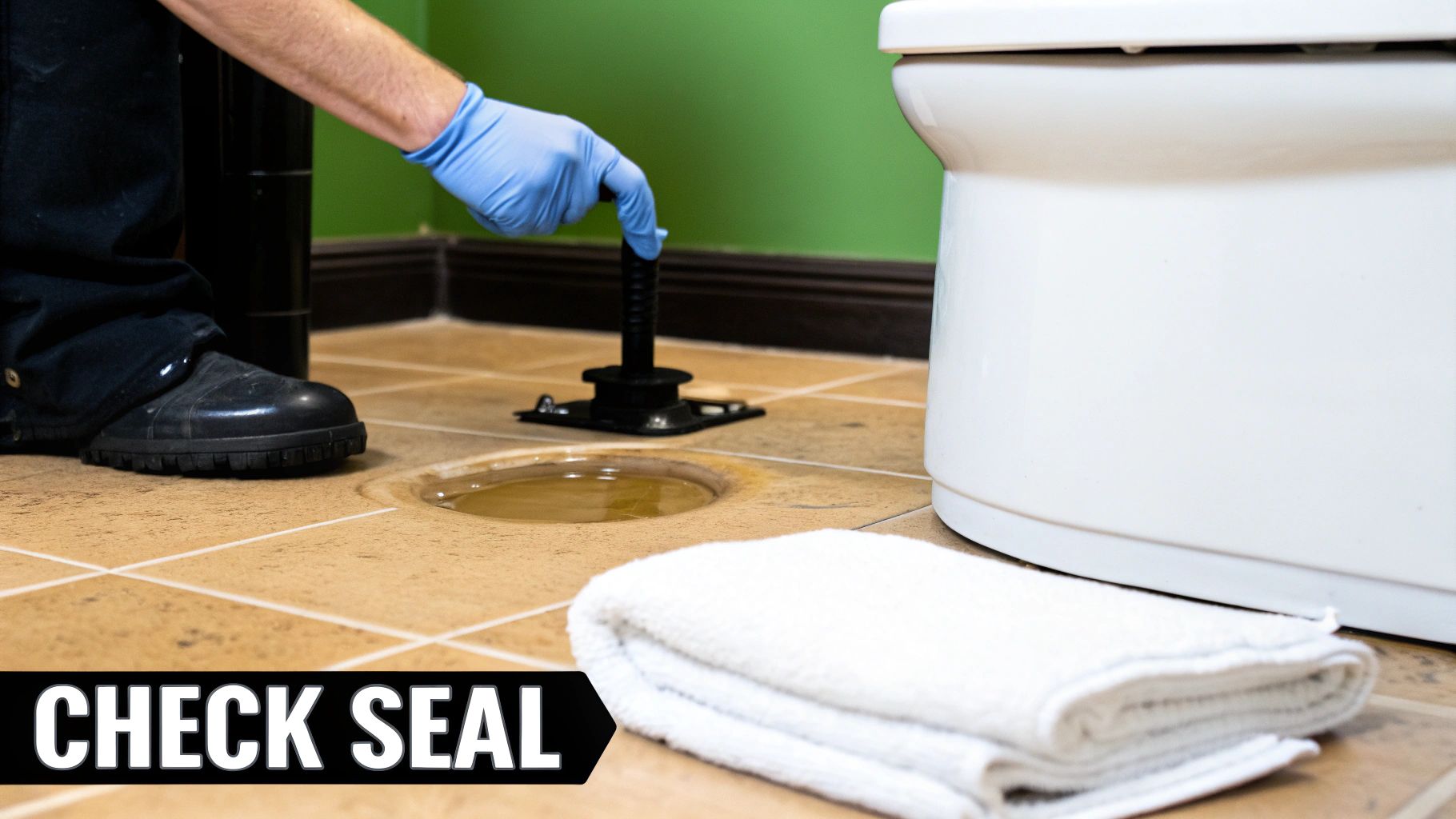
Discovering a puddle of water around the base of your toilet is a definite red flag. It’s an issue that needs sorting out straight away, as a persistent leak can easily seep into your subfloor, leading to rot and serious structural damage over time.
Before you jump to conclusions, your first job is to figure out where that water is coming from. Is it a proper leak, or just condensation? On a humid day in Eastbourne, it's not unusual for a cold cistern to "sweat," letting droplets run down and collect on the floor. Give the area a thorough wipe with a towel and then wait. If the puddle comes back after you flush, you’ve confirmed it's a leak.
Investigating the Common Causes
Once you've ruled out condensation, there are two main culprits for a leak at the toilet's base: loose tee bolts or a failed wax ring. The tee bolts are what hold your toilet securely to the floor, and you’ll find them hiding under plastic caps on each side of the base.
Over the years, these bolts can sometimes work themselves loose. You can try to gently tighten them with a spanner, but you have to be careful here. Overtightening can crack the porcelain in a heartbeat, turning a small problem into a much bigger, more expensive one. You’re aiming for a snug fit—just enough to stop the toilet from wobbling.
If tightening the bolts doesn't do the trick, the problem is almost certainly a failed wax ring. This is the vital seal between the bottom of your toilet and the drainpipe in the floor. With age, it can degrade or get compressed, breaking the watertight seal.
A failed wax ring isn’t just about the leak; it can also let nasty sewer gases escape into your bathroom. If you notice a persistent, foul smell along with the water, that’s a sure-fire sign the wax ring needs replacing.
The Risks of Replacing a Wax Ring
While replacing a wax ring might seem like a straightforward DIY task, it's a job we at Harrlie Plumbing and Heating strongly advise leaving to the professionals. The process involves shutting off the water, draining the toilet completely, and then physically lifting the heavy, awkward unit off the floor.
Getting a perfect, level seal with the new ring is absolutely crucial. If it’s not set just right, the leak will come back, and you'll be right back where you started. Our technicians have the experience and tools to get this right the first time, protecting your Eastbourne home from the risk of costly water damage.
For more insights into tracking down leaks, check out our practical guide for homeowners on how to stop a toilet leaking.
When to Call a Professional Plumber in Eastbourne
Knowing your limits is probably the most important skill in any DIY project. This is especially true when you're trying to fix a toilet. While many minor repairs are well within reach for a confident homeowner, some situations really do need a professional touch. Trying to push through could turn a small issue into a major, costly disaster.
Sometimes, a DIY fix just won't cut it, or the problem is far more complex than it first appears. If you’ve followed the steps in this guide and the toilet is still acting up, that’s a clear sign it's time to call in an expert.
Signs You Need an Expert
It’s time to put down the wrench and pick up the phone if you run into any of these scenarios. Pushing ahead on your own could easily lead to cracked porcelain or, worse, significant water damage to your home.
Persistent Clogs: If plunging and augering don't shift the blockage, it’s likely located deep within your drainpipe. This requires specialist equipment to clear safely and effectively.
A Crack in the Bowl or Cistern: Even a hairline crack is a serious problem. It needs immediate professional assessment to prevent leaks that could damage your floor and ceiling.
Water Pooling at the Base: While it might just be loose bolts, this often signals a failed wax ring. That's a job best left to a pro to ensure a perfect, watertight seal.
Sewer Gas Smells: A nasty smell like this indicates a breach in your plumbing's seal somewhere, which can be a genuine health hazard for your family.
For complex issues beyond a straightforward DIY repair, it's always best to consult with professionals for expert plumbing works to ensure the problem is sorted properly and safely.
Harrlie Plumbing and Heating Is Here to Help
Faulty toilet mechanisms are a common reason UK homeowners reach for the phone. Professional replacements can cost anywhere from £150-£400 on average. While a DIY kit might seem like a bargain at £20-£50, statistics show that 35% of these attempts still end up needing a professional to come and fix them properly.
At Harrlie Plumbing and Heating, we provide a rapid emergency response across Eastbourne, Hastings, and Bexhill. Calling a trusted local company like ours means you can be sure the job is done correctly the first time, giving you lasting peace of mind.
Got a Question About Your Toilet? We've Got Answers
We hear a lot of the same questions from homeowners in Eastbourne grappling with a misbehaving toilet. Here are some quick answers to the most common queries we get.
"Why Does My Toilet Keep Running On and Off?"
That phantom flush you’re hearing is a classic sign of a slow, internal leak. More often than not, the culprit is the flapper at the bottom of the cistern. It’s supposed to create a perfect seal, but over time, it deteriorates and lets water seep through.
Here in Eastbourne, our hard water really speeds up this wear and tear, making the rubber flapper stiff and ineffective. Occasionally, it could also be a dodgy fill valve that isn't shutting off when it should.
"Are Those Chemical Drain Cleaners Safe to Use?"
Honestly, we’d advise you to steer clear of harsh chemical drain cleaners for your toilet. These corrosive chemicals can do a real number on the rubber seals inside your toilet and, even more worryingly, can damage the older pipework common in many Eastbourne properties.
They don’t always get the job done, either, and can sometimes just compact the blockage further down the line. A proper toilet auger is a much safer and more effective first step for stubborn clogs.
Remember, a persistent blockage often signals a deeper issue in your drain line. If an auger doesn’t solve it, it's time to call in the professionals before the problem escalates.
"How Can I Tell If the Wax Ring Has Failed?"
There are three tell-tale signs that your toilet's wax ring needs replacing. Keep an eye out for these:
Water seeping from the base right after you flush is the most obvious clue.
A persistent sewer gas smell lingering in your bathroom means that airtight seal is broken.
The toilet itself feels wobbly or unstable, even after you've gently tightened the bolts at the base.
If you spot any of these, it’s a job we at Harrlie Plumbing and Heating strongly recommend leaving to an expert. A DIY attempt gone wrong can lead to some pretty serious and costly floor damage.
When your DIY fixes just aren't cutting it, trust your local experts. For reliable toilet repairs and all your plumbing needs in the Eastbourne area, contact Harrlie Plumbing and Heating for a professional and lasting solution. https://www.harrlieplumbing.co.uk

Comments