Increase Water Pressure Home: A Practical Guide to Boosting Shower Power
- Luke Yeates
- Feb 6
- 17 min read

If you’re looking to increase water pressure in your home, the first job is to play detective and figure out what’s causing the problem in the first place. More often than not, the fix is something simple you can handle yourself, like fully opening a stopcock that’s been knocked shut or giving a clogged tap aerator a quick clean.
Diagnosing Low Water Pressure in Your Eastbourne Home
That sad, trickling shower is more than just a rough start to your day—it's a clear sign that something isn't right with your plumbing. Before you can get that satisfying flow back, you need to pinpoint the source of the issue. This initial check is vital, as it’ll quickly tell you whether the problem is inside your house or a bigger issue affecting the whole neighbourhood.
As local plumbers at Harrlie Plumbing and Heating, we've seen it all across Eastbourne, from the modern builds down in Sovereign Harbour to the lovely old Victorian terraces closer to the town centre. The good news? Most of the time, the cause of low water pressure is surprisingly straightforward to track down.
Start with a Simple Flow Rate Test
Your first move should be a quick, no-nonsense measurement of your water flow. You don’t need any fancy gear for this—just a measuring jug from the kitchen and a timer. It’s often called the 'bucket test'.
Grab a 1 or 2-litre measuring jug and get the stopwatch ready on your phone.
Turn your kitchen tap on full blast and time how long it takes to fill the jug.
Do a quick calculation: If it takes 10 seconds to fill a 1-litre jug, your flow rate is 6 litres per minute (60 seconds / 10 seconds = 6, then 6 x 1 litre = 6 L/min).
A flow rate dipping below 10 litres per minute is generally considered low and definitely warrants a closer look. This simple test gives you a solid baseline to work from as you investigate further. For a more detailed walkthrough, have a look at our guide on how to test water pressure in your home.
Is It Just Your Home or the Whole Street?
Next up, you need to work out if the problem is confined to your property. A quick chat with your neighbours is often the easiest way to do this. For example, if you're in the Roselands area of Eastbourne and your neighbour has the same issue, it's likely a mains supply problem.
If they’re also putting up with a weak flow, the issue is almost certainly with the mains supply in your Eastbourne neighbourhood. It could be down to maintenance work or even a leak in the network. If that’s the case, your best bet is to get in touch with your local water supplier.
But if your neighbours' pressure is perfectly fine, then the culprit is somewhere on your property. This is where the real diagnostic work begins, and it’s time to start checking the common troublemakers inside your home.
Key Takeaway: A simple chat over the garden fence is one of the most effective diagnostic tools you have. It instantly tells you whether to focus your attention on your own plumbing or to ring up the local water authority.
It’s also helpful to know what’s considered acceptable. In England and Wales, the minimum standard set by water companies is a flow rate that can fill a 4.5-litre container in 30 seconds. Yet, as of March 2024, there were 26,390 properties falling below this minimum standard, which shows just how many homeowners are dealing with this frustration. You can find more stats on UK water pressure on DiscoverWater.co.uk. This context helps you understand if what you're experiencing is genuinely below par.
Quick Diagnostic Checklist for Low Water Pressure
To help you get started, here's a quick reference table to run through the most common symptoms and their likely causes. It's a great way to perform an initial check and narrow down the possibilities.
Symptom | Possible Cause | Initial Check |
|---|---|---|
All taps in the house are weak | Mains supply, main stopcock, or PRV issue | Ask neighbours about their pressure. Check your main stopcock. |
Only hot water has low pressure | Issue with the boiler or hot water cylinder | Check your boiler's pressure gauge (combi) or inspect the cylinder. |
Only one tap is affected | Clogged aerator or faulty tap valve | Unscrew the tap's spout end (aerator) and clean it. |
Pressure drops when multiple taps are on | Undersized pipes or a partial clog | This is common in older homes; a plumber can best advise. |
Shower pressure is particularly low | Clogged shower head or faulty mixer valve | Descale the shower head by soaking it in white vinegar. |
Working through this checklist can often lead you straight to the source of the problem. If you've tried these initial checks and are still stumped, that's usually the point where it's best to bring in a professional like Harrlie Plumbing and Heating.
A Hands-On Guide to Investigating Your Plumbing System
Alright, now that you've checked the basics outside, it's time to roll up your sleeves and take a look at the plumbing inside your home. Low water pressure often hides in plain sight, and a methodical check can help you pinpoint the most common culprits without having to call for backup straight away.
We see this a lot at Harrlie Plumbing & Heating, especially in the charming older terraced houses around Old Town in Eastbourne. A previous owner, or even a past tradesperson, might have partially closed a valve for a repair and simply forgotten to open it fully again. It’s a surprisingly frequent cause of a weak flow that can go unnoticed for years.
This hands-on guide will walk you through the key checkpoints, showing you exactly what to look for.
Locating and Checking Your Main Stopcock
Your home's main stopcock (or stop valve) is the master control for all incoming water. If this isn't fully open, your entire system will be starved of pressure, no matter what else you do. Finding it is your first mission.
It's typically found where the water supply pipe enters your property. Good places to look are:
Under the kitchen sink
In a downstairs loo or utility room
Tucked away in a cupboard under the stairs
Once you've found it, check its position. For a traditional stopcock with a round handle, you need to turn it fully anti-clockwise until it stops. Don't force it, but make sure it's all the way open. If you have a more modern lever-style valve, the handle should be lined up parallel with the pipe.
Pro Tip: In older Eastbourne properties, stopcocks can become stiff from lack of use. If it won't budge, don't try to force it with a wrench—you could damage the valve and cause a serious leak. Gentle, firm pressure is best. If it’s truly seized, that’s a clear sign to ring a professional.
Inspecting Your Pressure Reducing Valve (PRV)
Not every home has a Pressure Reducing Valve (PRV), but they are common in areas with high mains pressure to protect a home's plumbing. A PRV is a bell-shaped brass valve usually installed right after the main stopcock. Its job is to cap the incoming pressure to a safe level, typically around 3 bar (or 45-50 PSI).
If your PRV is faulty or has been set too low, it can be the direct cause of your weak flow. You can often adjust it yourself with a spanner or screwdriver on the adjustment screw at the top, but be careful. Small, incremental turns are key; a quarter-turn clockwise will usually increase the pressure slightly.
This simple diagnostic process helps you quickly identify common issues. This visual guide simplifies the first steps of your investigation.
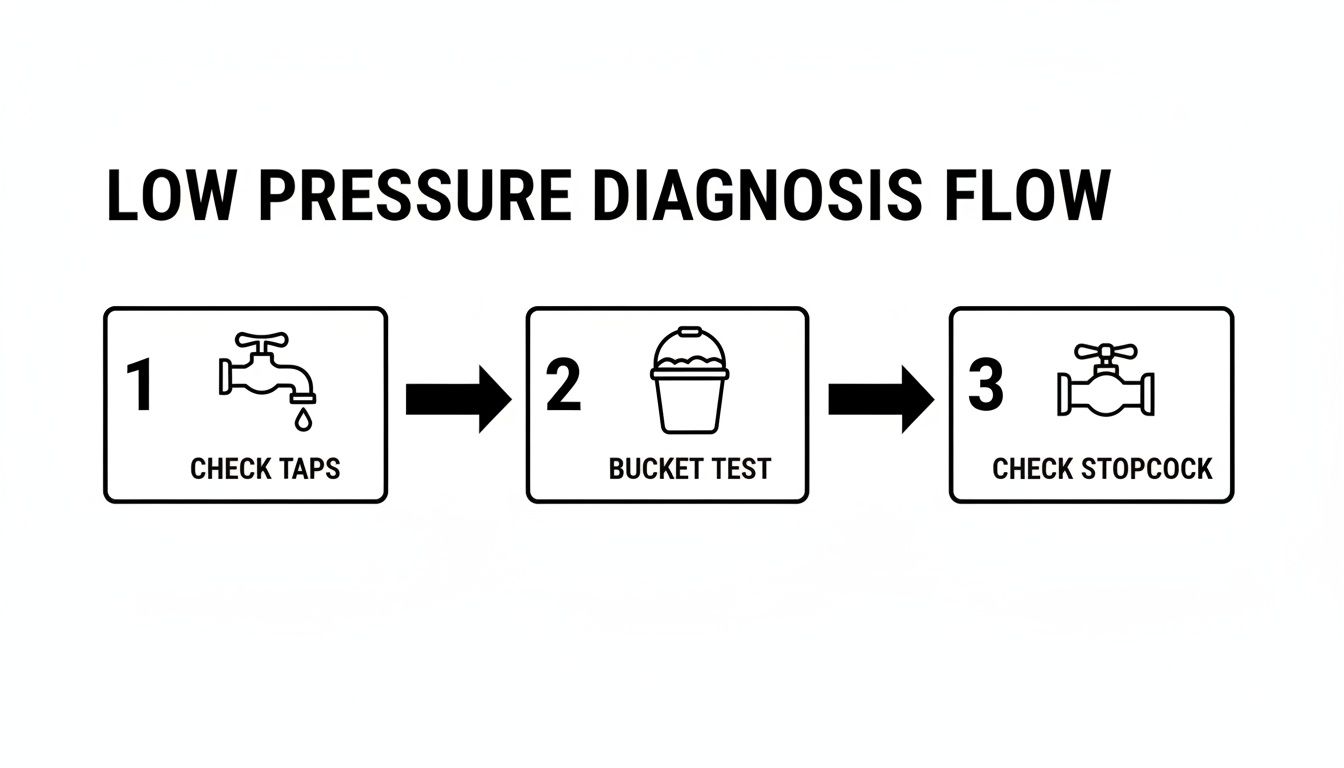
This flowchart shows that checking your taps, performing a bucket test, and inspecting your stopcock are the foundational steps to diagnosing the problem.
Checking Individual Shut-Off Valves
Beyond the main controls, many of your appliances and fixtures will have their own isolation valves or shut-off valves. You’ll find these on the pipes leading to toilets, sinks, washing machines, and dishwashers. They are usually small levers or have a slot for a flathead screwdriver.
Just like the main stopcock, these must be fully open. It's easy for them to get knocked during cleaning or when you're storing things under the sink. If low pressure is only affecting one tap, a partially closed isolation valve is the most likely suspect. Check that the lever or slot is parallel to the pipe for a fully open flow. To learn more about tracking your water usage, you might find our guide on how to read your water meter in your Eastbourne home useful.
Comparing Hot and Cold Tap Performance
One final, crucial test is to check your hot and cold taps separately. Run the cold tap in your bathroom and get a feel for the pressure. Then, switch to only hot water and see if there’s a noticeable difference.
A big drop in pressure on the hot side is a strong clue that the problem isn’t with your mains supply at all. Instead, it points towards an issue with your heating system—a very common call-out for the Harrlie Plumbing & Heating team in Eastbourne. The cause could be anything from limescale build-up in your hot water cylinder to a pressure problem within a combi boiler.
If you find that only the hot water is weak, it's best to stop your DIY investigation right there. Working on boilers and hot water cylinders requires specialist expertise, so it’s time to contact a Gas Safe registered engineer.
Alright, you've checked the main valves and the problem's still there. Now it's time to play detective and look at the common culprits we see every day on our rounds in Eastbourne, Hastings, and Bexhill.
The good news is that many causes of low water pressure are surprisingly simple to fix yourself. From mineral build-up literally choking your taps to the more serious issue of a hidden leak, figuring out the symptoms is the key to finding the right solution.
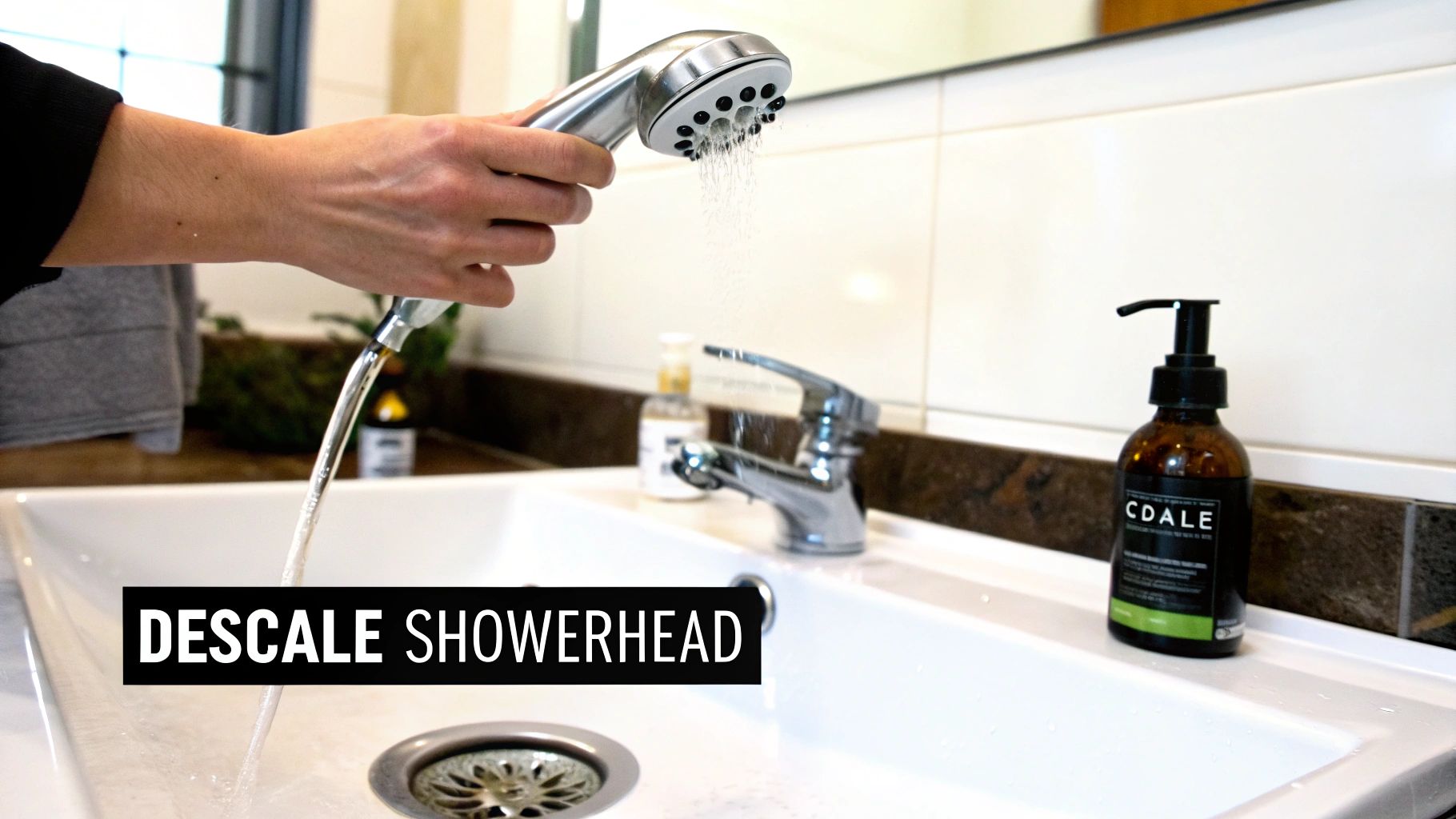
Let’s walk through the most frequent offenders, starting with the easiest wins. These are the issues you can often sort out with a bit of time and some basic household items, hopefully restoring that satisfying flow without needing to call us in just yet.
The Hard Water Problem: Clogged Taps and Showerheads
Here in East Sussex, we have notoriously hard water. That means it’s packed with minerals like calcium and magnesium. While harmless to drink, these minerals can wreak havoc on your plumbing fixtures over time, leaving behind a chalky deposit known as limescale.
As limescale builds up, it narrows the tiny openings in your tap aerators (the little screw-on mesh tips) and showerheads, effectively strangling the water flow. If your low pressure is only affecting one or two fixtures, this is almost certainly the cause. It's a quick fix that can dramatically increase water pressure at that specific outlet.
The DIY Fix: A Vinegar Soak
This is one of the most effective and cheapest tricks in the book.
Unscrew the Fixture: Carefully unscrew the aerator from your tap spout or detach the showerhead from its hose or arm.
Soak in White Vinegar: Pop the part in a bowl and submerge it completely in white vinegar. Let it soak for at least a few hours—overnight is even better—to dissolve those stubborn mineral deposits.
Scrub and Rinse: Grab an old toothbrush and give it a gentle scrub to get rid of any remaining limescale. Rinse it thoroughly under running water before putting it back on.
You should notice an immediate improvement. If the pressure is still poor after a good clean, the blockage might be further back in the tap's valve or the supply pipe.
The Hidden Threat of Small Leaks
Even a tiny, barely noticeable leak can have a massive impact on your home's water pressure. That constant drip from an outside tap, a toilet cistern that won't stop running, or a mysterious damp patch on a wall are all red flags. Your system is losing water somewhere it shouldn't be.
This constant loss means your plumbing system can never fully pressurise, leading to a weak, disappointing flow at every tap. It’s like trying to inflate a tyre with a slow puncture; you’re fighting a losing battle. The national picture really highlights the scale of this problem.
Across England and Wales, an astonishing 46.4 litres of water were lost per person, per day in 2024-25 due to leaks in the distribution networks. While this figure relates to the wider infrastructure, it underscores how even small leaks collectively result in massive pressure loss. You can explore more about national leakage targets and performance from Ofwat.
At Harrlie Plumbing & Heating, we've seen firsthand how a small, hidden leak in a Victorian property in the Meads area of Eastbourne can be the sole reason for a family's persistent pressure problems. Finding these leaks is crucial, not just for your water pressure, but to prevent costly water damage down the line.
Corroded and Ageing Pipework
If you live in an older property, particularly one built before the 1970s, your pipes could be the real root of the problem. Many older homes in the UK were built with galvanised steel or iron pipes, and over decades, these materials corrode from the inside out.
This corrosion creates a rough, uneven internal surface that restricts water flow and catches debris, narrowing the pipe's diameter year after year. The symptoms are often a gradual decline in pressure over a long time, sometimes with a bit of discoloured or rusty-looking water when you first turn on a tap.
Identifying Corroded Pipes
Material: Galvanised steel pipes are a dull, greyish colour.
Symptoms: Besides low pressure, look for reddish-brown water, visible rust spots on any exposed pipes, or frequent clogs.
The Verdict: Unfortunately, there's no simple DIY fix for corroded pipes. The only real long-term solution is repiping—replacing the old, tired pipework with modern copper or plastic. This is a significant job that absolutely requires a professional plumber.
If you suspect your pipes are past their prime, it's time to call in the experts. A professional from Harrlie Plumbing & Heating can properly assess the condition of your pipework in your Eastbourne home and give you a clear, honest opinion on the best way to permanently increase your home water pressure. We can figure out if a full or partial repipe is needed to get a strong, reliable flow back throughout your property.
When It’s Time to Call in the Pros for a Pressure Boost
So, you’ve descaled the showerhead, checked that every valve is wide open, and the water flow is still more of a trickle than a torrent. It's a frustrating spot to be in, and it usually means the problem runs deeper than simple DIY fixes can reach. When you’ve exhausted the basics, it’s time to look at the more powerful, permanent ways to increase water pressure in your home.
This is where you step away from the spanners and bring in a professional. These solutions involve getting into the core of your plumbing system, and a small mistake can lead to big leaks, serious damage, or dangerously high pressure. A certified plumber understands the dynamics of a plumbing system and, just as importantly, knows the local building regulations inside out.
We at Harrlie Plumbing and Heating get calls all the time from homeowners who are at their wits' end. A classic example is a family in a lovely old three-storey Victorian house in the Upperton area of Eastbourne. The pressure on the ground floor is perfectly fine, but the shower on the top floor is maddeningly weak. In this case, gravity is the enemy, and no amount of cleaning will solve it.
This is exactly when a professional pressure-boosting solution becomes the answer.
The Power of a Water Pressure Booster Pump
One of the most effective tools in our arsenal is the water pressure booster pump. It's an electric pump that we install directly onto your incoming water main. Its job is straightforward but incredibly effective: it takes the existing mains flow and gives it a serious push, forcing it through your pipes with greater velocity to guarantee a strong, steady flow everywhere in the house.
Think of it as a turbocharger for your plumbing. It senses when you turn on a tap and kicks in automatically to deliver that instant boost.
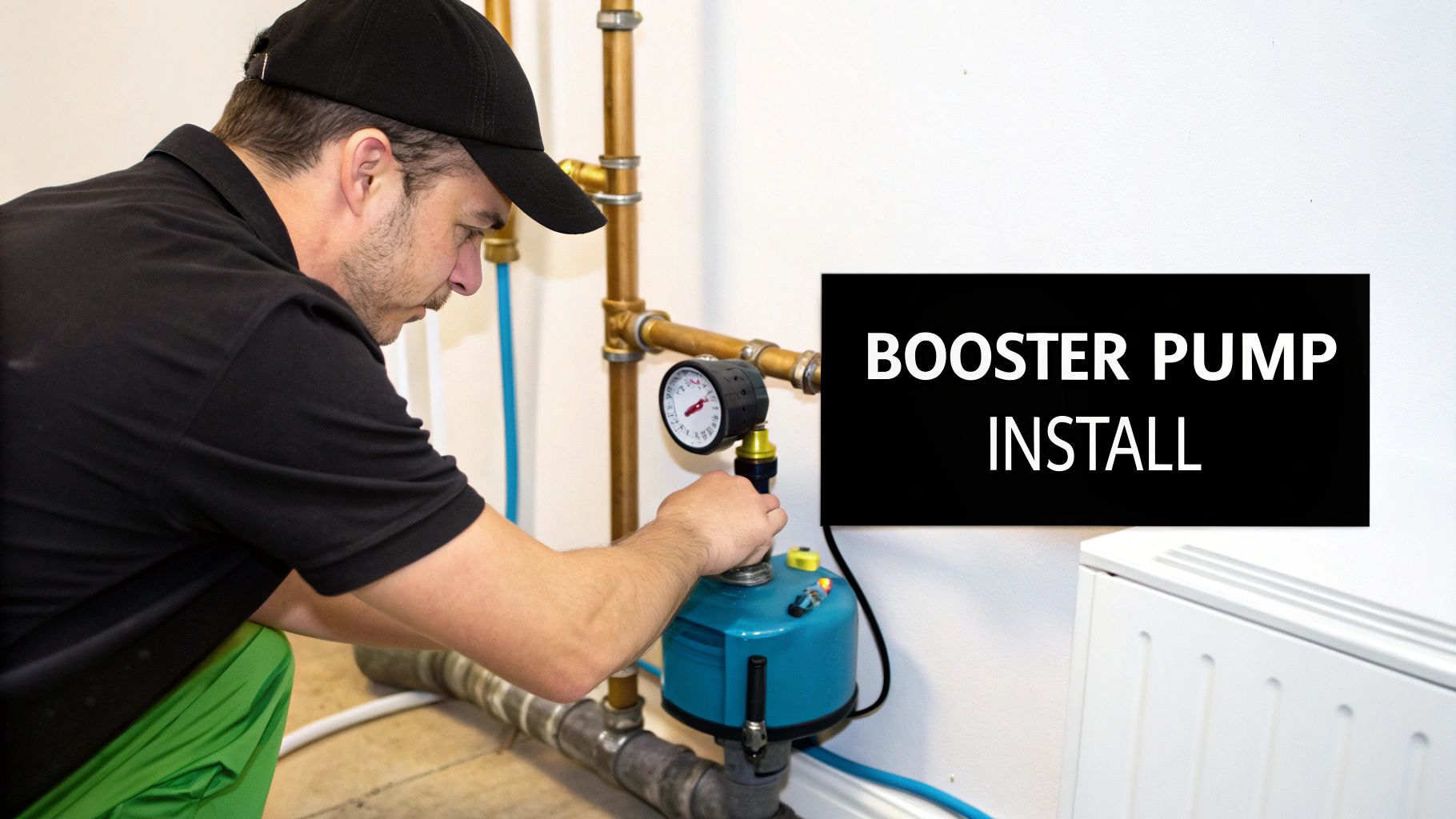
How it Works: Inside the pump, an impeller spins at high speed, dramatically increasing the speed and pressure of the water flowing through it.
Best For: Larger homes, properties with multiple bathrooms, or any house where the incoming mains pressure is just consistently low.
The Result: You finally get that powerful shower on the top floor. The bath fills in minutes, not half an hour. You can even run the dishwasher and washing machine at the same time without the kitchen tap dying.
Storing Power with Accumulator Tanks
An accumulator tank is another fantastic solution, though it works a bit differently. Instead of an active pump, it’s a storage tank that holds a large volume of water under pressure, ready to be released on demand. When you open a tap, this pressurised water floods into the system, supplementing the flow from the mains.
It’s less like a turbocharger and more like a pre-charged reservoir of high-pressure water. This is particularly brilliant for homes with high-demand hot water systems, like an unvented cylinder. If you have one of those, you might find our guide on what a Megaflow system is really useful.
Why is Pressure Dropping Anyway? It's worth remembering the strain our water systems are under. The average UK household uses 70% more water now than in 1985. With each person using around 136.5 litres per day, the infrastructure is working incredibly hard, which can sometimes lead to lower pressure reaching our homes.
When the Pipes Themselves Are the Problem: Repiping
For some of the beautiful older properties in Eastbourne, the issue isn't the pressure coming into the house, but the journey it has to take once it's inside. Decades-old galvanised steel or very narrow copper pipes can become so choked with limescale and corrosion that they act like a permanent bottleneck.
In these situations, adding a pump is just a plaster on a much bigger wound. The only true, long-term fix is repiping—replacing all the old, restrictive pipework with new, wider-bore copper or modern plastic pipes that allow water to flow freely.
While it’s the most disruptive and expensive option, repiping permanently solves flow restrictions, improves the overall health of your entire plumbing system, and can even add value to your property.
Professional Water Pressure Solutions Compared
Deciding between a pump, a tank, or a full repipe can be tricky. It really depends on your home’s specific circumstances and your budget. This table breaks down the main options we recommend for homes in Eastbourne.
Solution | Ideal For | Pros | Cons & Considerations |
|---|---|---|---|
Booster Pump | Homes with low mains pressure but otherwise healthy pipes. Great for multi-storey houses. | Provides an immediate and powerful pressure increase. Relatively quick to install. | Requires electricity to run. Can be noisy. Doesn't fix underlying pipe blockage issues. |
Accumulator Tank | Properties with high-demand systems (e.g., unvented cylinders) needing a buffer. | Stores pressurised water for peak usage. Silent operation. Less mechanical wear than a pump. | Takes up physical space. Doesn't increase the source pressure, only supplements it. |
Full Repipe | Older homes (Victorian, Edwardian) with original, narrow, or corroded pipework. | A permanent, long-term fix for flow issues. Improves plumbing health and home value. | Most expensive and disruptive option. Involves significant work accessing walls/floors. |
Ultimately, the best way forward is to get a professional diagnosis. The Harrlie Plumbing & Heating team can run proper flow and pressure tests to pinpoint the real cause of your low pressure. From there, we can give you clear, honest advice on the most effective and economical solution for your home.
Your Local Eastbourne Experts: Harrlie Plumbing & Heating
Fixing a stubborn water pressure problem often goes beyond a simple DIY tweak. When you’ve checked all the basics and your shower still feels disappointingly weak, it’s a clear signal the issue lies deeper within your plumbing system.
A misstep at this stage, like trying to force a seized valve or incorrectly adjusting a pressure regulator, can quickly turn a minor annoyance into a major, costly repair.
At Harrlie Plumbing & Heating, we've built our reputation across Eastbourne, Bexhill, and Hastings by being the team you can trust when things get complicated. Our promise is simple: to provide rapid, reliable service that restores the powerful, consistent water flow your family deserves. We get it—you just want the problem solved correctly, without fuss or hidden fees.
Clear Signs It's Time for a Professional
Knowing when to put down the wrench and pick up the phone is key. If you're running into any of the following, it’s time to call in a certified expert:
Widespread Low Pressure: If every tap in your house has a weak flow, the issue is systemic. This often points to your mains supply, a faulty pressure reducing valve (PRV), or a hidden leak somewhere.
Sudden Pressure Drop: A dramatic and sudden loss of pressure can mean a significant leak or even a burst pipe. This needs immediate attention to prevent serious water damage.
Hot Water Pressure Issues Only: When only your hot taps are suffering, the problem is almost certainly within your heating system—something that requires a Gas Safe registered engineer to investigate safely.
You Suspect Old or Corroded Pipes: In many of Eastbourne's older, charming properties, the original pipework is the culprit. This needs a professional eye to assess the best course of action.
Our Commitment to Eastbourne Homeowners
Our approach is built on trust and transparency. We don’t believe in guesswork; our certified engineers use proper diagnostic tools to conduct accurate pressure and flow tests. This lets us pinpoint the exact cause of the problem and recommend the most effective, economical solution for your home.
Whether it's a straightforward valve adjustment, a PRV replacement, or a full water booster pump installation, we provide clear, upfront pricing so there are no surprises. We'll explain your options in plain English, ensuring you have all the information needed to make the right decision for your property and budget. For local experts like us, understanding business growth strategies is vital, including insights into how contractors find work effectively in today's competitive landscape.
Our ultimate goal is your complete peace of mind. We combine skilled workmanship with a commitment to customer satisfaction, ensuring every job is completed to the highest standard. From the moment you call us, you're in safe, capable hands.
Don’t let low water pressure disrupt your daily routine any longer. Let the friendly, professional team at Harrlie Plumbing & Heating provide a permanent solution. We’re here to restore comfort and reliability to your home’s plumbing, giving you the powerful water flow you’ve been missing.
Your Water Pressure Questions Answered
When it comes to plumbing, water pressure is a topic that brings up a lot of questions. We get calls about it all the time from homeowners across Eastbourne. To help you get a clearer picture, we’ve put together some straightforward answers to the questions we hear the most.
Can My Local Water Company Fix Low Pressure?
This is usually the first question people ask, and it’s a good one. The answer is: sometimes.
If you’ve had a quick chat with your neighbours and they’re all experiencing the same dribble from their taps, then the problem is almost certainly on the mains supply network. In that scenario, your local water supplier is who you need to call.
But here's the catch: their responsibility stops right at your property boundary. If the low pressure is only happening in your house, the issue is somewhere in your internal plumbing. That's when you need a professional. At Harrlie Plumbing & Heating, we can carry out a proper pressure and flow test to pinpoint whether the fault is inside or outside your home.
Will a New Boiler Increase My Water Pressure?
Swapping out your boiler can feel like a night-and-day difference, but it’s not a magic fix for every pressure problem.
If you're upgrading from an old gravity-fed system (the kind with a big tank in the loft) to a modern combi boiler, you'll almost certainly feel a powerful boost. That's because a combi heats water directly from the high-pressure mains feed, rather than relying on gravity.
However—and this is the crucial part—a combi boiler can't invent pressure that doesn't exist in the first place. If the water coming into your home from the mains is weak, the new boiler will just be starved of water. It can’t solve the root cause. Our Gas Safe registered engineers can take a look at your setup and give you honest advice on what will actually work for your Eastbourne home.
Key Takeaway: A new boiler can improve hot water flow by using mains pressure, but it cannot boost low incoming mains pressure. The source pressure is the limiting factor.
How Much Does a Water Pressure Booster Pump Cost?
The cost to have a booster pump professionally installed really depends on the job. The final price is influenced by the model of pump your home needs and how tricky the installation is.
For a straightforward job where the pump can be fitted in an easily accessible spot, you might be looking at a few hundred pounds. If the work is more complex and involves re-routing existing pipework to make it fit, the cost will naturally be higher.
At Harrlie Plumbing & Heating, we don't believe in surprises. That’s why we offer free, no-obligation quotes, so you’ll know the exact cost before we pick up a single tool.
Is It Normal for Water Pressure to Fluctuate?
Yes, small dips in pressure can be completely normal. You might notice the shower isn't quite as powerful around 8 AM when everyone else in your Eastbourne neighbourhood is getting ready for work and school. That’s just down to peak demand on the local network.
However, if you're seeing dramatic drops or the pressure is up and down all day, that often points to an underlying problem. It could be an issue with the mains supply, a faulty pressure reducing valve that’s failing to keep things steady, or even a hidden leak that’s kicking in intermittently. It’s always best to get significant fluctuations checked out by a professional to stop a small issue from becoming a big, expensive one.
If you’re tired of living with a weak shower and trickling taps, you don't have to put up with it. Contact Harrlie Plumbing and Heating today for a professional assessment and a lasting solution. Visit us at https://www.harrlieplumbing.co.uk to schedule your free quote.

Comments