What Is a Boiler Flue A Guide to How It Works and Why It Matters

A boiler flue is essentially the exhaust pipe for your central heating system. Its whole purpose is to safely funnel nasty combustion gases away from your living space and get them outside where they can disperse harmlessly.
Without a flue that’s in good working order, these dangerous fumes—including the silent but deadly carbon monoxide—could easily build up inside your home.
Your Boiler's Most Important Safety Feature
Think of your boiler as a small, contained fire that heats the water for your radiators and taps. And just like any fire, the combustion process creates waste products, which in this case are hot, toxic gases. The flue's number one job is to act as a sealed, dedicated escape route for these fumes.
In many Eastbourne homes, from the Victorian terraces in Meads to more modern builds in Sovereign Harbour, you can spot the flue as a simple round pipe, usually white or silver, poking out of an external wall or through the roof. It might not look like much, but its role in your heating system is absolutely critical for your family's safety.
A correctly installed and well-maintained flue is your first and most important line of defence against carbon monoxide poisoning. At Harrlie Plumbing and Heating, we see it as the unsung hero of your home's warmth, working silently in the background to keep you safe.
Let's quickly run through the main functions of a boiler flue to see why it's so important for the safety and efficiency of UK homes.
Boiler Flue Key Functions at a Glance
Function | Why It Matters for Your Safety |
|---|---|
Exhausting Fumes | Safely removes toxic by-products like carbon monoxide and nitrogen oxides from your living space, preventing poisoning. |
Preventing Backdrafts | Ensures that harmful gases are pushed outwards and don't get blown back into your home, even on a windy day along the Eastbourne coast. |
Supplying Oxygen | Modern balanced flues draw fresh air in from outside, creating a sealed system that's much safer and more efficient. |
Protecting Property | Channels corrosive condensation and heat away from your home's structure, preventing long-term damage to walls and ceilings. |
As you can see, this simple pipe does a lot more than you might think. This process is absolutely vital for two main reasons:
Removing Harmful Gases: It expels dangerous by-products like carbon monoxide, nitrogen oxides, and water vapour. You can learn more about the risks by reading our guide on what to do when carbon monoxide alarms go off.
Supplying Oxygen (on some models): Many modern boilers use a 'balanced flue' which also pulls in the fresh air needed for combustion. This creates a completely sealed system, making the boiler a much safer unit that doesn't use up the air inside your home.
As your local Gas Safe experts in Eastbourne, our team at Harrlie Plumbing and Heating wants to give you the knowledge you need to keep your home safe and warm.
Navigating UK Boiler Flue Regulations
When it comes to installing a boiler flue, this is one job you absolutely cannot DIY. It’s governed by strict UK Gas Safe regulations designed to keep you, your family, and even your neighbours safe. Getting your head around these rules, especially where the flue terminal can and can't go, is vital for any homeowner.
The regulations are all about minimum safe distances—how far a flue must be from windows, doors, property boundaries, and public walkways.
Picture a classic terraced house in the Old Town of Eastbourne, where homes are practically on top of each other. If a flue is installed just below a neighbour's open window, dangerous waste gases could easily drift inside their home. This is exactly why these placement rules are non-negotiable and legally enforced. Only a certified professional, like the team at Harrlie Plumbing & Heating, has the expertise to make these critical judgements and carry out the work safely.
Key Placement Distances You Should Know
The position of your boiler flue is tightly controlled to stop fumes from getting back into a property—yours or anyone else's. For instance, flues must be positioned at least 300mm away from any window that can be opened. The same 300mm minimum distance applies to doors as well.
Got Velux-style windows in your roof? In that case, the flue must be located no less than 2,000mm below them. And if the flue terminal faces a public path or space, it has to be at least 2.1 metres off the ground to prevent any risk to people walking by.
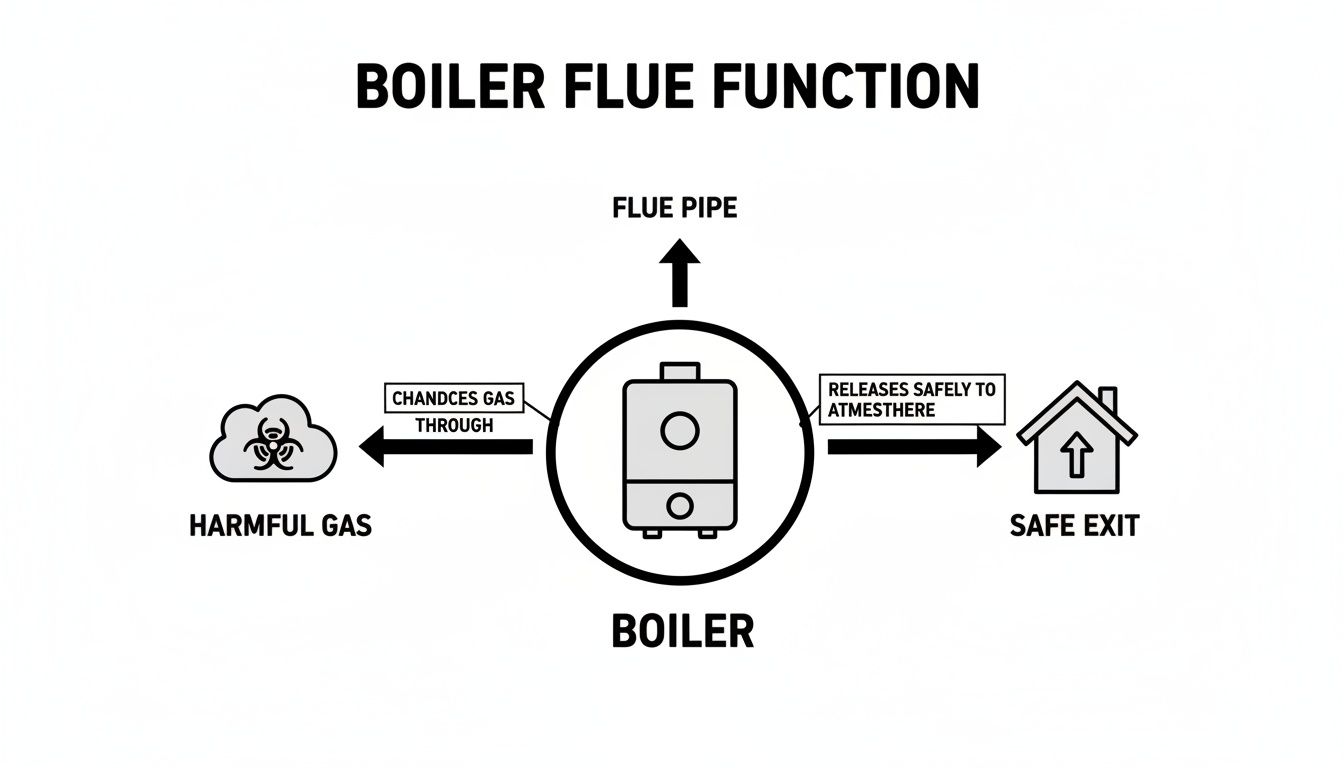
This diagram shows you exactly what a flue does. It acts as a crucial exhaust pipe, safely channelling the harmful gases created during combustion out of your boiler and away from your home.
Crucial Takeaway: Following flue placement regulations isn’t a choice—it’s a legal must. These rules exist to prevent serious health risks, including deadly carbon monoxide poisoning.
These specific flue regulations are part of the broader UK fire safety legal requirements that all property owners need to follow. A Gas Safe registered engineer will always ensure your installation is fully compliant with all the current standards, giving you complete peace of mind.
Identifying The Type Of Flue In Your Home
Not all boiler flues are created equal. The type attached to your heating system tells a story about its age, design, and how efficiently it runs. Just by looking at where and how the pipe leaves your property, you can get a pretty good idea of what’s going on.
Many modern homes in Eastbourne have a horizontal flue. This is usually a plastic pipe that runs straight from the boiler through an outside wall. It’s a simple, common-sense setup for properties where the boiler is already on an external wall.
Then again, you might have a vertical flue. This style travels up, making its exit through the roof. You’ll often find these in homes where the boiler is tucked away somewhere central, like an airing cupboard in a Langney home or a basement, far from a suitable side wall. No matter which way they point, they both do the exact same job: getting those waste gases safely outside.
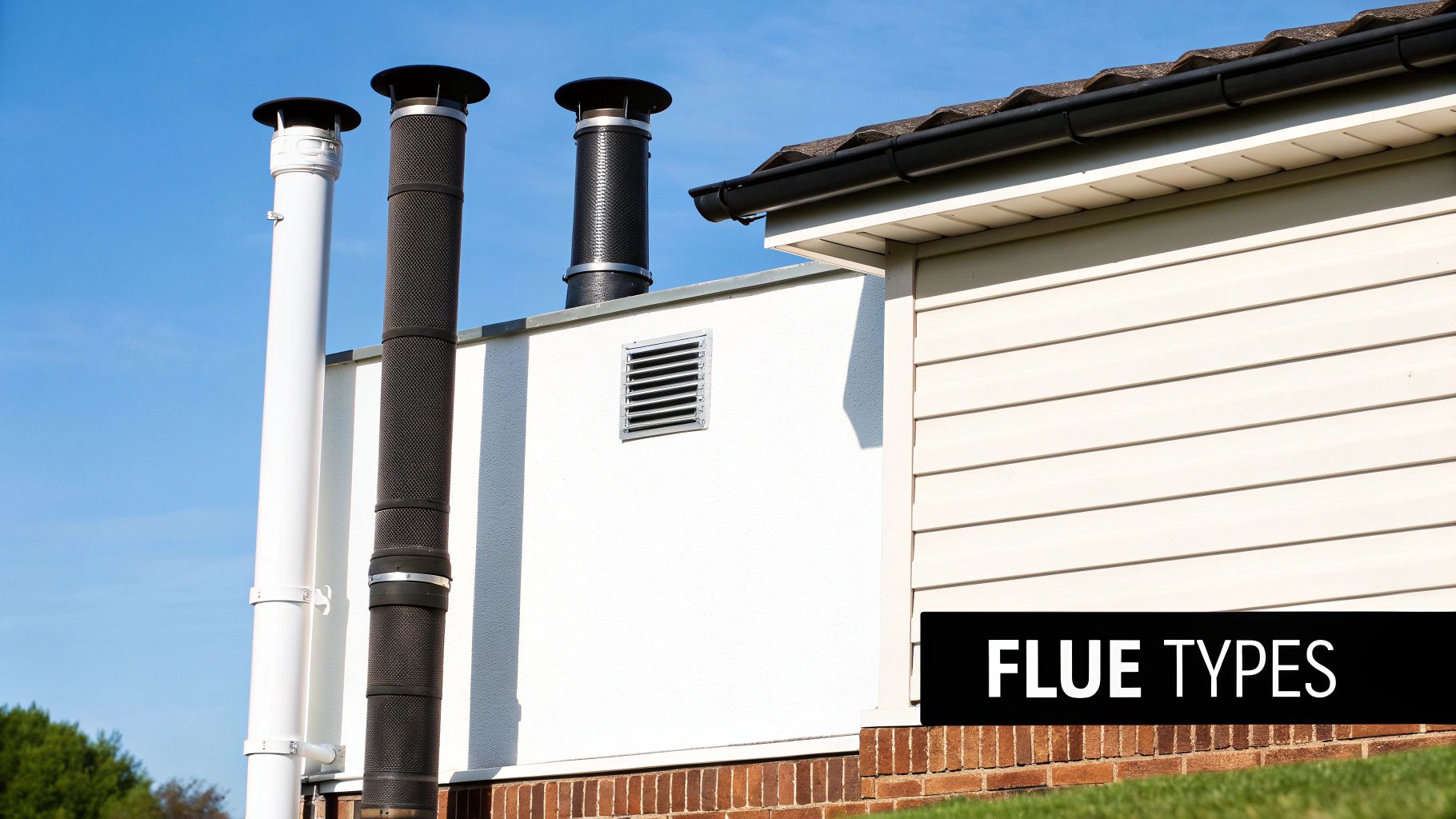
Horizontal vs Vertical Flues Which One Is Right for Your Home?
Deciding between a horizontal or vertical flue really comes down to your boiler's location and your home's layout. Here’s a quick comparison to see how they stack up.
Flue Type | Common Installation Location | Best Suited For | Key Consideration |
|---|---|---|---|
Horizontal | Through an external wall. | Most modern homes, especially where the boiler is installed on an outside wall (e.g., kitchen, utility room). | The flue terminal must be a safe distance from windows, doors, and neighbouring properties. |
Vertical | Through the roof. | Properties where the boiler is located centrally (e.g., airing cupboard, basement, or loft). | Requires more complex installation and careful weatherproofing around the roof exit point. |
Ultimately, a Gas Safe engineer from Harrlie Plumbing and Heating will determine the best and safest option for your property, ensuring everything is up to code.
Open vs Balanced Flues
Beyond its direction, the flue’s design is a massive factor. Older systems often used an open flue, which drew air for combustion directly from the room the boiler was in. For obvious safety and efficiency reasons, this design is now completely outdated.
In contrast, the modern condensing boilers we install across Eastbourne here at Harrlie Plumbing and Heating use a balanced flue. This clever design is basically a 'pipe-within-a-pipe'.
The outer tube of a balanced flue pulls fresh air in from outside to feed the boiler, while the smaller inner pipe pushes the waste gases out. This creates a completely sealed system that’s not only far safer but also much more efficient because it isn’t using the pre-warmed air from inside your home.
This concentric setup is one of the key reasons new boilers can hit such high efficiency ratings. If you're keen to get into the nuts and bolts, you can find out more about what a balanced flue boiler is and how it works in our detailed guide. Spotting this feature on your boiler is a great sign that your heating system is up to modern standards.
How a Modern Flue Can Lower Your Energy Bills
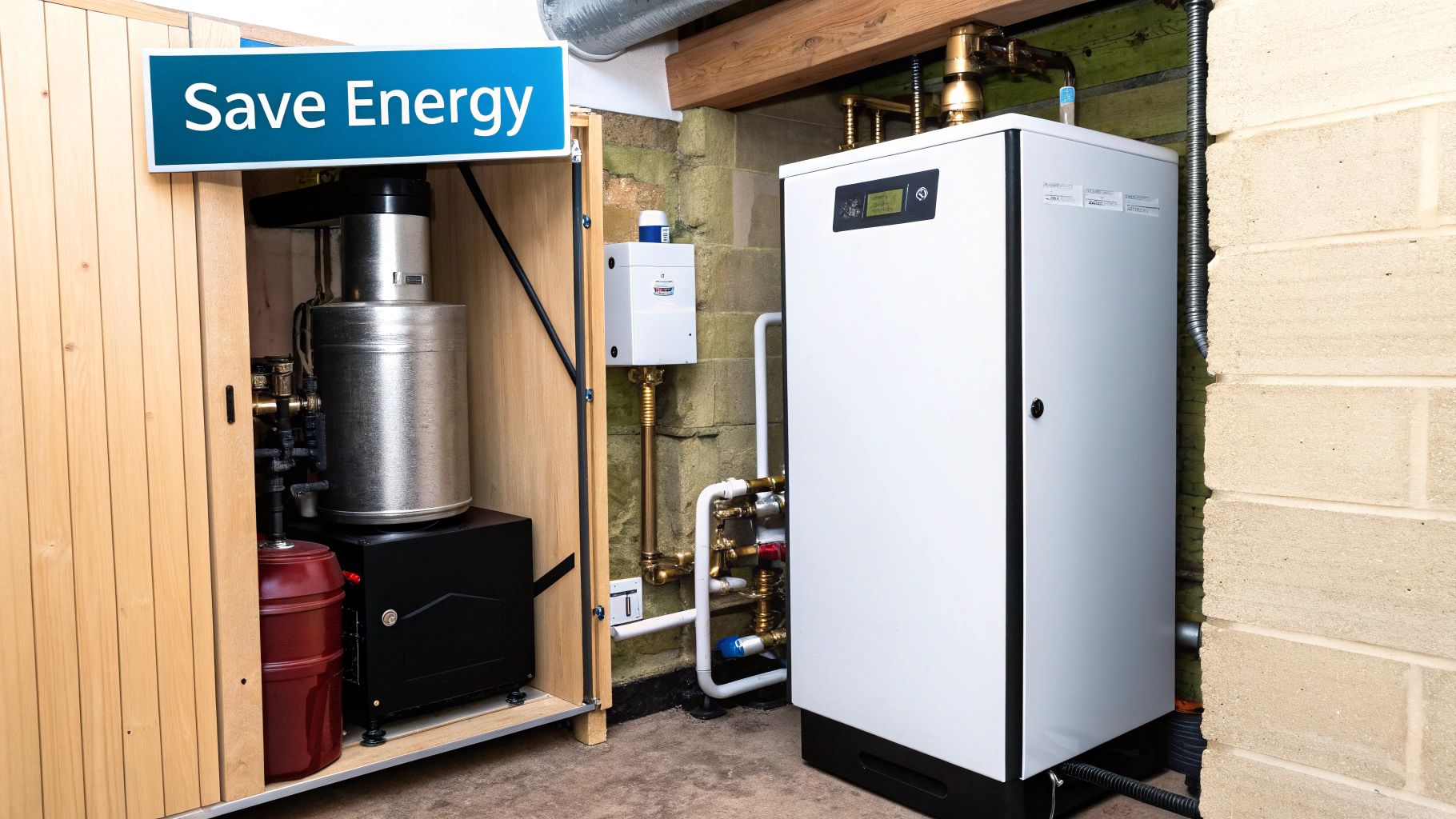
It’s easy to think of a boiler flue as just an exhaust pipe, but a modern one is so much more than that. It’s actually a clever piece of kit that can actively help you save money on your heating bills. The technology built into today's condensing boilers and their flues is designed to capture and recycle precious heat that, in older systems, would have simply vanished into thin air.
This smart process is called flue gas heat recovery. You can think of it as getting free energy. The hot exhaust gases travelling up the flue are used to pre-heat the cold water coming into your boiler. This means the boiler doesn't have to fire up as intensely or use as much gas to get the water hot enough for your radiators and taps. It’s a simple but incredibly effective way to improve efficiency.
Maximising Your Savings at Home
So, how can you make the most of this tech? There are a few simple but powerful steps you can take. One of the best is to adjust your boiler’s flow temperature, which is the temperature of the water it sends to your radiators. Turning this down a notch helps the boiler operate in its super-efficient condensing mode more often.
A landmark study revealed that dropping the boiler flow temperature from 80°C down to 60°C can slash gas consumption by up to 9%. For a typical UK home, that could mean saving around £112 a year. Imagine if just 10 million UK households made this change—it would trim a staggering £1 billion from our collective energy bills. You can discover more about these boiler statistics to see the impact.
By running your boiler at a lower flow temperature, you enable the flue gas recovery system to work at peak performance. This small adjustment is a powerful way to reduce your energy bills without sacrificing comfort, a tip we often share with our Eastbourne customers at Harrlie Plumbing and Heating.
Our team can give you expert advice on how to get your system’s settings just right for real savings. For even more pointers, take a look at our guide on 7 proven strategies to lower heating costs in Eastbourne.
Warning Signs Your Boiler Flue Needs an Expert Check
A failing boiler flue often sends out distress signals long before it becomes a critical danger. Getting familiar with these warnings is one of the most important things you can do to keep your home safe, as the flue’s whole job is to get rid of harmful gases. If you ignore them, you could be facing serious risks, including carbon monoxide exposure.
You don’t have to be a heating expert to spot the most common issues. Some signs are easy to see with your own eyes, while others mess with your boiler’s performance. If you notice any of these problems, it’s a clear signal that your flue needs immediate professional attention from a team like ours at Harrlie Plumbing and Heating.
Visible and Performance-Related Symptoms
Keep an eye out for physical signs of damage or any unusual boiler behaviour. These are often the first clues that something is wrong with your flue system.
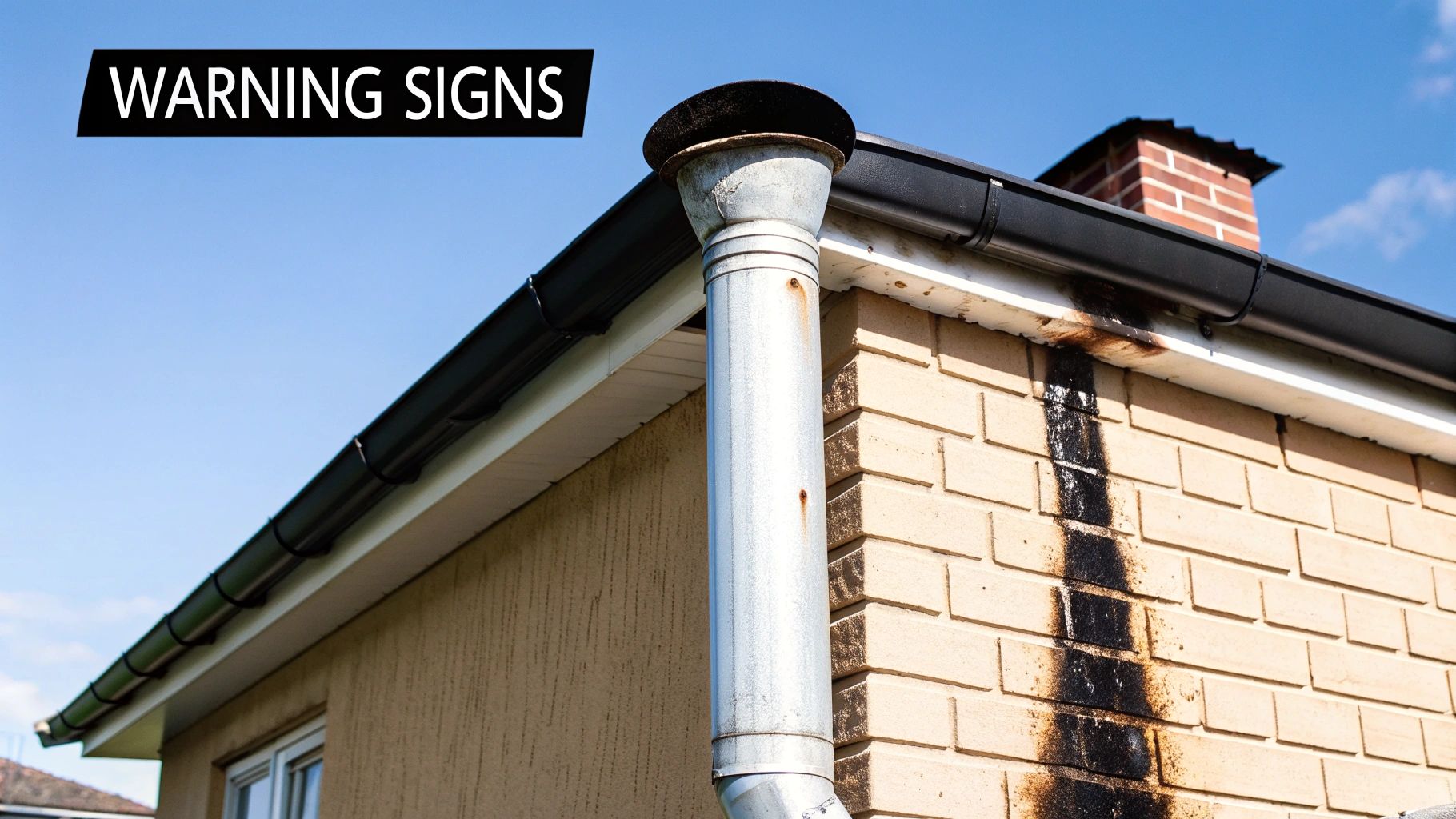
A quick visual check can reveal a lot. In many Eastbourne properties, particularly older ones exposed to sea air, you might spot:
Black Stains or Soot: Dark marks on the wall around the outside flue terminal are a classic sign of poor combustion or a blockage inside.
Dripping Water: While a little condensation can be normal, constant dripping could point to an internal blockage or an incorrectly fitted flue.
Physical Damage: Cracks, holes, or loose fittings on the flue pipe itself are serious issues that compromise the seal and need fixing fast.
Performance problems can also point straight to a dodgy flue. Watch out for your pilot light repeatedly going out or your boiler frequently locking out and showing an error code. These issues suggest the system is struggling to push gases out correctly.
Never attempt a DIY fix on a boiler flue. It’s a critical safety component, and any repairs must be carried out by a certified professional from a company like Harrlie Plumbing and Heating. Incorrect work can have life-threatening consequences.
The Invisible Dangers
By far, the most serious risk from a faulty flue is carbon monoxide (CO) poisoning. Its symptoms can be subtle and easily mistaken for common illnesses like the flu. If anyone in your household is experiencing persistent headaches, dizziness, nausea, or general confusion, a faulty flue could be the culprit.
Professional flue inspections often involve using specialized carbon monoxide analysers to detect dangerous leaks that you'd never spot otherwise. If you suspect a problem, your first move should be to call a Gas Safe engineer immediately.
For homeowners in Eastbourne, Harrlie Plumbing and Heating offers an emergency service to provide rapid, expert assistance and ensure your home is safe.
Why a Professional Flue Inspection Is Non-Negotiable
Your boiler flue might be tucked away out of sight, but it should never be out of mind. Think of it as the lungs of your heating system—and keeping it in top condition is the cornerstone of a safe, efficient home here in Eastbourne.
A thorough flue inspection isn't just a "nice-to-have"; it's a mandatory part of every annual boiler service. When a Gas Safe engineer from a trusted local company like Harrlie Plumbing and Heating visits your Eastbourne property, they'll meticulously check for blockages, signs of corrosion, and any insecure fittings that could put your household at risk.
This professional check-up is only becoming more critical. With UK regulations tightening, by 2025, the rules for boiler flues will demand much higher standards for both efficiency and emissions control. This means certified installation and regular servicing are no longer optional—they're essential for compliance. You can learn more about these critical updates to boiler flue regulations to stay ahead of the curve.
Key Takeaway: A properly maintained flue is your first line of defence against harmful gases. Its placement is legally regulated, and its condition directly impacts your safety and energy bills.
The message is simple: scheduling that annual service with a certified local provider like Harrlie Plumbing and Heating is one of the most important jobs for any responsible homeowner. It’s a non-negotiable step to ensure your heating system runs safely and efficiently all year round.
Your Boiler Flue Questions Answered
To wrap things up, our engineers at Harrlie Plumbing and Heating often get asked a few common questions by homeowners across Eastbourne. Here are some quick answers to help clear up any lingering confusion about boiler flues, focusing on safety and doing things by the book.
Can I Hide or Box in My Boiler Flue?
It’s a tempting thought, especially if the flue pipe isn’t the prettiest feature, but the answer is a firm no. You should never cover up or obstruct your boiler flue in any way.
Gas Safe regulations are very clear on this: the entire length of the flue must be accessible for a visual inspection during your annual boiler service. We often see this in renovated Eastbourne kitchens where homeowners want a cleaner look. Boxing it in might look tidier, but it could hide dangerous corrosion or a failing joint, preventing a certified engineer from spotting a problem before it becomes serious.
My Neighbour’s Flue Seems Too Close. What Should I Do?
This is a tricky situation we encounter in densely populated parts of Eastbourne. If you’re concerned that a flue on a neighbouring property is too close to your window, door, or boundary, your first port of call could be the Gas Safe Register for official advice.
Often, a friendly chat with your neighbour is a good starting point, as they might not even be aware of the regulations. If you want a professional opinion on your own flue's compliance, the Harrlie team can pop over and perform a full safety check for your peace of mind.
A flue must be checked at least once a year by a Gas Safe registered engineer. This is a critical part of your annual boiler service to spot blockages, joint failures, or corrosion before they become serious safety hazards.
To ensure your boiler flue is safe, compliant, and working as it should, book your annual service with Harrlie Plumbing and Heating today. Visit us at https://www.harrlieplumbing.co.uk for a free, no-obligation quote.

Comments