What Does a Gas Safety Check Involve? An Eastbourne Guide
- Luke Yeates
- Dec 28, 2025
- 13 min read

A gas safety check isn't just a box-ticking exercise; it's a complete health check for your home's gas system. Think of it as an MOT for your boiler, cooker, and pipework—an essential annual inspection that confirms everything is running safely and efficiently. For landlords in Eastbourne, it’s a legal must-do, but for any homeowner, it's a critical safety measure.
Your Essential Guide to Gas Safety Checks
So, what actually happens during a gas safety check? It’s the first question most people ask, and understanding the process is key to appreciating why it’s so important for keeping your family safe from gas leaks or carbon monoxide.
When one of our Gas Safe registered engineers from Harrlie Plumbing and Heating visits your Eastbourne home, they carry out a systematic examination of your entire gas installation. This is far from a quick glance. It's a detailed, methodical process designed to spot potential problems before they escalate into serious dangers.
Imagine a typical terraced house in Eastbourne's Old Town. Our engineer would meticulously inspect the boiler, the gas hob in the kitchen, and any gas fires. The core mission is to confirm three things: each appliance is burning its fuel correctly, any harmful fumes are being channelled safely outside, and there are absolutely no leaks anywhere in the system. It’s this thorough approach that gives you genuine peace of mind.
To break it down, the inspection really focuses on three main areas:
Gas Appliances: Making sure they are set up and working as the manufacturer intended.
Pipework and Flues: Checking they are stable, clear of blockages, and completely leak-free.
Safety and Ventilation: Confirming that all safety devices are operational and there’s enough fresh air for the appliances to work properly.
Here’s a quick overview of the key components our engineers look at during a check. We'll dive into each of these points in more detail a bit later in the guide, but this table gives you a great snapshot of what to expect.
Key Components of a Gas Safety Check at a Glance
Component | What the Engineer Checks | Why It's Important |
|---|---|---|
Gas Appliances | Correct gas pressure and burn rate, proper operation of safety devices, visual condition. | Ensures the appliance isn't producing harmful carbon monoxide and is working efficiently. |
Flues & Chimneys | Flue is clear of obstructions, properly connected, and safely removing fumes. | Prevents dangerous gases from re-entering your home, which is a major cause of CO poisoning. |
Gas Pipework | A tightness test is performed to detect any leaks throughout the property's pipework. | Identifies hidden gas leaks that could lead to fires or explosions if left unchecked. |
Ventilation | Checks that there is an adequate air supply for gas appliances to burn correctly. | Proper airflow is crucial for safe combustion and prevents the build-up of toxic fumes. |
Each of these checks plays a vital role in a bigger picture: ensuring the gas system in your home is not just functional, a principle we at Harrlie Plumbing and Heating uphold on every job, but fundamentally safe for everyone living there.
A Step-by-Step Breakdown of the Inspection Process
When one of our Gas Safe registered engineers from Harrlie Plumbing and Heating arrives at your door, think of them as performing a thorough MOT for your home's gas system. It’s not just a quick glance; it's a deep dive into every component to make absolutely certain everything is working safely and as it should. Knowing what goes on during the check can really help you appreciate its value.
The process kicks off with the appliances themselves. Picture a classic terraced house in Eastbourne's Old Town; our engineer would start by visually inspecting the boiler, gas cooker, and any gas fires. They’re looking for correct installation, stability, and any tell-tale signs of wear and tear. After that, it's on to functional tests to ensure each appliance is operating exactly as the manufacturer intended.
A key part of this is checking the burner pressure and gas rate. This is vital because it confirms the appliance is burning the right amount of gas—too little can make it inefficient, but too much can be downright dangerous. Our engineer will also check that the flames on your hob or fire are a crisp, steady blue, which is the hallmark of complete and safe combustion.
Checking Flues and Ventilation
Once the appliances get the all-clear, our focus shifts to making sure any harmful by-products of burning gas are being safely escorted out of your home. This is where checking flues and chimneys is absolutely critical.
A flue is essentially the exhaust pipe for your boiler or gas fire. Our engineer will make sure it’s fitted correctly, is secure, and has no blockages. Something as simple as a bird's nest or some fallen debris can obstruct a flue, potentially forcing dangerous gases like carbon monoxide back into your room. We've seen this happen in older properties around the Meads area of Eastbourne, where chimneys are more common.
Just as important is ventilation. Gas appliances need a constant supply of fresh air to burn fuel safely and completely. The engineer will check that any vents, grilles, or air bricks are clear and providing enough airflow for the appliances you have.
This flowchart gives you a simple overview of the core stages of the check, showing how we assess the main components.
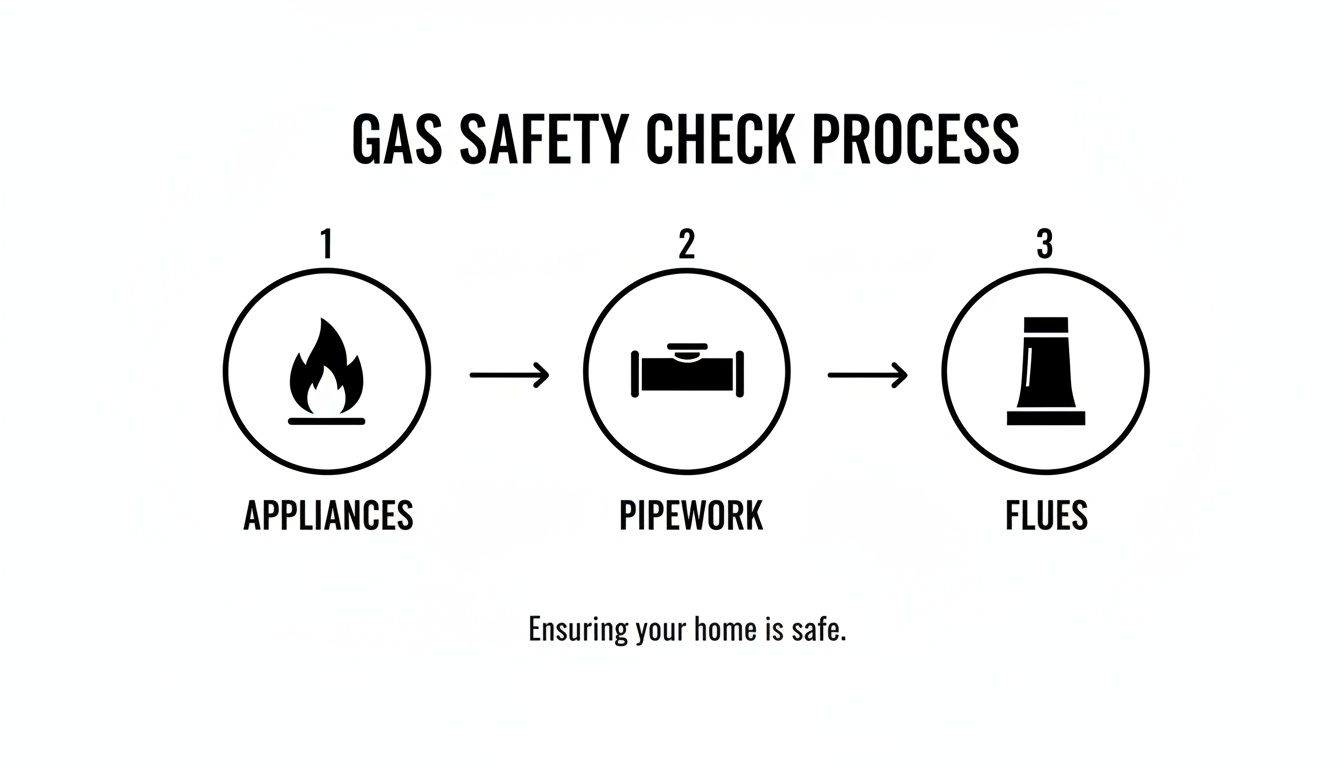
As you can see, the inspection flows logically from the appliances to the systems that support them, like the pipework and flues, creating a complete safety picture.
The Gas Tightness Test
Perhaps the single most important part of any gas safety check is the gas tightness test. Its sole purpose is to hunt down any gas leaks in your home's pipework, no matter how small they might be.
The tightness test is non-negotiable for safety. Using a calibrated pressure gauge, our engineer will check the entire system from the meter onwards to ensure there is no drop in pressure, which would signify a leak.
Even a tiny, undetected leak can pose a massive risk of fire or explosion. This test is the only way to get definitive proof that your pipework is secure and gas-tight, giving you total peace of mind.
Finally, the engineer will double-check all relevant safety devices. These are things like the flame failure devices on your cooker, which are designed to shut the gas off instantly if the flame ever goes out. It's a methodical and comprehensive process from start to finish. For landlords looking to ensure their entire property is up to scratch, a comprehensive rental property inspection checklist can be a useful tool alongside the gas check. If you're wondering about the timing, you can also learn more about how long does a gas safety check take in our other guide.
Who Can Legally Perform a Gas Safety Check
When it comes to the safety of your gas appliances, this is one area where you absolutely cannot cut corners. It’s not a job for a local handyman, and it’s certainly not a DIY task. In the UK, the law is crystal clear: only a Gas Safe registered engineer is legally allowed to perform a gas safety check and provide the official certificate.
This isn't just red tape; it's a critical safety measure. Gas work is incredibly specialised, and the risks of getting it wrong are severe. An untrained eye could easily overlook a small but deadly fault, putting your family at risk of gas leaks, fires, or carbon monoxide poisoning. It’s a stark reminder of why attempting your own HVAC repairs is unwise, especially when gas is involved.
Every engineer on the Gas Safe Register has gone through extensive training and assessments to prove they know exactly what they’re doing. They are the only people qualified and legally permitted to work on gas systems in your home.
Verifying an Engineer's Credentials
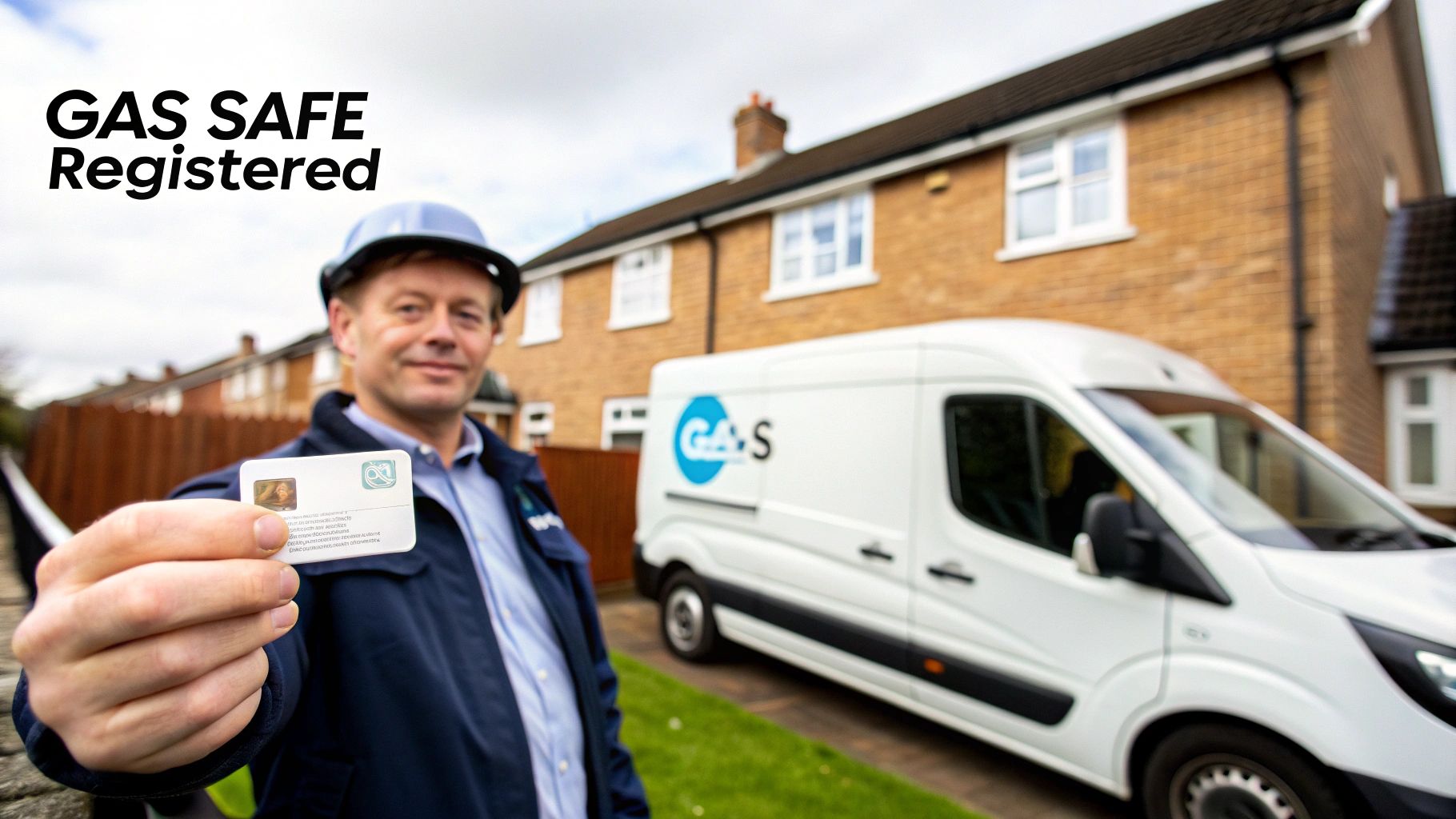
Before letting anyone start work, you should always check they are who they say they are. Every genuine Gas Safe engineer carries an official ID card, and you have every right to ask to see it before they step inside. Don’t be shy about it – a true professional will expect you to ask.
The ID card gives you all the essential information:
A clear photo of the engineer.
Their unique 7-digit licence number.
The card’s expiry date.
Crucially, the back of the card lists the specific types of gas work they are qualified to carry out.
You can pop their licence number into the official Gas Safe Register website for an instant check. This simple step takes seconds and gives you complete confidence that you’re dealing with a qualified expert. Every engineer at Harrlie Plumbing and Heating is fully registered and will gladly show you their ID when they arrive at your Eastbourne property.
How Long Does a Gas Safety Check Take?
We often get asked how long an appointment will last. The honest answer is: it depends. The time needed for a proper, thorough inspection varies based on the size of your property and how many gas appliances you have.
For example, a modern one-bedroom flat in Sovereign Harbour with just a boiler might only take around 30 minutes. But a larger period home in the Meads area of Eastbourne with a boiler, gas hob, and a couple of gas fires could easily take an hour, if not longer, to check everything correctly.
Typically, a standard check on a property with one appliance takes between 20 and 40 minutes. For larger homes with more complex systems, you can expect it to take anywhere from 60 to 90 minutes. This allows our engineer enough time to visually inspect all the appliances and flues, test the burner pressures, run a gas tightness test to check for leaks, and make sure all the safety controls are working as they should. It’s always best to plan for this time to ensure the job isn’t rushed.
Understanding Your Gas Safety Record (CP12)
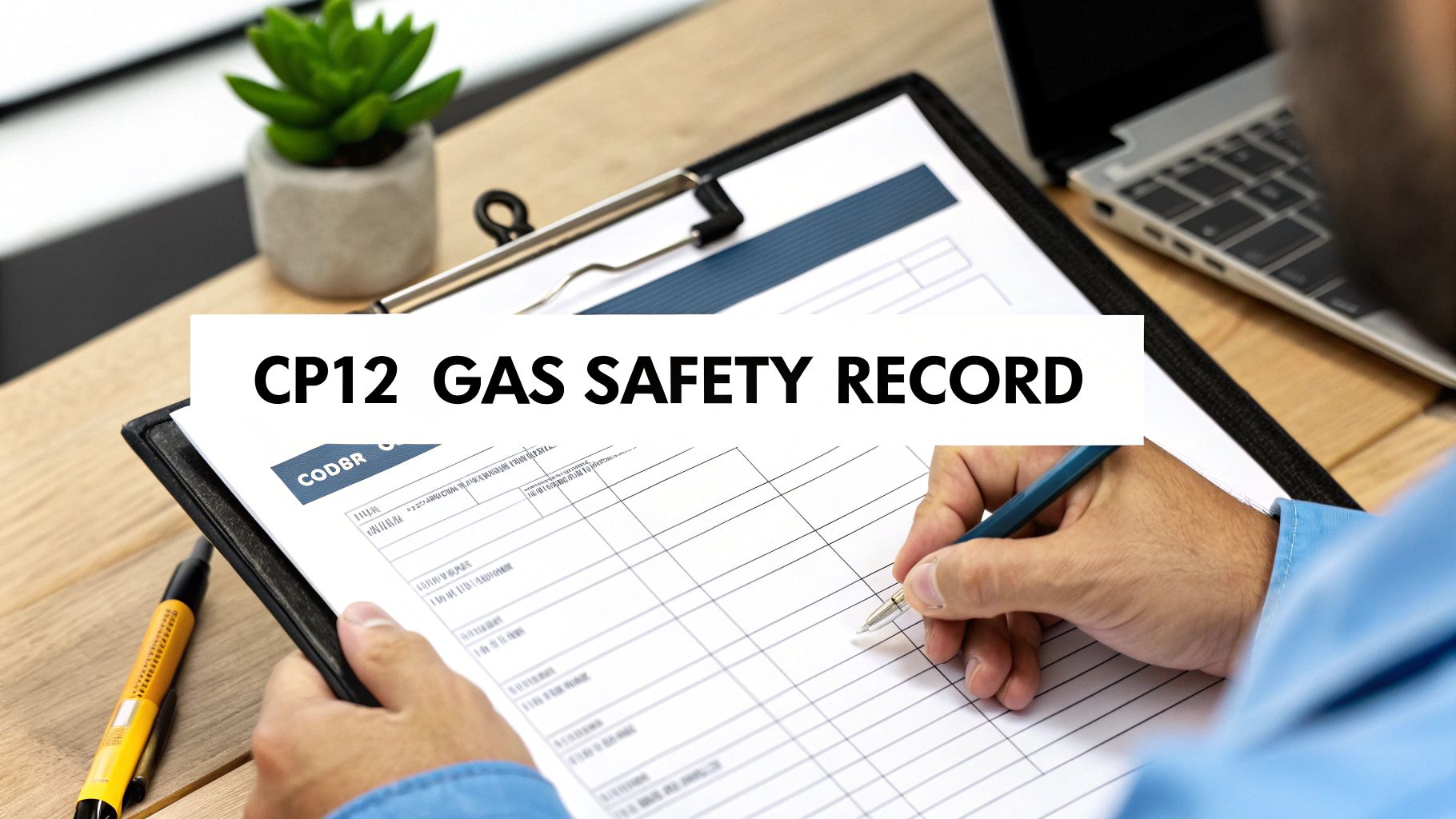
Once our engineer has meticulously completed their checks, the final step is to issue your Gas Safety Record. You might still hear people call it a CP12, which was its old name (short for CORGI Proforma 12), but it’s the official document proving a qualified professional has signed off on your gas system.
Think of it as the MOT certificate for your home’s gas installation. It’s not just a simple pass/fail slip; it’s a detailed report card on the health of your gas appliances and pipework. For landlords in places like Eastbourne, Bexhill, or Hastings, giving a copy to your tenants is a legal must-do. For any homeowner, it’s an invaluable piece of paper that confirms your property’s safety.
The record contains all the crucial information: the property address, the date of the check, and our engineer’s details—including their all-important Gas Safe registration number. Most importantly, it lists every appliance checked and the outcome of each inspection.
Decoding the Results: Pass, Fail, or Repair
The most critical part of your Gas Safety Record is the verdict on each appliance. This isn't just a tick-box exercise. Our engineer will use specific, industry-standard codes to classify the condition of each item, which tells you exactly what, if any, action you need to take.
If an appliance passes, fantastic! It means it’s operating safely according to current standards. If there’s an issue, however, our Harrlie Plumbing and Heating engineer will categorise it in one of three ways:
Not to Current Standards (NCS): This means the appliance is technically safe to use right now, but it doesn't meet the very latest regulations. We’ll offer advice on the benefits of upgrading, but it’s not an emergency.
At Risk (AR): This is more serious. An ‘At Risk’ appliance has one or more faults that could pose a danger. It’s considered unsafe and you shouldn't use it.
Immediately Dangerous (ID): This is the highest alert. The appliance poses an immediate danger to life and property and must be disconnected from the gas supply right away.
What Happens If an Appliance Fails?
Finding out you have a faulty appliance can be worrying, but our process is designed to keep you safe and give you a clear path forward. If one of your appliances is flagged as 'At Risk' or 'Immediately Dangerous', our engineer will explain the situation calmly and professionally.
Your safety is our absolute priority. If an appliance is deemed 'Immediately Dangerous,' our engineer is legally obligated to disconnect it from the gas supply with your permission to eliminate the risk.
For any faults we find, our Harrlie Plumbing and Heating engineer won’t just leave you with the problem. They will walk you through the issue and provide a clear, no-obligation quote for the remedial work needed. Whether it’s a simple repair for an 'At Risk' boiler in a Bexhill flat or a full replacement for an 'Immediately Dangerous' cooker in a Hastings rental, we ensure you have all the information to make an informed decision. This approach gets your system back to a safe and compliant state as quickly and smoothly as possible.
Your Legal Duties as a Landlord or Homeowner
When you own a property, whether it’s your family home in Old Town or a rental property in Hampden Park, getting to grips with gas safety responsibilities is non-negotiable. The rules do vary slightly, but the goal is always the same: keeping people safe.
For homeowners, there's no law forcing you to have an annual gas safety check. However, it's one of the most important things you can do to protect your family. Think of it as an MOT for your home’s gas system – a crucial check-up for your peace of mind.
For landlords in the UK, it’s a different story entirely. These aren't just recommendations; they are enshrined in law. Under the Gas Safety (Installation and Use) Regulations 1998, you have a cast-iron legal duty to ensure every gas appliance, flue, and pipe you provide for your tenants is safe. This means arranging a gas safety check with a Gas Safe registered engineer every single year.
The Landlord’s Non-Negotiable Checklist
As a landlord, your duties are crystal clear. You are legally required to maintain all gas equipment and book a check every 12 months. Simple as that.
Once the inspection is done, you must give your current tenants a copy of the Gas Safety Record (often called a CP12 certificate) within 28 days. If new tenants are moving in, you need to provide them with a copy before they get the keys.
Failing to tick these boxes can lead to some incredibly severe consequences. We’re not talking about a slap on the wrist. Penalties can include unlimited fines and, in the worst-case scenarios where a fault causes injury or death, even prison time. This is why partnering with a trusted local company like Harrlie Plumbing and Heating is so vital for Eastbourne landlords. We help you stay compliant, keep your tenants safe, and protect your investment. For a deeper dive, check out our complete guide to gas safety checks for landlords in Eastbourne.
The Real Risks of Non-Compliance
While it might seem like most landlords are on top of this, the reality is that thousands of properties slip through the net. Recent social housing data, for example, showed that while 99.98% of homes had a valid gas safety certificate, less than half of social landlords managed to achieve 100% compliance across their entire property portfolio.
This just goes to show that a single missed check in an Eastbourne rental isn't a minor oversight—it's a massive legal and safety risk. Fines can start from £6,000 just for failing to produce the right records. You can discover more insights about landlord compliance on Housing Today.
How Much a Gas Safety Check Costs in Eastbourne
Let's talk about one of the most common questions we get: how much does a gas safety check actually cost? It’s easy to see it as just another household bill, but it’s far better to think of it as a critical investment in the safety of your home and everyone in it.
Here in Eastbourne and the surrounding areas, the price really comes down to how many gas appliances need inspecting. A straightforward check on a property with just a gas boiler is naturally going to cost less than a larger home with a boiler, a gas hob, and a couple of gas fires. At Harrlie Plumbing and Heating, we’re big believers in transparent, honest pricing. We’ll give you a clear quote based on what your property needs, with no hidden surprises.
A Small Price for Essential Safety
Looking at the bigger picture, the national average for a Gas Safety Certificate (also known as a CP12) typically falls between £60 and £90. The final figure depends on the size and complexity of your property’s gas system. When you weigh this modest fee against the devastating potential costs of a gas leak or carbon monoxide poisoning, its value is crystal clear. For a more detailed look at the numbers, you can read our guide on how much a gas safety certificate costs in the UK.
This annual check is a non-negotiable part of responsible homeownership and property management. It’s a small, predictable cost that prevents unimaginable risks, protecting both your family and your financial investment in your property.
The specialised, calibrated equipment our engineers use isn't just for show—it quantifies safety, measuring everything from flue gas composition to pipework tightness with precision. This ensures any potential risks are spotted and dealt with on the spot. You can also learn more about gas safety certificate costs on Checkatrade.
Answering Your Top Gas Safety Questions
To wrap things up, let's go over a few of the questions we get asked all the time by homeowners and landlords across Eastbourne. This should clear up any lingering thoughts you might have about keeping your home safe.
How Often Do I Need a Gas Safety Check?
This is a big one. For landlords, the rules are crystal clear: you are legally required to get a gas safety check done by a Gas Safe registered engineer every 12 months.
If you're a homeowner, there's no law forcing you to do it. However, we strongly recommend an annual check as best practice. It’s a small price to pay for the peace of mind that comes with knowing your family is safe and your appliances are running correctly.
What's the Difference Between a Gas Safety Check and a Boiler Service?
It’s easy to mix these two up, but they serve very different purposes.
Think of a gas safety check as your home’s gas MOT. Its sole job is to confirm that your entire gas system—from the pipes to the boiler and cooker—is operating safely and not posing a risk.
A boiler service, on the other hand, is like a full tune-up for your car. The engineer goes much deeper, cleaning out components, making fine-tuned adjustments, and ensuring the boiler is running as efficiently as possible to save you money on bills. While a service often includes safety checks, a safety check does not include a service. At Harrlie Plumbing and Heating, we can perform either or both during a visit to your Eastbourne property, depending on your needs.
What Should I Do If I Smell Gas?
That distinct, rotten-egg smell of gas is a serious warning sign. If you smell it, you need to act fast.
Don't touch any electrical switches—turning them on or off could create a spark. Put out any candles or naked flames immediately. Open all your doors and windows to ventilate the property, and if you know how and it's safe to do so, turn the gas off at the emergency control valve by the meter.
Once you're safely outside and away from the building, call the National Gas Emergency Service on their free 24-hour number.
Do I Legally Need a Carbon Monoxide Alarm?
Absolutely. In England, landlords are legally required to fit a carbon monoxide alarm in any room that has a fixed combustion appliance, like a boiler, gas fire, or log burner.
For homeowners, while it might not be a legal mandate, it's a non-negotiable safety essential. These inexpensive alarms are your only warning against this silent, odourless killer. Here at Harrlie Plumbing and Heating, we urge every single household to have them installed and tested regularly.
For a professional and reliable gas safety check in Eastbourne, Hastings, or Bexhill, you can trust the experts at Harrlie Plumbing and Heating. Give us a call to book your appointment and get complete peace of mind.

Comments