Gas safety checks for landlords: Eastbourne guide to essential compliance
- Luke Yeates
- Dec 8, 2025
- 14 min read

As a landlord, your top priority is keeping your tenants safe. When it comes to gas appliances, flues, and pipework, this isn't just a good idea—it's a legal duty. The cornerstone of this responsibility is the annual gas safety check, which must be carried out by a Gas Safe registered engineer. It's a non-negotiable requirement across the UK.
Your Legal Duties for Landlord Gas Safety
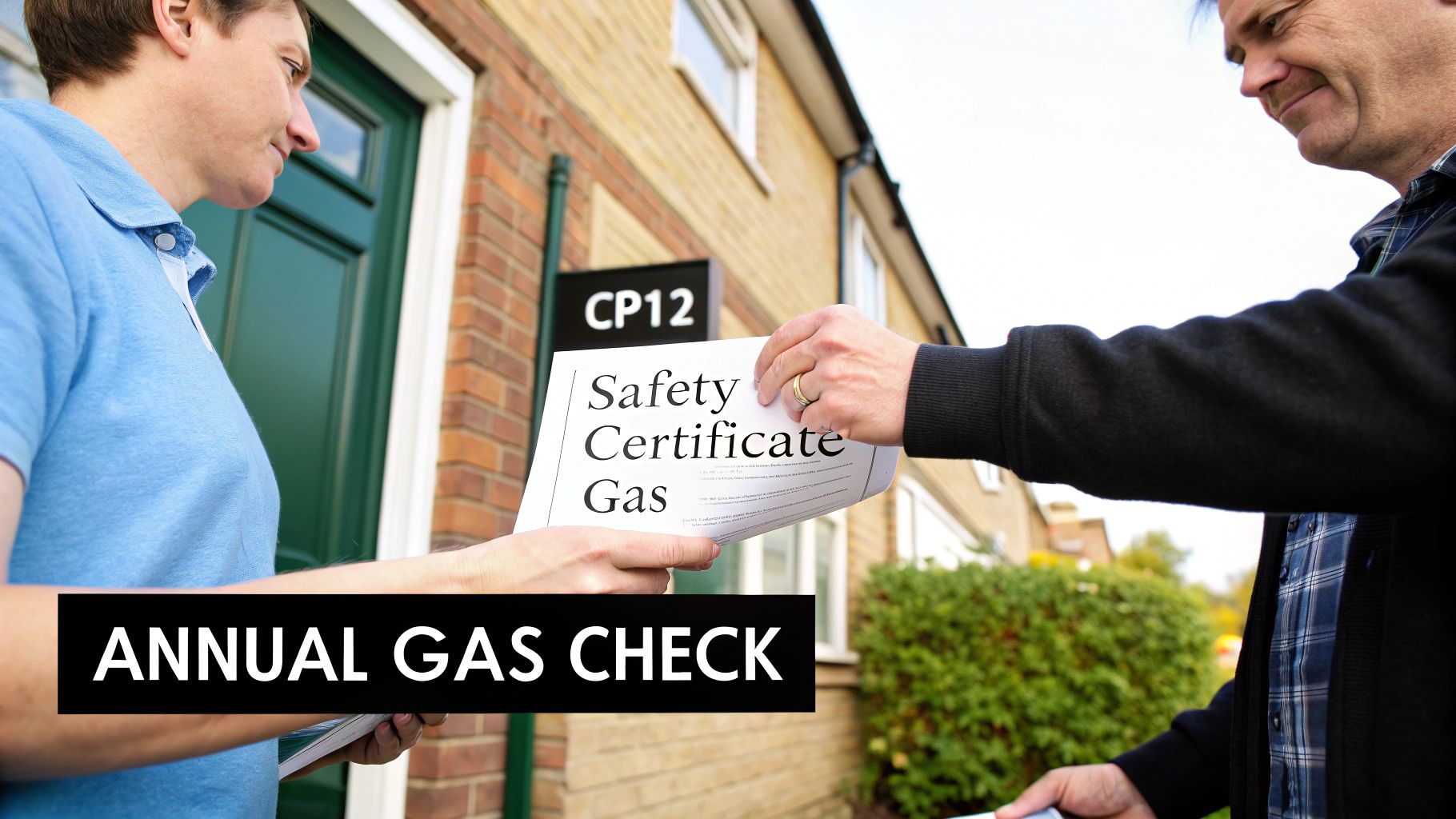
Getting your head around your gas safety obligations is absolutely crucial. Think of the annual check as an MOT for your property’s entire gas system. It's an essential inspection that confirms everything, from the boiler in a terraced house in Hampden Park to the gas hob in a seafront flat, is working as it should and, most importantly, safely.
Staying on top of gas safety checks for landlords does two things: it protects your tenants from serious dangers like carbon monoxide poisoning, and it shields you from hefty legal penalties. For landlords here in Eastbourne, this means finding a local, certified company you can trust. At Harrlie Plumbing and Heating, our Gas Safe registered engineers carry out every check to the letter, giving you peace of mind that you're fully compliant and your tenants are safe.
Core Landlord Responsibilities
The Gas Safety (Installation and Use) Regulations 1998 lay out your duties very clearly. It boils down to three key things:
Annual Checks: You must arrange for a qualified Gas Safe engineer to inspect every gas appliance and flue once every 12 months.
Record Keeping: A record of each gas safety check needs to be kept for at least two years.
Tenant Communication: You are required to give a copy of the Gas Safety Record (often called a CP12) to your current tenants within 28 days of the check. For new tenants, you must provide it before they even move in.
Don't be tempted to let this slide. Failing to comply can lead to severe consequences, including unlimited fines, criminal prosecution, and even your landlord insurance being declared void. The legal framework is strict for a reason—it’s all about ensuring tenant safety across the rental sector.
Your Gas Safety Record is much more than just a piece of paper. It’s documented proof that you’ve fulfilled your legal duty of care, showing a clear commitment to your tenants' well-being and protecting you from potential legal issues.
Of course, being a landlord involves more than just gas safety. To run your property business smoothly and efficiently, it's worth getting familiar with key tax deductions for UK landlords. It's also vital to understand what the safety certificate itself covers, which is why we've put together a guide on what's included in a landlord gas safety certificate and boiler service.
Right, so you've booked your annual gas safety check. That's the easy part done. But what actually happens when the engineer turns up at your property? It's a question we get asked a lot at Harrlie Plumbing and Heating, and frankly, understanding the process gives you peace of mind that you're not just ticking a box for the council.
Think of it less like a quick once-over and more like a full MOT for your property's entire gas system. A Gas Safe registered engineer—like our team here at Harrlie Plumbing & Heating—is trained to spot the hidden dangers, the kind of things that could turn into a serious problem if left unchecked.
This inspection is the absolute core of what makes gas safety checks for landlords so vital. Let's pull back the curtain and show you what goes on.
The Initial Walk-Through and System Check
First things first, the engineer gets a feel for the whole gas installation, starting right from where the supply enters the property. That means their first port of call is usually the gas meter.
Here, they'll perform a gas tightness test. This is a critical step designed to detect even the most microscopic leaks in the pipework. It's not uncommon for one of our engineers to visit a terraced house in Eastbourne's Roselands area and find a tiny, otherwise unnoticeable leak in the pipes under the floorboards—this is precisely the kind of hazard this test is designed to catch.
After the tightness test gives the all-clear, the engineer will visually inspect all the pipework they can see. They're looking for correct installation, making sure everything is secure and checking for any signs of corrosion or damage.
Appliance-by-Appliance Safety Inspection
With the main system checked, the focus shifts to each individual gas appliance. This is where the real detailed work begins. Whether it’s a combi boiler, a gas hob, or an old gas fire, each one gets a thorough shakedown.
For a typical gas cooker, say in a flat in Old Town, Eastbourne, here's what one of our engineers would be looking at:
Operating Pressure: Is the appliance getting the right amount of gas? Too much or too little pressure can lead to inefficient burning, which is a one-way ticket to producing deadly carbon monoxide.
Correct Combustion: The engineer will analyse the gases coming out of the flue to make sure the fuel is burning properly. You want to see a crisp, blue flame. A lazy, yellow, or orange flame is a massive red flag.
Flue and Ventilation Inspection: This is all about making sure the bad stuff gets out. The engineer checks that the flue isn't blocked by leaves, debris, or even a bird's nest, and that any vents are clear and doing their job.
Safety Devices: Most modern appliances have clever built-in safety features, like flame failure devices that shut off the gas if the flame goes out. The engineer will test these to confirm they're working as they should.
A classic issue our Eastbourne engineers find, especially after a storm, is a partially blocked flue in an older property. This simple check is one of the most vital parts of the entire inspection, as it stops carbon monoxide from silently building up inside the home.
This methodical process is done for every single gas appliance in the property. A boiler check, for example, will also involve inspecting the pressure vessel and cleaning out the condensate trap to keep it running efficiently.
Key Areas Covered in a Landlord Gas Safety Check
To give you a clearer picture, this table breaks down exactly what an engineer is looking for during a standard gas safety check. It’s a comprehensive process that covers every critical point of your gas system.
Component Inspected | What the Engineer Checks | Why It's Important |
|---|---|---|
Gas Meter & Pipework | A tightness test for leaks and a visual check for corrosion or damage. | To prevent dangerous gas leaks throughout the property's entire system. |
Gas Appliances | Correct operating pressure, safe combustion, and functionality of controls. | Ensures appliances are not producing carbon monoxide or operating inefficiently. |
Flues & Chimneys | Secure fitting, proper termination, and absence of any blockages. | Guarantees that poisonous exhaust fumes are safely vented outside the property. |
Ventilation | That air vents are clear and appropriately sized for the appliance. | Provides sufficient oxygen for the gas to burn correctly and safely. |
Safety Devices | Functionality of flame failure devices and other safety mechanisms. | Acts as a critical failsafe to shut off the gas supply in case of malfunction. |
Once the inspection is complete, the engineer fills out the Gas Safety Record (often called a CP12). This document details every check performed and lists any issues found, giving you official proof of compliance and a clear snapshot of your property's gas safety.
Decoding Your Gas Safety Record (CP12)
After your annual gas safety check, the engineer will give you a vital piece of paperwork: the Gas Safety Record, often called a CP12 certificate. This isn't just a box-ticking formality; it’s the official proof you've met your legal obligations. More importantly, it’s a detailed report card on the health and safety of your property's entire gas system.
Think of it as a thorough medical MOT for your property’s gas appliances and pipework. Each section provides critical information, telling you what’s working perfectly and, crucially, what isn’t. Understanding how to read it is key to being a responsible landlord.
Reading the Certificate Section by Section
At first glance, the form can look a bit technical, but it’s actually quite straightforward when you break it down. The first part covers the basics: your details, the property address—whether it’s a flat in Eastbourne’s Sovereign Harbour or a house elsewhere—and the date of the inspection.
Crucially, it will also clearly state the name and Gas Safe registration number of the engineer who did the work. This is your proof that the check was carried out by a properly qualified professional, like one of our trusted team at Harrlie Plumbing and Heating.
Next up, you'll see a detailed list of every single gas appliance and flue that was checked. For each item—be it a boiler, gas hob, or fire—the engineer records the results of their tests. This is where you’ll see specific checks for things like operating pressure, proper ventilation, and the function of any safety devices. For a really deep dive into what we look for, check out our complete guide on what a gas safety certificate checks.
This diagram shows the core elements our Gas Safe engineer inspects, from the pipework supplying the gas to the appliances that use it and the flues that safely remove fumes.
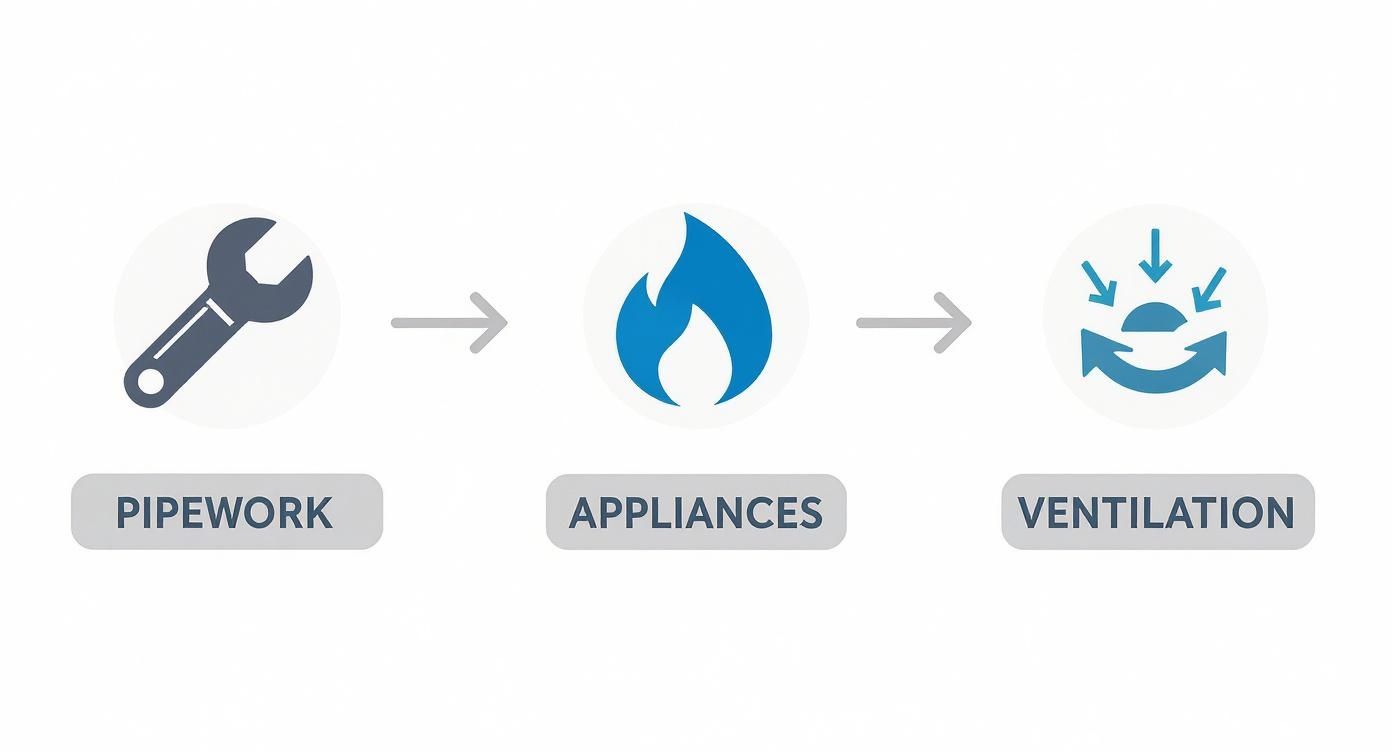
This systematic approach, moving from the main system to individual appliances, ensures nothing gets missed.
Understanding Safety Classifications
This is arguably the most important part of the entire document. If an engineer finds a fault, they won't just say it's "broken." They'll use specific, legally recognised codes to classify the danger level. You absolutely need to know what these mean.
Immediately Dangerous (ID): This is a red alert. It means the appliance poses a direct and immediate risk to life. It must be disconnected from the gas supply right there and then. No exceptions.
At Risk (AR): This is a serious warning. It means one or more faults have been found that could become dangerous. The engineer will tell you to stop using the appliance immediately until it's repaired.
Not to Current Standards (NCS): This means the appliance or installation is technically safe to use but doesn't meet the most up-to-date regulations. While there's no immediate danger, it's a strong recommendation to get it upgraded when you can.
If any appliance is flagged as ID or AR, our engineer at Harrlie Plumbing and Heating will explain the situation clearly to you or your tenant. They will then ask for your permission to disconnect it to make it safe. As the landlord, you are then legally required to get it repaired or replaced as a matter of urgency.
Your Record-Keeping Responsibilities: Don't forget, you must keep a copy of every Gas Safety Record for at least two years. You're also legally required to give a copy to your tenants within 28 days of the check, and to any new tenants before they move in.
The Real Consequences of Non-Compliance
Forgetting your annual gas safety check is far more than a simple admin slip-up. It's a serious breach of your legal duties as a landlord, and the penalties—financial, legal, and operational—are severe. Many landlords just see the annual check as another box to tick, but failing to get it done can cost you infinitely more than the price of the certificate itself.
The repercussions are harsh for a reason: the risks are incredibly high. A faulty boiler or a blocked flue isn’t just an inconvenience for your tenant; it can be a life-threatening hazard. The law treats this negligence with the gravity it deserves, and pleading ignorance won’t get you off the hook.
Imagine this scenario. A landlord in Eastbourne rents out a small two-bedroom house in the Langney area and simply forgets to renew their Gas Safety Record. A minor fault in the boiler, something an engineer from Harrlie Plumbing and Heating would have spotted in minutes, goes undetected. As winter sets in, the fault worsens, leading to a carbon monoxide leak. That single oversight quickly spirals into a nightmare of tenant injury, legal action, and financial ruin.
Financial and Legal Penalties
The penalties for failing to carry out proper gas safety checks for landlords are substantial and can escalate quickly. The Health and Safety Executive (HSE) has the authority to issue unlimited fines, especially if your negligence is proven. Worse still, if a tenant is harmed by a gas-related incident on your property, you could face criminal prosecution, leading to community orders or even prison time.
It’s a criminal offence to not provide a tenant with a valid Gas Safety Record. This alone is punishable by fines of up to £6,000 or a six-month prison sentence. When you compare that to the relatively small cost of a certificate—typically between £60 and £90 in the Eastbourne area—it’s clear that skipping the check is a gamble that just isn’t worth taking. You can discover more details about what UK landlords risk by not having a gas safety certificate to fully grasp the weight of these obligations.
Beyond the direct fines, the financial fallout continues:
Invalidated Insurance: Dig into the small print of your landlord insurance policy. You’ll almost certainly find a clause requiring you to comply with all legal duties. If a fire or other incident occurs and you don’t have a valid gas certificate, your insurer will likely refuse the claim, leaving you personally liable for all damages.
Civil Claims: If a tenant suffers an injury or loss because you failed to maintain gas safety, they can pursue a personal injury claim against you. These claims can result in massive compensation payouts that could cripple you financially.
Hindering Your Ability to Manage Your Property
The consequences don't just hit your wallet; they can also completely undermine your ability to manage your tenancy. One of the most critical repercussions catches many landlords by surprise and relates to eviction proceedings.
Crucially, you cannot legally serve a Section 21 notice to regain possession of your property if you haven't provided tenants with a valid Gas Safety Record at the start of their tenancy and after each subsequent annual check. This effectively traps you in a tenancy you may need to terminate.
This legal technicality can leave you powerless, unable to remove tenants even for perfectly legitimate reasons. It really highlights how the annual check isn't just about safety—it's also about maintaining fundamental control over your own property. And if an issue does arise, knowing what to do when a carbon monoxide alarm goes off is essential knowledge for both you and your tenants.
Ultimately, that annual check is one of the most important investments you can make. Here at Harrlie Plumbing and Heating, we help landlords across Eastbourne stay compliant. We see the inspection not as a burden, but as a vital safeguard that protects your tenants, your property, and your financial future.
Going Beyond Compliance with Proactive Gas Safety
Meeting your legal duties for gas safety is the absolute minimum, but real peace of mind comes from taking a more proactive approach. Think of the annual gas safety check as a snapshot in time—it confirms everything is safe on that particular day. A proactive strategy, on the other hand, makes safety an ongoing priority, protecting your tenants and your investment all year round.
This way of thinking positions you as a truly responsible landlord who does more than just tick boxes. It's about looking at the bigger picture of property maintenance. For example, while a gas safety check confirms a boiler is safe to use, it isn't a service. Arranging a separate annual boiler service with a team like Harrlie Plumbing and Heating can extend its life, boost efficiency, and help your Eastbourne tenants avoid those miserable and costly winter breakdowns.
Lifesaving Additions and Tenant Education
One of the most powerful steps you can take is to install and regularly test carbon monoxide alarms. While they're a legal must-have in rooms with solid fuel appliances, it’s a life-saving best practice to fit them in any room with a gas appliance, like a boiler or a hob. These inexpensive little devices are your first line of defence against the "silent killer."
Just as important is giving your tenants the right information. A simple, clear welcome pack or a quick email can make all the difference.
Recognising Gas Leaks: Let them know about the distinct "rotten eggs" smell of gas.
Spotting CO Poisoning: List the common flu-like symptoms, such as headaches, dizziness, nausea, and shortness of breath.
Emergency Steps: Give them clear, simple instructions: turn off the gas at the meter if it’s safe to do so, open all the windows, and call the National Gas Emergency Service.
For landlords who want to go beyond the basics, a great starting point is understanding how to begin performing a comprehensive risk assessment to proactively manage any potential hazards.
The Bigger Picture of Proactive Maintenance
Adopting a proactive mindset is about more than just a few individual actions; it’s a commitment to a higher standard of care. This is especially important when you consider the challenges even large-scale landlords face. A March 2024 survey revealed that only 45% of social landlords managed to achieve 100% gas safety compliance, a noticeable dip from previous years. Even with an average compliance rate of 99.98%, this still left roughly 1,000 homes without a current certificate, showing just how much pressure the sector is under.
By partnering with a local expert like Harrlie Plumbing and Heating for a complete maintenance plan, you’re not just meeting the legal minimum. You're building a reputation as a landlord who genuinely cares, which can help you attract better tenants and protect your property for the long term.
A proactive approach turns your gas safety checks for landlords from a yearly chore into a core part of running a well-managed, safe, and secure rental property.
Your Eastbourne Gas Safety Checklist and FAQs
Being a landlord comes with a long list of responsibilities, and gas safety sits right at the top. To make things clearer, we've put together this quick guide to answer the most common questions we get from landlords across Eastbourne. It also includes a simple checklist to help you stay on track.
Think of this as your go-to for those tricky situations. From tenants who won’t grant access to knowing what to do when your property is empty, having the answers ready helps you manage your legal duties with confidence.
Frequently Asked Questions for Eastbourne Landlords
What Should I Do If My Tenant Refuses Access for a Gas Safety Check?
This is a scenario many Eastbourne landlords worry about, but the key is to show you’ve taken every reasonable step to follow the law. First, give your tenant at least 24 hours' written notice of the appointment. If they refuse, send another letter explaining that this check is a legal requirement for their own safety.
It's vital to keep a detailed record of every conversation and attempted visit, including dates and times. For example, if you've booked a Harrlie Plumbing and Heating engineer for a property in the Meads area of Eastbourne and can't get in, document it. If the tenant still won't cooperate, you might need to seek legal advice, but your paper trail will prove you did everything you could to fulfil your obligation.
Am I Responsible for My Tenant's Own Gas Appliances?
In short, no. You aren't responsible for checking any gas appliances your tenant owns and brought with them, like a portable gas cooker. However, your responsibility doesn't completely end there.
You are still legally required to ensure the gas pipework and flue connected to their appliance are safe. When one of our engineers visits a property in Eastbourne, they will check the connection point to make sure it's secure and free from leaks, even if the appliance itself isn't yours. It’s always a good idea to make this clear in your tenancy agreement from the start.
Does a Property Need a Gas Safety Record If It's Empty Between Tenancies?
A Gas Safety Record isn’t legally required while a property is unoccupied. That said, it is an absolute must-have before a new tenant moves in.
We always advise Eastbourne landlords to get the gas safety check done during the void period. This prevents any delays with the new tenancy and guarantees you can hand over a valid certificate on day one, just as the law requires. It’s something our team at Harrlie Plumbing and Heating can easily arrange between lets.
Your Simple Gas Safety Checklist
To help you stay organised with your gas safety checks for landlords, here’s a straightforward checklist to follow.
Schedule in Advance: Book your annual gas safety check with a certified Gas Safe registered engineer at least a month before your current certificate expires.
Notify Your Tenant: Give your tenant a minimum of 24 hours' written notice of the appointment.
Check Engineer's ID: Always ask the engineer to show their Gas Safe Register ID card to you or your tenant before any work begins.
Review the Certificate: Once the check is done, read through the Gas Safety Record (CP12) carefully. You must act immediately on any faults labelled 'Immediately Dangerous' (ID) or 'At Risk' (AR).
Distribute and File: Give a copy of the new certificate to your tenants within 28 days. Keep your own copy somewhere safe for at least two years.
Following these steps will ensure you stay compliant, keep your tenants safe, and protect your investment.
For landlords in Eastbourne, Hastings, Bexhill, and the surrounding areas, staying on top of gas safety is straightforward. The certified Gas Safe engineers at Harrlie Plumbing and Heating are on hand to provide thorough, reliable gas safety checks that give you complete peace of mind. Schedule your landlord gas safety check with us today.

Comments