Solving Main Water Pressure Issues in Eastbourne
- Luke Yeates
- Dec 2, 2025
- 16 min read

Think of your home's main water pressure like the pulse in its veins. When it’s strong and steady, everything works as it should, but the moment it weakens or surges, you’ll notice something is wrong. This pressure is the force that pushes water from the public mains into your home, and it affects everything from the power of your shower to how quickly you can fill a saucepan. For homeowners in Eastbourne, getting to grips with this force is the first step to a happy, problem-free plumbing system.
Understanding Your Home's Water Pressure
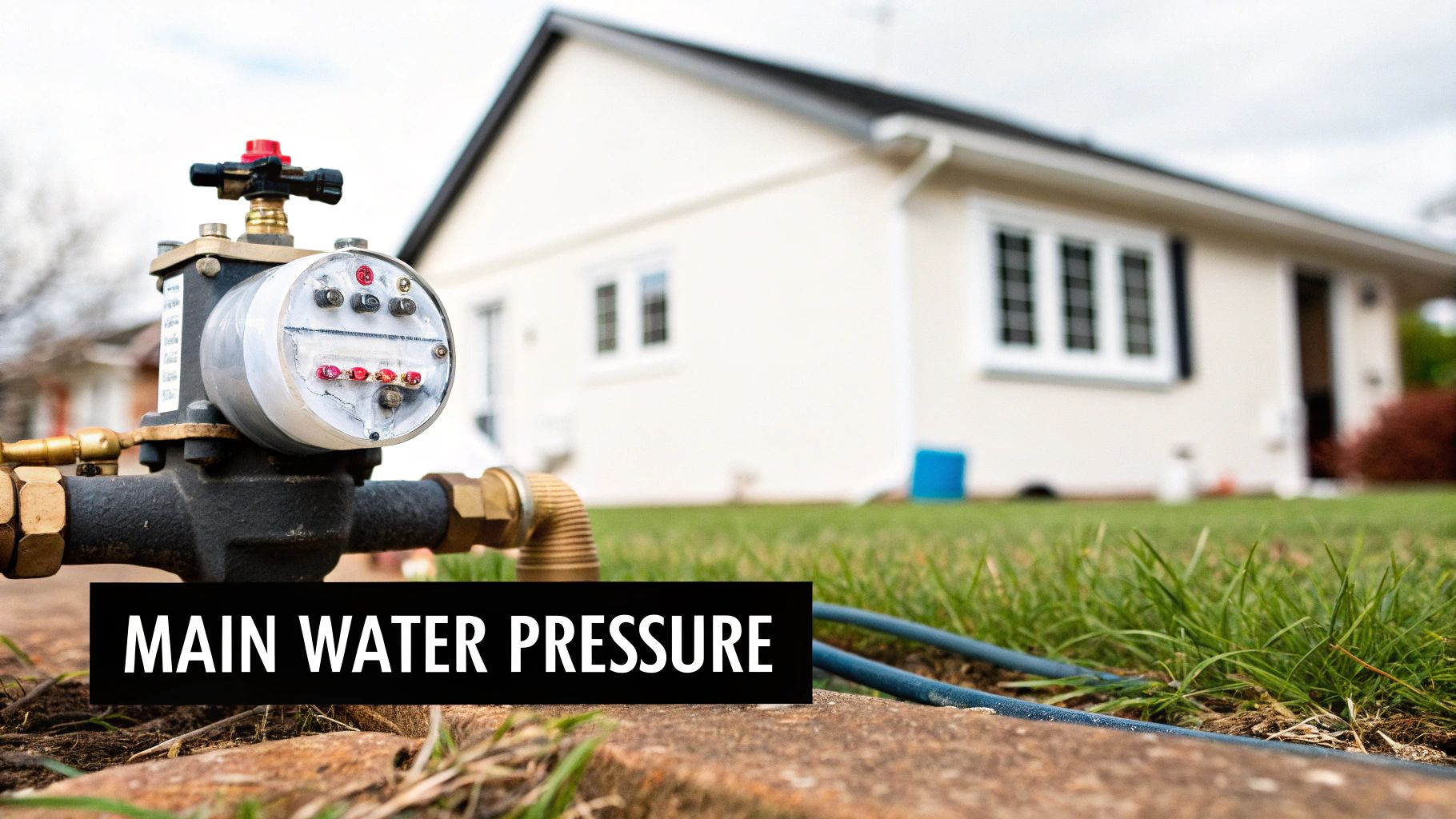
Picture the journey your water takes. It travels from a reservoir, through a massive network of underground pipes, and finally into the smaller pipe that feeds your Eastbourne home. The energy propelling it all the way to your tap is what we call main water pressure. It’s what ensures that when you turn on a tap, water actually comes out with a bit of purpose.
Here in the UK, we measure this force in two ways: Bar and Pounds per Square Inch (PSI). To put it simply, one Bar is roughly the same as the atmospheric pressure at sea level, which works out to about 14.5 PSI. These numbers really matter because most of your appliances, from your boiler to your washing machine, are designed to work best within a certain pressure range.
Why Balanced Pressure Is Vital
Good water pressure makes life easier. You can feel it in the satisfying spray of a powerful shower or see it when you fill the bathtub in minutes, not half an hour. But when the pressure drops, you’re left with a frustrating trickle from the taps and a shower that can barely rinse the shampoo out of your hair.
The importance of balanced pressure goes far beyond convenience, though. It’s crucial for the health and lifespan of your entire plumbing system.
Appliance Performance: Combi boilers, in particular, need a minimum amount of pressure to even fire up. If it's too low, you could be left with no hot water at all. Washing machines and dishwashers also rely on it to run their cycles correctly.
Pipework Integrity: On the flip side, excessively high pressure puts a constant strain on your pipes, joints, and fittings. This can lead to noisy pipes (often called water hammer) and, in the worst-case scenario, expensive leaks or burst pipes.
For many homeowners in Eastbourne, a sudden drop in pressure might just seem like a minor annoyance. But in our experience at Harrlie Plumbing and Heating, what starts as a weak shower can often be a symptom of a much bigger issue, like a hidden leak or a blockage that needs a professional to sort out.
Local Factors and National Demand
Water pressure isn't just about what’s happening inside your home. It’s connected to a huge network that’s influenced by everything from local geography to national demand. For example, homes in the hillier parts of Eastbourne, like up near Beachy Head, might naturally have different pressure levels compared to those on flatter ground in the town centre.
National water consumption also plays a huge part. The average UK household uses significantly more water today than it did back in the 1980s, putting more strain on the whole supply network. This can directly affect the pressure that eventually reaches your property. You can read more about how national water use impacts the system in this report on the UK's water industry.
How to Test Your Home's Water Pressure in Minutes
Guessing your water pressure is one thing, but knowing the exact figure is empowering. You don't need to be a professional plumber to get a clear answer, either. With a simple tool and just a few minutes of your time, you can get a precise reading and understand exactly what's going on with your home's water supply.
This quick diagnostic is the first real step toward solving any pressure-related headaches. All you need is a water pressure gauge, an inexpensive gadget you can pick up from most hardware shops or online. They're dead simple to use and give you an instant, accurate measurement.
Your Step-by-Step Guide to Testing Pressure
Getting a reading is a very straightforward process. The best place to test is nearly always an outside tap, as this gives you the most direct measurement of the pressure coming into your property before internal pipes start to affect it.
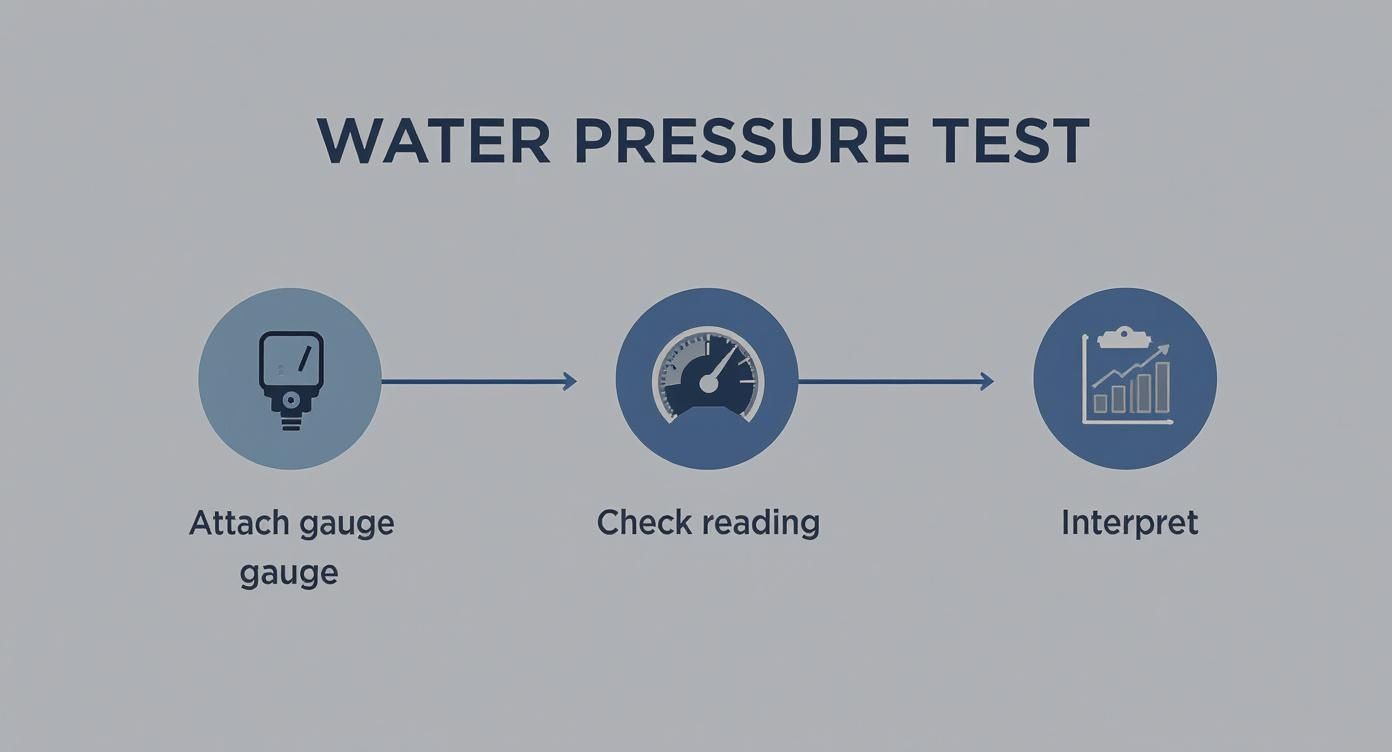
Turn Off All Water: Before you start, make sure nothing in your home is running. That means the washing machine, dishwasher, showers, and all your taps need to be switched off.
Attach the Gauge: Most pressure gauges are designed to screw right onto a standard threaded outdoor tap, just like a garden hose. Make sure you tighten it by hand until it feels snug—this will stop any leaks from skewing the reading.
Open the Tap Fully: Turn the tap on all the way. You'll see the needle on the gauge jump up and then settle on a number. That's it! This is your home's static water pressure.
Note the Reading: Take a clear note of the number, paying attention to whether you're reading the Bar or PSI scale. It’s always a good idea to take two or three readings just to be certain.
Once you have your number, you can get to the most important part: figuring out what it actually means for your home.
Interpreting Your Water Pressure Readings
A number on a gauge is pretty meaningless without context. Here in the UK, water companies aim to deliver a minimum pressure, but what's considered "good" can vary quite a bit.
The table below is a quick reference guide designed to help you make sense of your reading and what it means for a typical Eastbourne property.
Pressure Reading (Bar) | Pressure Reading (PSI) | What This Means for Your Home | Potential Issues in an Eastbourne Property |
|---|---|---|---|
Below 1.0 Bar | Below 14.5 PSI | Very Low Pressure. This is often below the minimum required for many appliances, especially combi boilers. | Your boiler may fail to ignite, showers will be weak, and filling a bath will take a very long time. We see this in some older Eastbourne flats. |
1.0 - 1.5 Bar | 14.5 - 22 PSI | Low Pressure. Considered the legal minimum in some areas but is still likely to cause poor performance. | You might notice taps flowing weakly, especially upstairs. Running more than one tap at a time will cause a noticeable drop. |
1.5 - 3.0 Bar | 22 - 43.5 PSI | Good/Optimal Pressure. This is the ideal range for most UK homes, providing strong flow without straining the system. | Appliances will run efficiently, showers will be powerful, and the system operates as intended. This is the target for a happy home. |
3.0 - 4.0 Bar | 43.5 - 58 PSI | Slightly High Pressure. While it delivers a powerful flow, it can start to put mild stress on pipes and appliances. | You might hear faint noises in your pipes. It's a good idea to monitor, but not usually an immediate cause for alarm in a modern build. |
Above 4.0 Bar | Above 58 PSI | High Pressure. This level is excessive and can cause significant long-term damage to your plumbing system. | This can lead to noisy pipes (water hammer), dripping taps, and a shortened lifespan for washing machines and dishwashers. Common in low-lying Eastbourne areas. |
As you can see, there's a definite sweet spot. Both very low and very high readings can cause problems, so knowing where you stand is the first step toward getting it right.
At Harrlie Plumbing and Heating, we often visit homes in Eastbourne where a reading below 1.0 bar is the root cause of a non-functioning combi boiler. Homeowners are often surprised that a simple pressure issue is the culprit behind their lack of hot water. Identifying this early can save a lot of guesswork and frustration.
Finding the Cause of Low Water Pressure
Is your shower more of a pathetic drizzle than a powerful downpour? You’re not just imagining it. Low water pressure is a common headache for homeowners in Eastbourne, but figuring out why it's happening is the first step towards getting that satisfying flow back.
The cause can be anything from a surprisingly simple fix you can do yourself to a more complex issue hiding in your pipework or even the local water network. Before you start thinking the worst, let's run through a quick diagnostic checklist.
Starting with the Simplest Checks
Your journey to better water pressure begins right at the source. There are two crucial valves that control the water coming into your home, and if either isn't quite right, it can slow everything down to a frustrating trickle.
The Main Stopcock: This is your home's main shut-off valve, usually tucked away under the kitchen sink or in a utility cupboard. It needs to be turned fully anti-clockwise to be completely open. Sometimes, after a plumbing job, it gets left partially closed by mistake, which is enough to restrict the flow.
The Outside Stop Valve: You'll typically find this outside your property boundary, under a small metal or plastic cover on the pavement. While you should be careful about operating this yourself, you can lift the cover to see if it looks damaged or blocked.
It's also a good idea to have a quick chat with your neighbours in your part of Eastbourne. If everyone on the street is suffering from weak showers, it’s a strong sign the problem is with the local supply network, not just your house.
Common Culprits Inside Your Home
If the main valves seem fine, the next place to look is your home’s internal plumbing. Over the years, all sorts of issues can crop up that slowly but surely reduce your water pressure.
Ageing Pipework: This is a big one in Eastbourne, especially in the beautiful older parts of town like Meads or Old Town. Those lovely Victorian and Edwardian properties often still have their original galvanised iron pipes. After a century of use, they can get badly corroded and clogged with limescale, narrowing the pipe and choking the water flow.
Hidden Leaks: Even a small, unseen leak somewhere in your plumbing can cause a noticeable drop in pressure. Instead of reaching your taps, that water is escaping where it shouldn't. Finding them can be tricky, but our guide has some great DIY tips for discovering a hidden water leak in your home.
Peak Usage Times: Does your water pressure plummet first thing in the morning when everyone in the neighbourhood is getting ready for work and school? This could simply be a case of local demand outstripping supply during those busy hours.
Broader Issues with the Water Network
Sometimes, the problem is bigger than your home and lies with the wider water network. The UK’s water infrastructure is a vast, complex system, and much of it is getting on a bit, leading to issues that can affect whole communities.
A major factor is leakage within the supplier's own network. Water companies across England and Wales have been tackling this for years, with total leakage recently reported at a staggering 2,967.5 million litres per day. That’s a huge amount of water lost before it even gets to our homes, which has a direct impact on the main water pressure for entire areas.
At Harrlie Plumbing and Heating, we've seen countless cases in Eastbourne where homeowners were convinced they needed a new boiler, only for us to discover the true cause was a partially closed stopcock or severely corroded pipework from a century ago. A thorough diagnosis is key to avoiding unnecessary expense and getting to the real root of the problem.
By working through these potential causes—from the simple checks to the more complex possibilities—you can build a much clearer picture of what’s behind your low water pressure. It's the first and most important step to getting the problem sorted for good.
The Hidden Dangers of High Water Pressure
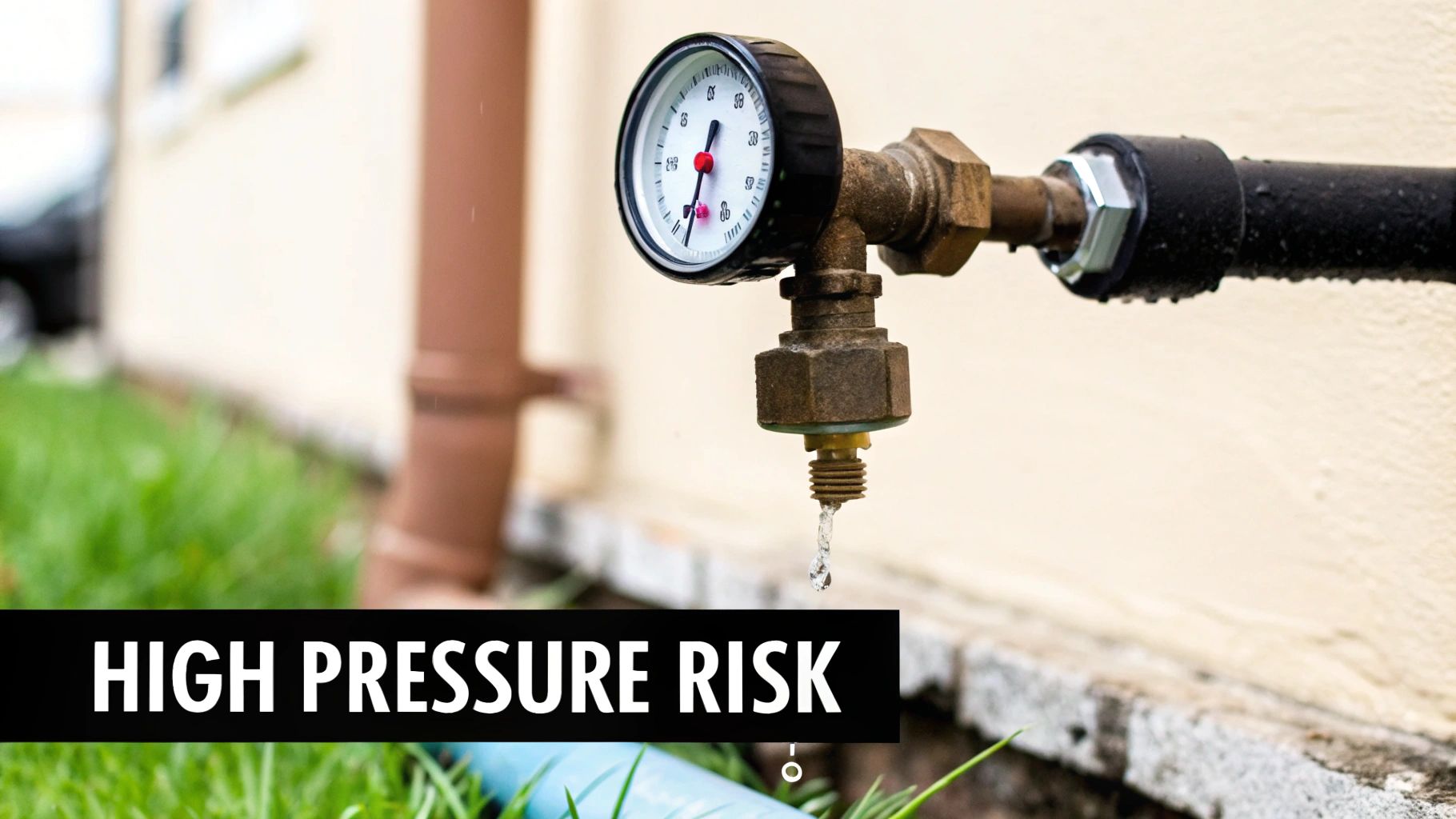
While a weak, dribbling shower is definitely frustrating, it’s the powerful, jet-like flow of high water pressure that poses a silent and much more serious threat to your home. It might feel like a touch of luxury at first, but that excessive force puts your entire plumbing system under constant, damaging strain.
This unseen stress can lead to a whole cascade of expensive problems, from noisy pipes and constant drips to the premature failure of your expensive appliances. Think of it like over-inflating a car tyre. For a while, it seems fine, but the material is being stretched beyond its limits, making it far more likely to fail when you least expect it. The same principle applies to your pipes, joints, and taps when your main water pressure is too high.
The True Cost of Excessive Pressure
For a typical UK home, any pressure consistently reading above 4 bar (or about 58 PSI) is considered too high. This level of force, day in and day out, causes significant wear and tear that often goes completely unnoticed until it’s too late.
The damage can show up in several ways:
Appliance Breakdown: Your washing machine, dishwasher, and even your boiler have internal valves and seals that simply aren't designed to withstand relentless high pressure. It can shorten their lifespan significantly.
Constant Drips and Leaks: High pressure forces water past the seals in taps and toilet cisterns. This leads to persistent, wasteful dripping that quietly adds up on your water bill.
Water Hammer: Ever heard a loud banging or shuddering sound when you turn a tap off quickly? That's water hammer. It’s a shockwave created by fast-moving water suddenly stopping, and it can weaken pipe joints over time.
Why Do Some Eastbourne Homes Have High Pressure?
High water pressure isn’t always a sign of a fault. Sometimes, it’s just down to local geography. Here in Eastbourne, for example, homes located at the bottom of a hill—like those in areas sloping down from the South Downs, such as parts of Old Town or Lower Meads—are naturally more likely to have higher pressure.
It’s simple physics, really. Gravity adds extra force to the water as it travels downhill from the mains network, delivering it to your property with more punch than your plumbing can handle.
We often visit properties in Eastbourne where the homeowners are dealing with noisy pipes and recurring leaks. In many cases, the root cause isn't faulty plumbing but simply that their main water pressure is far too high for their system to handle safely. It's a hidden stress test that their plumbing fails over time, and a job the Harrlie Plumbing and Heating team knows well.
The Most Effective Safeguard: A Pressure Reducing Valve
Fortunately, there’s a straightforward and highly effective solution to protect your home: a Pressure Reducing Valve (PRV). This simple but clever device is installed on your incoming water main, usually near your stopcock, and acts as a permanent guardian for your entire plumbing system.
A PRV automatically reduces the pressure of the water entering your home to a safe, consistent level. It doesn't restrict the flow, so you still get a satisfying shower, but it caps the force at a preset limit. By installing one, you effectively protect every pipe, appliance, and tap in your home from unnecessary strain, preventing costly future repairs and extending the life of your appliances.
Your Options for Fixing Water Pressure Problems
Right, you’ve done the detective work and you know whether your water pressure is too high or too low. What's next? It's time to look at the solutions, and thankfully, there are some seriously effective fixes that can bring your home’s plumbing back into balance.
Whether you're battling a frustrating trickle from the shower or your system is creaking under dangerous strain, getting the right fix in place will make a world of difference. The real key is matching the right bit of kit to your specific problem, something our team at Harrlie Plumbing and Heating has become pretty good at for properties across Eastbourne.
Tackling Low Mains Water Pressure
Living with a dribble for a shower doesn't have to be your new normal. If the water coming into your home from the street is just a bit weak, we can give it a serious helping hand once it’s inside your property.
The go-to solution is fitting a water pressure booster pump. Think of it as a powerful little engine for your plumbing. This clever device is a centrifugal pump that grabs the existing water flow from your mains and uses a spinning impeller to ramp up the pressure before sending it on its way around your home.
The result? A powerful, invigorating shower and taps that fill the sink in seconds, even if the supply from the mains is underwhelming. Modern booster pumps are smart, too – they only kick in when they sense you've turned on a tap, so they're not guzzling electricity unnecessarily.
In bigger homes or properties where lots of people are using water at once, we can pair a booster pump with an accumulator tank. This tank holds a reserve of pressurised water, ready to be released when needed. This combination guarantees a consistently strong flow, stopping that annoying pressure drop when someone flushes the loo while you're in the shower. To get into the nitty-gritty of boosting your flow, have a look at our detailed guide on how to increase water pressure in your UK home.
Taming Dangerously High Water Pressure
As we've mentioned, high water pressure is a silent troublemaker. The single best line of defence you can install is a Pressure Reducing Valve (PRV). This sturdy bit of kit is fitted directly to your incoming water main, where it acts as a gatekeeper for your entire system.
A PRV works by automatically squeezing the incoming pressure down to a safe, pre-set level—usually around 3 bar. It’s an invisible shield, protecting every single pipe, joint, and appliance in your home from the relentless force of excessive pressure.
Installing a PRV is one of the smartest investments an Eastbourne homeowner can make, especially for properties in areas prone to high pressure. At Harrlie Plumbing and Heating, we see it as an essential preventative measure that protects against costly future leaks and appliance failures.
Water companies are always trying to balance network pressure against leaks – higher pressure often leads to more burst pipes over time. By managing the pressure inside your home, you're not just protecting your property; you’re also playing a part in wider water conservation. The government’s analysis of the UK water industry's performance gives some fascinating insight into this challenge.
When Pipe Replacement Is the Only Answer
Sometimes, the problem isn't the pressure itself, but the pipes carrying the water. This is a classic issue in the beautiful older properties you see all over Eastbourne, especially in areas like Old Town or Meads. Homes from the Victorian or Edwardian eras often still have their original galvanised iron pipework.
Over decades, these old pipes corrode and build up limescale on the inside. This process, known as encrustation, slowly narrows the pipe until it’s like a clogged artery, strangling the water flow. It doesn't matter how good the pressure is from the street; it simply can't force its way through.
In these situations, adding a booster pump would just put more stress on an already failing system. The only real, long-term solution is to replace the old, constricted supply pipe with a new one made from modern MDPE (medium-density polyethylene). It's a bigger job, yes, but it solves the problem at its root, guaranteeing full flow and pressure for decades. Knowing whether to boost or replace is a judgement call that requires an expert diagnosis – and that’s where having a trusted local plumber on your side is invaluable.
When You Need a Professional Plumber in Eastbourne
While it’s great to get your hands dirty and figure out what’s going on with your plumbing, it’s just as important to know when to put the tools down. Knowing where the DIY route ends and professional expertise begins is crucial. Pushing your luck with complex plumbing work can quickly turn a small problem into an expensive, water-logged disaster.
Simple checks are always a good starting point. Making sure your internal and external stopcocks are fully open is something any homeowner can, and should, do. But if the issue is more complicated than a stiff valve, it's time to bring in someone with the right experience.
When to Call an Expert
If your own investigation points to a deeper issue with your main water pressure, the smartest move is to pick up the phone. Here are the clear signs you need a professional plumber:
Installing a Booster Pump or PRV: Fitting these devices means cutting directly into your mains water supply pipe. This isn’t a job for guesswork; it demands precision, specialist tools, and a solid understanding of how plumbing systems work to prevent leaks and ensure the device operates correctly.
Investigating Underground Leaks: If you suspect a leak somewhere between the street and your front door, a professional has the specialist listening gear and tracing equipment to find it without having to dig up your entire garden.
Persistent Pressure Problems: You've tried the simple fixes, but your pressure is still stubbornly low or uncomfortably high. A professional diagnosis is the next step. At Harrlie Plumbing and Heating, we can uncover the real cause, whether it's hidden corrosion inside old pipes or another fault you simply can't see.
Pipe Replacement is Needed: This one’s non-negotiable. Replacing a main supply pipe is a major job that is absolutely not for the DIY enthusiast. It involves excavation and expert knowledge to guarantee a durable, leak-free connection for years to come.
When the integrity of your home’s water supply is on the line, there’s simply no substitute for professional experience. A qualified plumber doesn’t just patch up the symptom; we get to the root of the problem to deliver a lasting solution, saving you a world of stress and money down the road.
For any tricky main water pressure concerns in the Eastbourne area, our team at Harrlie Plumbing and Heating is here to help. We offer an expert diagnosis and reliable solutions designed for your home. If you're looking for more guidance, our article on finding a trusted plumber in Eastbourne offers a homeowner's guide to help you make the right choice.
Frequently Asked Questions About Water Pressure
It's completely normal to have a few questions when you're trying to figure out your home's main water pressure. To give you some clear, straightforward answers, we’ve gathered the most common queries we get from homeowners around Eastbourne. This should help you get a better handle on your own plumbing.
Can I Fix Low Water Pressure Myself?
Sometimes, yes! The very first thing to check is your internal stopcock (usually lurking under the kitchen sink) and the external stop valve out on the pavement. A partially closed valve is a surprisingly common culprit for low pressure, and it's an easy fix.
However, if both valves are wide open and your shower still feels more like a drizzle, the problem probably runs deeper. Issues like hidden leaks, old pipes clogged with limescale, or even problems with the local supply network need a professional eye to diagnose and sort out properly.
Is My Landlord Responsible for Water Pressure?
In a rental property, the landlord is generally responsible for making sure the plumbing is in good nick. This means they need to fix any internal issues that could be causing low or high water pressure, like leaks or old, faulty pipework.
If the problem is with the water supplier's network, that’s out of their hands. Even so, it's their job to liaise with the water company and arrange for any internal upgrades, like a booster pump, if it comes to that.
At Harrlie Plumbing and Heating, we work with landlords all over Eastbourne to get pressure problems sorted in their rental properties. It's a key part of keeping a home safe and comfortable for tenants.
Will a New Boiler Improve My Water Pressure?
This is one of the biggest myths we hear. A new boiler, no matter how powerful, cannot increase your main water pressure. Think of it this way: a boiler can only heat the water that it receives.
If your incoming pressure is weak, a brand-new boiler will still be starved of water and might even struggle to work at all. The real fix for low pressure is to tackle the root cause (like a blockage or leak) or install a booster pump to increase the pressure before the water even reaches your boiler.
How Does Eastbourne's Hard Water Affect Pressure?
Eastbourne is well-known for its very hard water, which is full of minerals like calcium and magnesium. Over the years, these minerals build up inside your pipes, forming a chalky crust of limescale.
This process, called encrustation, slowly narrows the inside of the pipes, restricting the flow of water and leading to a drop in pressure. It's especially common in older homes with their original metal pipework. While it doesn't happen overnight, it’s a major long-term contributor to pressure headaches in our area.
If you're dealing with persistent water pressure problems or just need an expert to get to the bottom of it, don't leave it to guesswork. Contact Harrlie Plumbing and Heating for reliable, professional solutions in and around Eastbourne. Visit us at https://www.harrlieplumbing.co.uk to schedule a call-out.

Comments