Repair Gas Boiler: Eastbourne Guide to Quick Fixes

That sudden silence when your heating should click on, or the shock of a lukewarm shower on a chilly Eastbourne morning—it’s a story we’ve heard countless times at Harrlie Plumbing and Heating. Before you jump to conclusions and start budgeting to repair your gas boiler, take a breath. Many common issues can actually be sorted with a few simple, safe checks that anyone can do.
Troubleshooting Your Gas Boiler Like a Pro
When your boiler goes on the blink, the first instinct is usually to pick up the phone. But here at Harrlie Plumbing and Heating, we always suggest running through a few basic checks first. It could easily save you the time and expense of a call-out, especially for those little gremlins that don’t actually need an engineer.
Picture this: a popular Worcester Bosch boiler in a Sovereign Harbour flat suddenly flashes a fault code. It’s a scene we at Harrlie Plumbing and Heating see play out all the time across Eastbourne. Before panic sets in, a few logical steps can often pinpoint the problem. Ruling out the simple stuff is always the best place to start.
Start With The Basics
More often than not, the culprit is surprisingly simple. Your first port of call should always be the thermostat. Has it been knocked down by accident, or have the batteries died? It happens more than you'd think in busy Eastbourne family homes. While you’re at it, make sure the boiler's power switch is on and that a breaker hasn't tripped in your fuse box. These checks take seconds but solve a remarkable number of "boiler breakdowns."
Another major player is boiler pressure. A quick glance at the pressure gauge—that little dial on the front of your boiler—can tell you almost everything you need to know.
Check the Pressure Gauge: Ideally, the needle should sit somewhere between 1 and 1.5 bar. If it’s dropped into the red zone, the pressure is too low for the boiler to operate.
Look for the Filling Loop: This is usually a silver braided hose with a small valve or lever, tucked away underneath the boiler.
Try a Reset: If you see a fault code on the display, a simple reset (just follow your manufacturer's instructions) can sometimes be enough to clear the error and get things going again.
Low pressure is one of the most common reasons a boiler will shut down. While topping it up is often a straightforward fix, a system that constantly loses pressure usually points to a small leak somewhere. The team at Harrlie Plumbing and Heating often traces these back to an old radiator valve or hidden pipework.
Before you pick up the phone, running through a few safe, simple checks can often solve the problem or at least give a professional a head start. Here’s a quick list of things you can safely check yourself.
Quick Boiler Diagnostic Checklist
Symptom | Potential Simple Cause | Action You Can Take |
|---|---|---|
No Heat or Hot Water | Power issue | Check the boiler's power switch, fuse box, and thermostat batteries. |
Fault Code on Display | Temporary glitch | Try resetting the boiler according to the manufacturer's manual. |
Radiators Cold at Top | Trapped air | Bleed the affected radiators (if you feel confident doing so). |
Boiler Shuts Off | Low water pressure | Check the pressure gauge. If below 1 bar, it may need re-pressurising. |
These steps are designed to rule out the most frequent and easily fixable issues. If you’ve tried them and the boiler still isn’t behaving, it’s a clear sign that a deeper problem needs a professional eye.
If you find yourself constantly battling with low pressure, it’s worth understanding the root causes. We’ve put together a handy guide to help you learn more about what causes a boiler to lose pressure here: https://www.harrlieplumbing.co.uk/post/what-causes-boiler-to-lose-pressure-a-quick-homeowner-guide. For a broader look at other typical malfunctions, there are some great resources online covering common boiler problems and their fixes. Taking a few minutes to do these initial checks can empower you to handle minor issues with confidence and know exactly when it’s time to call in the experts.
Sorting Out Common Boiler Problems Yourself (Safely!)
Let’s talk about the most frequent boiler faults we see day in and day out across Eastbourne, from the lovely old terraces in Old Town to the newer builds along the coast. While some problems definitely need an expert hand from a team like Harrlie Plumbing and Heating, you’d be surprised how often you can safely sort out the most common hiccups yourself.
Knowing these simple fixes can save you a fair bit of time, stress, and the cost of an unnecessary call-out. Most boiler troubles boil down to just a handful of recurring issues. We'll focus on the big three: low pressure, weird noises, and pilot light problems. Getting to grips with these is the first step in knowing when you can DIY and when it’s time to call in a pro to repair your gas boiler.
Tackling Low Boiler Pressure
Low pressure is, without a doubt, the most common fault we get called out for in Eastbourne. If you've got a Vaillant or Worcester Bosch boiler, you might see an error code like "F22" pop up or notice a little light flashing at you. This almost always means the water pressure in your heating system has dipped below where it needs to be, typically under 1 bar.
To get this sorted, you’ll need to find your boiler's filling loop. It’s usually a silver, braided hose tucked underneath the boiler with one or two small levers or knobs on it.
First, double-check the gauge: Before you do anything, make sure the pressure gauge is actually below the 1 bar mark.
Open the valves: Slowly open both valves on the filling loop. You should hear the gentle sound of water starting to refill the system.
Keep a close eye on the gauge: Watch that little needle! You want it to climb back up into the green zone, which is usually between 1 and 1.5 bar.
Shut the valves tight: As soon as it hits the right spot, firmly close both valves again. It’s really important to make sure they're fully shut to stop the system from getting over-pressurised.
Once that’s done, you might need to reset your boiler to clear the fault code and get things running again.
What Are Those Strange Boiler Noises?
Is your boiler gurgling, whistling, or making a loud banging sound like a kettle that’s about to boil over? These noises are your boiler's way of telling you something isn't quite right, and here in the Eastbourne area, the cause is often our notoriously hard water.
A loud rumbling or banging noise, what we in the trade call 'kettling', is a classic sign of limescale building up on the boiler's heat exchanger. This creates tiny hotspots that cause the water to boil, steam up, and expand violently, making that racket. It restricts the flow of water and puts a massive strain on the boiler’s parts.
While bleeding your radiators can sometimes fix gurgling noises caused by a bit of trapped air, kettling is a more serious issue. It points to an internal problem that will eventually need a professional system flush from a company like Harrlie Plumbing and Heating to get rid of all that scale and sludge.
Ignoring these sounds will likely lead to a much more expensive repair down the line. If you hear persistent banging, take it as a clear signal to get an engineer's opinion.
When the Pilot Light Goes Out
If you have an older boiler with a pilot light—that little blue flame that's always on—and it goes out, you’ll have no heating or hot water. Before picking up the phone to us at Harrlie Plumbing and Heating, there are a couple of things you can check. First, could a simple gust of wind from a nearby window or door have blown it out? It happens.
Relighting it is usually quite straightforward; the instructions are often printed on a label on the inside of the boiler's front panel.
However, if the pilot light just won’t stay lit, or if the flame is burning yellow or sooty instead of a crisp, clean blue, stop what you are doing immediately. This can signal a serious ventilation or gas supply problem and is a non-negotiable sign to call a Gas Safe engineer, like one of the team here at Harrlie Plumbing and Heating.
When to Call a Gas Safe Engineer Immediately
There's a great deal of satisfaction in sorting out a household problem yourself, but the line between a safe DIY fix and a dangerous gamble is crystal clear with a gas boiler. The rule is simple and absolute: if you need to remove the boiler's outer casing for any reason, you must stop immediately. This isn't just a friendly suggestion; it's a legal requirement here in the UK.
Trying to repair a gas boiler by getting into its internal workings is incredibly risky. You're dealing with a complex mix of gas, high-pressure water, and electricity, all in one box. One wrong move could lead to gas leaks, serious water damage, or even carbon monoxide poisoning. It’s a risk that no homeowner should ever take.
We at Harrlie Plumbing and Heating once had a call-out to a property in the Langney area of Eastbourne where the homeowner tried to fix a persistent fault code by tinkering with an internal sensor. In the process, they unknowingly knocked a seal out of place, creating a small but very dangerous gas leak. Thankfully, they smelled gas, realised something was wrong and called us straight away. It’s a perfect example of how a well-intentioned fix can quickly become an emergency.
Red Flags That Demand a Professional
Some symptoms are undeniable signals that the problem is beyond a simple DIY task and needs an expert from a team like Harrlie Plumbing and Heating. Knowing what to look for is crucial for your safety.
A Suspected Gas Leak: If you smell gas (often described as rotten eggs or sulphur), don't touch any light switches or electrical appliances. Your first move should be to turn off the gas supply at the meter, open your windows to ventilate the area, and call a Gas Safe engineer from a safe location. For a more detailed walkthrough, have a look at our guide on how to detect gas leaks.
Significant Water Leaks: A minor drip from a radiator valve is one thing, but a steady leak coming directly from the boiler unit itself is a major red flag. This often points to a serious internal failure, like a corroded heat exchanger or a failing pump seal.
Persistent Fault Codes: You've tried resetting the boiler, maybe even topped up the pressure, but that pesky fault code just keeps coming back. This is your boiler's way of telling you there's a component failure that needs a professional diagnosis.
This decision tree can help you figure out if the strange noises your boiler is making are something to worry about.
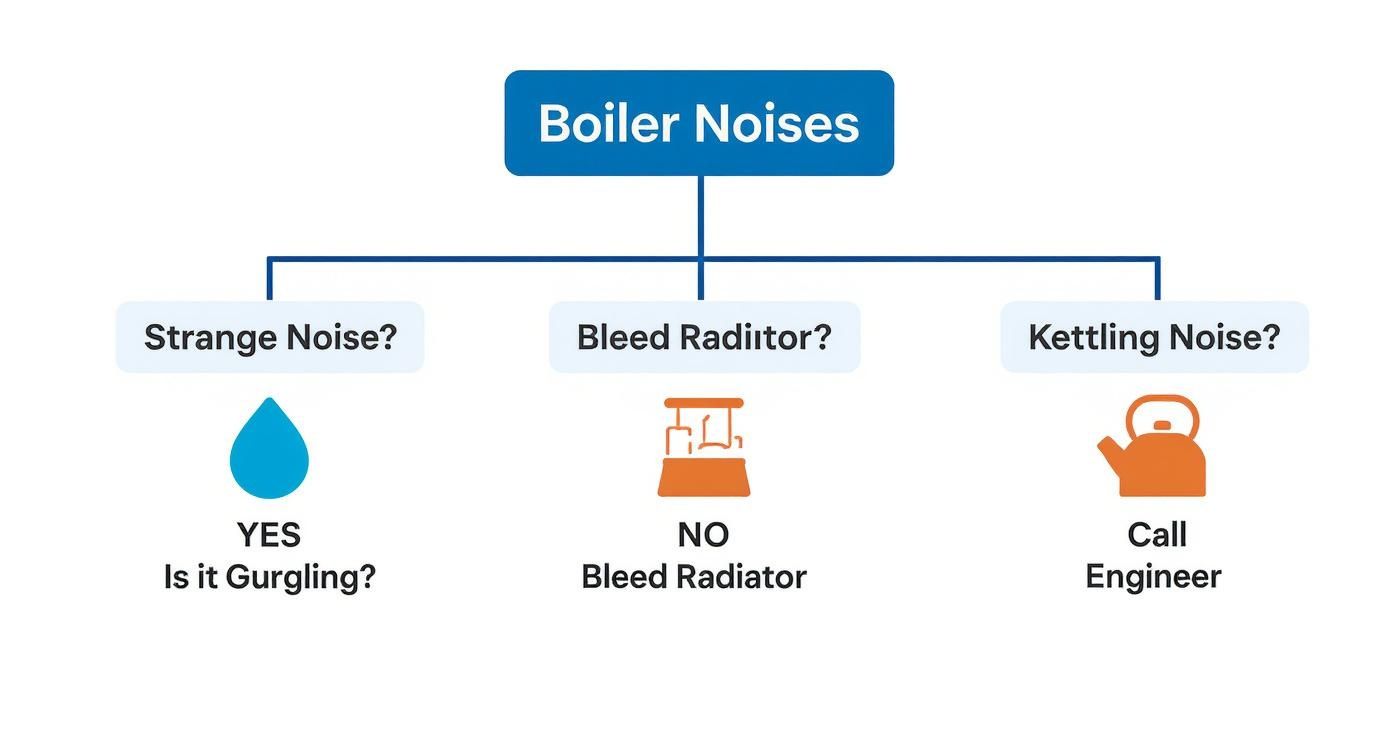
The main takeaway here is that while some sounds like gurgling might be solved by bleeding your radiators, others like 'kettling' point directly to an internal build-up of limescale or sludge that only a Gas Safe engineer should tackle.
Calling an engineer isn't admitting defeat; it's making the smart, safe choice for your home and family. The UK's boiler repair market is growing, partly due to ageing systems and increasingly strict safety regulations. In fact, scheduled maintenance now accounts for around 42% of the market, showing a strong shift towards preventing problems before they turn into cold-shower emergencies.
Understanding Boiler Repair Costs in Eastbourne
When your boiler decides to pack it in, one of the first questions that pops into your head is always, "How much is this going to set me back?" It's a fair question. Knowing the potential costs helps you make a clear-headed decision, especially when you need to call in a professional to repair your gas boiler.
The final bill really boils down to what part has failed and how long the job takes.
A fairly straightforward job, like replacing a faulty pump or a fan, gives you a good baseline. These parts are essential for circulating hot water to your radiators and safely getting rid of fumes, and swapping them out is a routine task for our engineers here at Harrlie Plumbing and Heating in Eastbourne.
Of course, the costs can climb quite a bit for the more complex components. A failed printed circuit board (PCB)—which is basically the boiler's brain—is often one of the pricier parts to replace.
Breaking Down Common Repair Costs
To give you a clearer idea, here are some typical price ranges you might expect for common boiler repairs. Bear in mind these are just estimates; the final cost can vary depending on your specific boiler model and how tricky the job is.
Faulty Pump Replacement: A new central heating pump is vital for pushing hot water around your system and getting your radiators warm.
New Boiler Fan: This is a critical safety component, making sure harmful gases are correctly expelled from your home.
Printed Circuit Board (PCB) Replacement: This is a major repair that involves replacing the boiler's main control unit, and it's one of the more expensive jobs our Harrlie Plumbing and Heating engineers do.
The age and model of your boiler play a huge role in the final cost. Parts for older or obscure models can be difficult to source, which often means they are more expensive and take longer to arrive, especially for some of the older systems we see in Eastbourne homes.
When Is a Repair No Longer Worth It?
This brings us to the big question: when does it make more sense to replace your boiler rather than keep repairing it?
As a general rule of thumb, if the repair cost is creeping up to 50% of the price of a new boiler, it's probably time to seriously consider an upgrade.
Let's imagine a ten-year-old boiler in a house in the Roselands area of Eastbourne needs a new heat exchanger. This is one of the most expensive components to replace. Our advice at Harrlie Plumbing and Heating would be clear: given the boiler's age and the high cost of the part, investing that money into a new, highly efficient A-rated model often makes far more sense in the long run.
The rising cost of a new boiler is a big factor in this decision. Data shows the price of a typical new gas boiler installation has seen noticeable increases, climbing from around £2,250 in 2020 to an estimated £2,820 by 2025. You can explore more data on boiler installation costs to get a feel for the market trends. This makes weighing the cost of a major repair against a full replacement even more important for homeowners.
Preventing Breakdowns With Annual Boiler Servicing
Let's be honest, the best way to deal with a major boiler repair is to stop it from happening in the first place. Being proactive with maintenance is far less stressful—and cheaper—than making a frantic emergency call when the heating gives up. The cornerstone of that approach? A simple annual boiler service.
Think of an annual service as your boiler's MOT and health check all in one. It’s a chance for a qualified Gas Safe engineer to get under the bonnet and make sure everything is running safely and, just as importantly, efficiently. A proper service helps you avoid the headache of needing to repair your gas boiler at the worst possible time, like in the middle of a cold snap here in Eastbourne.
What a Professional Service Really Involves
Some people think a boiler service is just a quick look-over, but a thorough check from a professional team like ours at Harrlie Plumbing and Heating goes much deeper.
Our engineers follow a detailed checklist to give you complete peace of mind. This includes:
Cleaning key components: We’ll clean out crucial internal parts like the heat exchanger and burner, getting rid of any gunk or debris that’s hurting your boiler’s efficiency.
Testing gas pressures: It's vital that your boiler is operating at the correct gas pressure. We check this to ensure it's burning fuel safely and effectively.
Checking safety mechanisms: We test all the boiler’s safety devices, from pressure relief valves to carbon monoxide detectors, to confirm they are working exactly as they should be.
Inspecting for wear and tear: We keep a sharp eye out for any early signs of corrosion or tiny leaks, catching small problems before they turn into expensive disasters.
An annual service isn't just about safety; it's also about saving money. A well-maintained boiler runs more efficiently, which directly translates to lower energy bills month after month.
Legal Duties and Manufacturer Warranties
For landlords in Eastbourne, this annual check isn't just a good idea—it's the law. Gas boiler servicing is a legal requirement, and after we're done, a Harrlie Plumbing and Heating Gas Safe engineer issues a CP12 Gas Safety certificate. This is a critical document for any rental property. A service typically costs around £100, a small but essential investment in your tenants' safety and your legal compliance.
For homeowners, keeping up with annual servicing is usually a condition of your manufacturer’s warranty. Miss a service, and you could find your warranty is void, leaving you to pay the full cost if a major component fails. An official service report gives you proof of maintenance and, more importantly, peace of mind. To get a better idea of the process, have a look at our Eastbourne homeowner guide on how to service a boiler.
Got a Boiler Question? We've Got the Answer
As Eastbourne's local heating experts, we at Harrlie Plumbing and Heating get asked a lot of questions about boilers. From strange noises to simple maintenance, homeowners want to know what's normal, what's not, and when it’s time to call in the pros. Here are our straightforward answers to the queries we hear most often.
How Often Should I Get My Gas Boiler Serviced?
Think of it like an MOT for your heating system. To keep your boiler running safely and efficiently, it absolutely needs to be serviced once a year by a Gas Safe registered engineer. If you're a landlord in Eastbourne, this isn't just good practice—it's a legal requirement.
An annual service from Harrlie Plumbing and Heating does more than just tick a box. We spot and fix small issues before they snowball into costly breakdowns, ensure your manufacturer's warranty stays valid, and fine-tune the system to keep your energy bills as low as possible.
Is It Worth Repairing a Boiler That's Over 10 Years Old?
This is a really common dilemma, and honestly, it all comes down to the specific problem and the repair cost. If it's a minor fix for a boiler that's been well looked after, repairing it is almost always the sensible choice. We often visit homes in areas like Old Town in Eastbourne and find that an older boiler just needs a small, inexpensive part to get it back up and running.
However, if you're looking at a hefty bill for a major component—like the heat exchanger or the printed circuit board (PCB)—it often makes more financial sense to put that money towards a new, A-rated boiler. A replacement comes with a long warranty and will make a real dent in your energy bills.
As a rule of thumb, if the repair quote is creeping up to 50% of the cost of a new boiler, it’s time to seriously think about an upgrade.
Why Are My Radiators Cold at the Top?
This is a classic symptom of trapped air in your heating system, which isn't usually a fault with the boiler itself. It's an incredibly common problem in Eastbourne homes, and the good news is you can often sort it out yourself.
You'll need a radiator key to "bleed" the rads. This just means opening a small valve to let the trapped air hiss out. Always make sure the heating is off and the radiators have cooled down before you start.
If you find you’re having to bleed them frequently or the issue just won’t go away, it could point to a bigger problem, like a tiny leak somewhere in the system. If that’s the case, it’s best to get an engineer from Harrlie Plumbing and Heating in for a proper diagnosis.
What Are the Dangers of Carbon Monoxide?
Carbon monoxide (CO) is a silent threat because you can't see, smell, or taste it. This dangerous gas is produced when fuel—including the natural gas your boiler uses—doesn't burn correctly. A faulty or poorly maintained boiler is one of the most common sources of CO leaks in a home.
This is precisely why UK law states that only Gas Safe registered engineers can work on gas appliances. We strongly recommend that every home in Eastbourne with a gas boiler has an audible CO alarm fitted. It’s a simple, vital safety measure, and the team at Harrlie Plumbing and Heating can supply and fit one for your complete peace of mind.
If your boiler is playing up or it’s time for its annual service, don't leave it to chance. Harrlie Plumbing and Heating is here to provide fast, reliable, and safe boiler repair services across Eastbourne and the surrounding areas. Visit our website for a free, no-obligation quote today.

Comments