Radiator won't bleed: Simple Fixes and When to Call a Pro

So, you’re all set to bleed that pesky radiator. You’ve got your radiator key, a few old towels laid out, and you’re ready to finally sort out that annoying cold spot at the top. But when you turn the key… nothing. No hiss of air, no little trickle of water. It’s a frustratingly common problem, especially in the lovely older properties we see all the time around Eastbourne.
When a radiator just refuses to bleed, it usually points to one of a few key culprits. Figuring out which one is the first step to getting your heating back on track.
Why Your Radiator Refuses to Bleed
Your central heating system is a closed loop, and any little disruption can throw the whole thing off. Here are the most common reasons your radiator is playing stubborn:
Low Boiler Pressure: This is always the first thing to check. If your system pressure has dropped too low (usually anything below 1 bar), there just isn't enough oomph to push the trapped air or water out of the radiator, especially if it’s on an upper floor. We see this often in the three-storey townhouses in the Meads area of Eastbourne.
A Stuck or Seized Bleed Valve: Over the years, a bit of paint, rust, or limescale can easily cause the tiny pin inside the bleed valve to seize up. This means it won’t open even when you turn the key.
An Internal Blockage: This is the one we hope it isn’t. A build-up of thick, dark sludge (a lovely mix of rust and debris) can completely clog the bleed valve from the inside, stopping anything from getting out.
That internal sludge is a dead giveaway that there’s corrosion happening inside your system. At Harrlie Plumbing and Heating, we always tell clients that using a quality central heating inhibitor is the best way to prevent this from happening in the first place. If you want to get your head around how it works, have a look at our guide on what central heating inhibitor is and why you need it.
To help you narrow it down, here’s a quick table to match your symptoms with the likely cause.
Quick Radiator Problem Diagnosis
Symptom | Likely Cause | Next Action |
|---|---|---|
Nothing comes out of the valve | Low Boiler Pressure | Check the pressure gauge on your boiler and top it up if it's below 1 bar. |
The radiator key won't turn | Stuck Bleed Valve | Apply a little penetrating oil and gently try to work it free. Don't force it. |
The valve turns, but nothing comes out | Internal Blockage | This suggests sludge is blocking the valve. It's time to call a professional. |
Only radiators upstairs are affected | Low Boiler Pressure | Low pressure struggles to reach the highest points in the system. |
This table should give you a good starting point, but remember that some issues can have overlapping symptoms.
Is It a DIY Fix or a Professional Job?
You can often sort out low pressure yourself, and sometimes a stuck valve can be gently persuaded to open. A blockage, however, points to a much bigger problem that really needs a professional eye. In the UK, the residential central heating market was valued at around £1.48 billion in 2025, which just shows how crucial these systems are to our homes. When a simple bleed fails, many homeowners find it’s just easier to call for a pro fix, which can cost between £60 and £90 for a straightforward call-out.
Here at Harrlie Plumbing and Heating, we've seen it all across Eastbourne and the surrounding villages. Our advice is simple: if a gentle attempt doesn't work, don't force it. You could easily strip the valve or cause a leak, turning a small headache into a much bigger, wetter one.
Your Essential Toolkit and Safety Checks
Before you even think about touching that bleed valve, let’s talk prep. Getting your tools and a quick safety plan sorted is the difference between a five-minute job and a call-out to a plumber for a watery mess.
The good news? You don’t need a massive collection of specialist gear. Most of what you’ll need is probably already in a drawer somewhere. It's all about being ready for the job and any little surprises, like a stubborn valve or an unexpected drip.
Assembling Your Radiator Bleeding Kit
There's nothing worse than scrambling for a towel while water is trickling down your wall. Gather your bits and pieces first, and the whole process will be far less stressful.
Here’s a quick checklist of what our Harrlie Plumbing and Heating engineers always have to hand:
A Radiator Bleed Key: This is the most important bit of kit. If you don't have one, they’re available for a couple of quid at any DIY shop in Eastbourne. Some modern radiators might use a small flat-head screwdriver instead, so check yours first.
Old Towels or a Rag: Grab at least two. Pop one on the floor beneath the valve and hold the other one around the key to catch any spray.
A Small Jug or Bowl: You'll need this to catch the water once the air has hissed out, saving your flooring from a puddle.
Penetrating Oil (like WD-40): An absolute must-have if you suspect the valve is rusted or has been painted over. A quick spray can work wonders on a stuck mechanism.
A top tip from our team: Always keep a small roll of PTFE tape in your kit. If you find the bleed valve has a slight weep after you’ve tightened it, a quick wrap of PTFE tape around the threads can often create a perfect seal and save you a lot of hassle.
Critical Safety Steps to Take First
Safety first, always. You’re dealing with a central heating system, which means hot water under pressure, so cutting corners is never an option.
The very first thing you need to do is turn off your central heating completely. Now, wait. Give it at least an hour, or until all the radiators in your home are properly cool to the touch.
Trying to bleed a hot radiator is a guaranteed way to get sprayed with scalding water, and that can cause some serious burns. This bit of patience is the most important part of the job. It also lets the water in the system settle, making the whole process much more effective.
How to Tackle a Stuck Radiator Bleed Valve
You've done everything right: the heating is off, the rads are cool, and you’re ready with your bleed key. You slot it into the valve, give it a turn, and… nothing. It’s completely seized. This is a common headache, especially in the beautiful older Victorian and Edwardian homes we often see around Eastbourne, where years of paint and a bit of corrosion can lock a valve solid.
Whatever you do, don't try to force it. A stripped bleed screw or, even worse, a sheared valve will turn a simple five-minute job into a major plumbing repair that could mean draining your entire system. A little patience and the right technique will usually get things moving again without any drama.
Applying Gentle Persuasion to a Seized Valve
The first port of call is to give the valve a bit of help. A few drops of penetrating oil, like WD-40, sprayed right onto the valve is a great start. Leave it for ten to fifteen minutes to work its magic. This gives the oil time to creep into the threads and dissolve any rust or grime that’s causing the jam.
After it’s had a good soak, try turning the key again with firm, steady pressure. No jerky movements. Still won’t budge? It’s time for a classic engineer’s trick we often use on stubborn jobs from Meads to Roselands.
The Tap and Turn Method Gently tap the body of the valve—not the screw itself—a few times with the handle of a screwdriver or a small spanner. This light vibration is often just enough to break the seal of old paint or corrosion. Immediately after tapping, try turning the key again. More often than not, this combination is all it takes to free it up.
Remember, the goal here is gentle persuasion, not brute force. If the valve still refuses to cooperate after a few tries, it's safer to stop. Give Harrlie Plumbing and Heating a call; we have specialised tools to deal with seized valves without risking damage to your radiator.
When the Valve Turns but Nothing Happens
So, you’ve managed to turn the valve. You might hear a faint click, but then... silence. No satisfying hiss of escaping air, and certainly no trickle of water. This is a different problem altogether and a classic sign your radiator won't bleed because of an issue somewhere else.
When this happens, it almost always points to one of two culprits:
A Complete Blockage: Thick, black sludge has built up inside the radiator over time and is now physically plugging the tiny opening of the bleed valve from the inside.
Critically Low System Pressure: There simply isn't enough pressure in your heating system to force anything—air or water—out of the radiator, especially one on an upper floor.
If you suspect a sludge blockage, there isn't much more you can safely do yourself. This level of build-up usually requires a professional system flush. However, checking your boiler pressure is a straightforward next step you can take. If low pressure is the problem, fixing it might solve the issue instantly. We’ll dive into exactly how to check and top up your boiler pressure in the next section—it’s a key skill for any homeowner and can save you from an unnecessary call-out.
Troubleshooting Your Broader Heating System
If you've fiddled with the bleed valve and you're still getting nowhere, it's time to zoom out and look at the bigger picture. A single stubborn radiator is often just the messenger for a wider problem, and nine times out of ten, the real culprit is low boiler pressure. It’s the lifeblood of your entire heating system.
Think of it like trying to get water to the top floor of a house with a weak pump; without enough force, it just won’t get there. The same thing happens with your heating. If a radiator—especially one upstairs in a classic Eastbourne townhouse—refuses to bleed, that’s a textbook symptom of low system pressure.
Checking and Topping Up Your Boiler Pressure
First things first, find the pressure gauge on your boiler. It's usually a small, round dial with a needle and coloured zones. When your heating is off and has cooled down, that needle should be sitting comfortably in the green zone, which is typically between 1 and 1.5 bar.
If you see it’s dropped below 1 bar, you've likely found your problem. To get it back up, you’ll need to use the filling loop. This is normally a silver, braided hose tucked underneath your boiler that connects two valves.
Make sure the heating is completely switched off.
Securely attach the filling loop at both ends if it isn't already connected.
Open one valve fully, then slowly open the second. You should hear the sound of water flowing into the system.
Keep a close eye on that pressure gauge. As soon as it hits the 1.5 bar mark, shut off the second valve first, and then the first one.
It's crucial to then disconnect the filling loop. This prevents any potential contamination of your mains water supply.
Often, this simple top-up is all it takes to get things working again. But a word of warning: if you find yourself having to re-pressurise the system regularly, it’s a big clue that you have a leak somewhere. That's when you need a professional diagnosis from a team like ours at Harrlie Plumbing and Heating.
This decision tree gives you a quick visual guide for checking if the valve is the core issue before you start diving into system-wide checks. The flow guides you from turning the valve to hearing a hiss, helping you confirm whether this quick fix has sorted it or if you need to investigate further.
Investigating Other Valve-Related Issues
If your boiler pressure is spot on, there are two other valves on the radiator itself that could be causing a blockage. The Thermostatic Radiator Valve (TRV) has a tiny internal pin that can get stuck down, completely stopping water from flowing. You can usually fix this by unscrewing the TRV head and gently wiggling the exposed pin up and down with a pair of pliers until it moves freely.
On the other side of the radiator, you'll find the lockshield valve. This valve is there to balance the system by controlling the overall flow. If it has been accidentally knocked shut, no water can get into the radiator at all. Check that it's open—you might need to pop off the plastic cap to get to the valve underneath.
These system-wide checks often solve the issue when a radiator won't bleed. Interestingly, with the UK's big shift towards heat pumps and low-temperature systems, we’re seeing more cases where radiators seem faulty but are actually suffering from incompatible valves or poor system balancing from a recent retrofit.
If none of these steps work, you could be dealing with a serious internal blockage from sludge build-up, which is stopping water from circulating entirely. In that scenario, your system is going to need a professional clean. You can learn more about this process in our guide on what a powerflush is and why your home might need one.
When It’s Time to Call a Heating Engineer
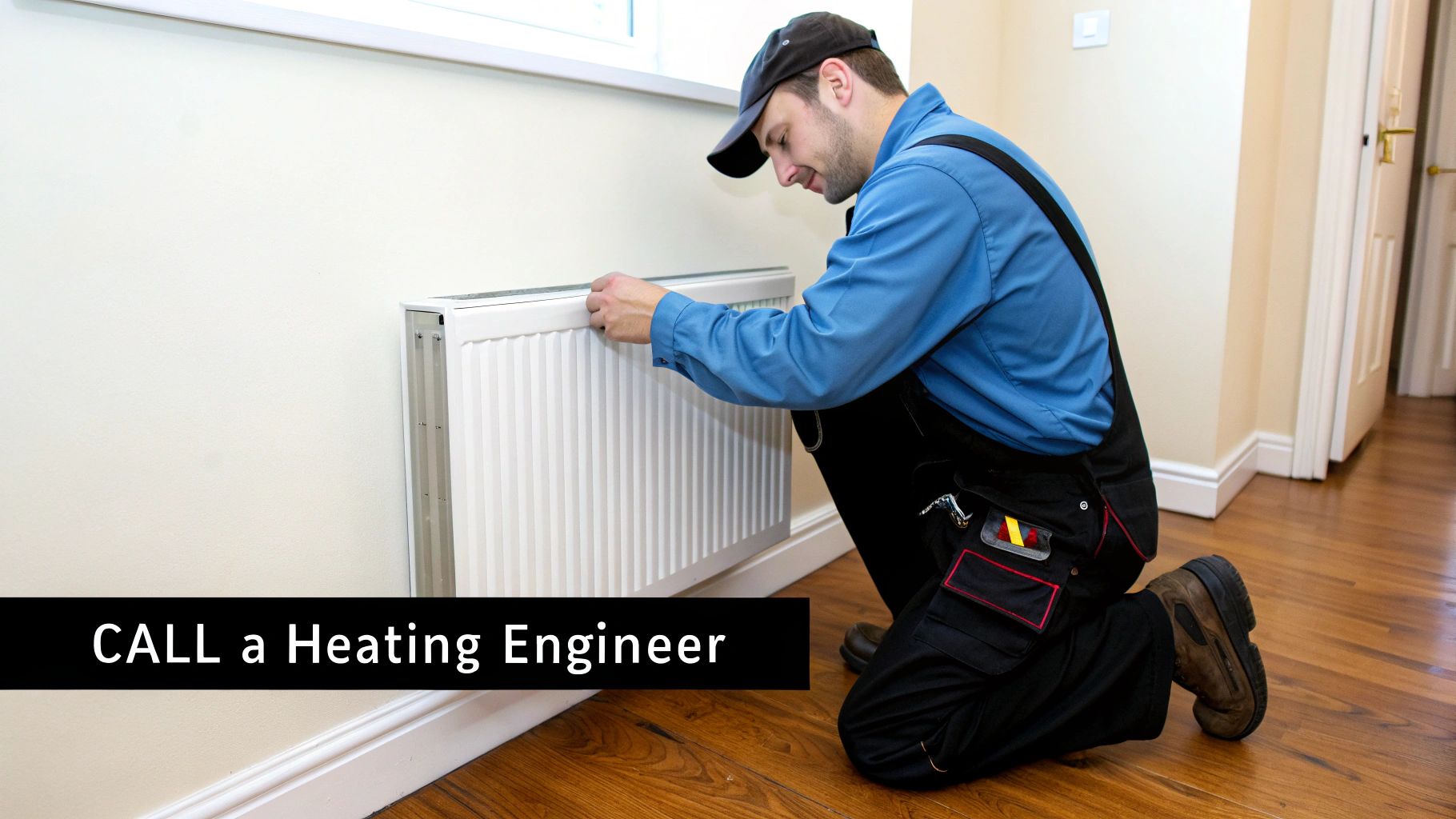
There comes a point in every DIY job where you have to know when to admit defeat. Pushing on when you’re out of your depth can often do more harm than good, especially with something as vital as your central heating.
If you’ve followed all the steps and that stubborn radiator still refuses to bleed, it’s a big clue that the issue is more serious than a bit of trapped air. Trying to force valves or fiddle with settings you don’t understand is a fast track to leaks, damaged parts, or even a total system breakdown. Knowing when to put the tools down and pick up the phone is a skill in itself.
Clear Signs It's Time for a Professional
Sometimes, the symptoms are screaming that it's a job for an expert. These aren't just minor annoyances; they're red flags pointing to a system-wide problem that a simple bleed key will never fix. Getting a professional diagnosis at this stage isn't just a good idea—it's essential for the long-term health of your heating.
Here are the undeniable signs you need an expert:
You're Constantly Bleeding Radiators: If you feel like you’re bleeding the same radiators every few weeks, you have an underlying issue. Air is getting into your system somehow, either through a tiny, hidden leak or, more worryingly, from internal corrosion producing hydrogen gas.
Black, Sludgy Water Appears: When you finally get something out of the bleed valve and it's thick, black, and oily, that’s a major warning sign. This sludge is a nasty cocktail of rust, limescale, and other debris that has been building up inside your system for years.
Boiler Pressure Keeps Dropping: Needing to top up your boiler pressure once in a blue moon is fairly normal. But if you're having to do it every time you’ve attempted to bleed a radiator, it almost certainly means there's a leak somewhere in the system that needs finding and fixing.
A radiator that won’t bleed can quickly escalate from a simple job to a significant expense. UK consumer data shows a basic bleed costs £60–£90, but if the issue is a blocked valve or sludge, you could be looking at £350–£600 for a powerflush. Acting quickly prevents these costs from spiralling. Discover more about UK radiator repair costs.
How a Heating Engineer Can Help
When you're faced with a persistent problem, calling in a professional is easily the safest and most effective solution. Here in Eastbourne, the team at Harrlie Plumbing and Heating is fully equipped to handle these exact issues.
Our Gas Safe registered engineers won't just bleed your radiator; we’ll get to the bottom of why it wasn’t bleeding in the first place. If sludge is the culprit, we can carry out a chemical flush or a full powerflush to get your system circulating freely again. If there’s a leak, we have the specialist tools to locate it and repair it properly.
Trying to flush a central heating system yourself without the right equipment is messy, time-consuming, and rarely effective. By giving us a call, you can be confident the job is done right, restoring warmth to your home and preventing long-term damage to your boiler and pipework. Don't let a stubborn radiator turn into a winter-long struggle.
Got More Radiator Bleeding Questions?
We’ve walked through the common causes and fixes for a radiator that just won’t bleed, but it's completely normal to have a few more questions rattling around. To wrap things up, our team at Harrlie Plumbing and Heating has answered some of the most frequent queries we hear from homeowners across Eastbourne.
Think of it as your quick-fire troubleshooting guide.
What if Nothing Comes Out When I Open the Bleed Valve?
You’ve got your bleed key, you turn the valve, and… nothing. Just silence. No hiss of air, no drip of water. This is a classic symptom of one of two things happening.
The most common culprit is that your central heating system pressure is too low. Go and find the pressure gauge on your boiler—it should be sitting somewhere between 1 and 1.5 bar when the heating is off and cold. If it’s dropped below that, there simply isn't enough oomph in the system to push anything out, especially if the troublesome radiator is upstairs. You'll need to top up the system pressure using the filling loop.
In rarer cases, it could mean the bleed valve itself is totally clogged with sludge. If you've definitely re-pressurised the system and still get nothing, it’s probably a job for a professional to sort out.
Why Are Some Radiators Still Cold After Bleeding?
This one is incredibly frustrating. You've done everything right—you’ve successfully bled the radiator, your boiler pressure is spot on, but that radiator stubbornly remains cold. When this happens, it’s time to look at the valves on the radiator itself.
Often, the little pin inside the Thermostatic Radiator Valve (TRV) can get stuck in the "off" position, which stops hot water from getting in. You can try taking the TRV head off and giving the pin a gentle wiggle to see if you can free it up.
If that doesn't do the trick, your system might need balancing. The lockshield valve on the other side of the radiator controls the flow of water through it. In an imbalanced system, water is lazy—it takes the easiest route, meaning some radiators get all the heat while others are left out in the cold.
Balancing radiators can be a fiddly process of trial and error. If you're not confident, it’s often quicker and easier to get a heating engineer to do it correctly, ensuring every room heats up evenly.
How Often Should I Have to Bleed My Radiators?
In a healthy, well-maintained central heating system, you should hardly ever have to bleed your radiators. Needing to do it once a year, maybe just as you fire up the heating for autumn, is perfectly normal.
However, if you find yourself reaching for the bleed key every few weeks, that’s a big red flag. It’s a clear signal that air is getting into your system from somewhere it shouldn't be. This could be from a small, undetected leak in your pipework. More seriously, it could be a sign of internal corrosion producing hydrogen gas.
Either way, it’s a symptom that needs a proper diagnosis to prevent long-term damage to your boiler and radiators. Don't just ignore it and keep bleeding them.
If you’ve tried everything and your heating still isn’t playing ball, don’t hesitate to get in touch. For reliable, expert advice and professional service in Eastbourne and the surrounding areas, contact Harrlie Plumbing and Heating today. https://www.harrlieplumbing.co.uk

Comments