Power Shower from Combi Boiler: Boost Water Pressure Now

It’s a question we get asked all the time here at Harrlie Plumbing and Heating: can I get a proper, powerful shower from my combi boiler? The short answer is a definite yes. But—and this is a big but—you absolutely cannot achieve it by hooking up a traditional power shower.
Those standard power shower units are built with an internal pump designed to boost water from old-school, low-pressure gravity-fed systems. Trying to connect one to a high-pressure combi boiler is a recipe for disaster, almost guaranteed to cause some serious and expensive damage to your system.
Understanding Power Showers And Combi Boilers

Everyone dreams of a high-pressure shower, especially here in Eastbourne where the mains pressure can be a bit hit-or-miss, from the seaside properties right up to the higher ground in Meads. It's a common mistake to think a "power shower" is the only ticket to that powerful, drenching spray.
The reality is, the term "power shower" specifically means a unit with its own pump, made for gravity-fed systems with a hot water cylinder and a tank in the loft.
Combi boilers work in a completely different way. They draw cold water straight from the mains, heat it on the spot, and deliver it to your taps and shower at mains pressure. This on-demand efficiency is exactly why they've become the go-to choice for UK homes. In fact, around 80% of all domestic boilers sold today are combi units, a testament to just how popular they are.
The Source Of The Confusion
So, why does everyone get them mixed up? It’s understandable, really. Both systems are designed to deliver the same thing: a strong, satisfying shower. The crucial difference is in how they do it.
A combi boiler’s performance hinges entirely on two things: the force of your incoming mains water supply and its own "flow rate"—its ability to heat a certain amount of water per minute.
This means the secret to a fantastic combi shower isn't about adding a pump at the shower end. It’s all about making sure the whole system is working together properly.
The real path to a fantastic shower experience lies in understanding and optimising your home's water flow. Think of it like this: your combi boiler has a maximum output, and your mains supply has a certain force. The goal is to get those two things working in perfect harmony.
Key Considerations For Your Combi System
Before you start looking at solutions, it pays to get your head around a few key ideas that dictate your shower's performance. Knowing what a combi boiler is and how it works is the perfect place to start.
Here are the factors that really matter:
Mains Water Pressure: This is simply the force of the water coming into your house from the street. It can vary quite a bit depending on where you are in Eastbourne, from Willingdon to the town centre.
Mains Water Flow Rate: Often more important than pressure, this measures how much water your mains can deliver over a set time, usually measured in litres per minute (LPM).
Combi Boiler Flow Rate: This is the big one. It tells you how many litres of water your boiler can physically heat per minute. If your boiler's flow rate is lower than what your shower head needs, you're going to get a weak flow. Simple as that.
Figuring Out What's Really Wrong with Your Water Flow
Before you can even think about getting a powerful shower from your combi boiler, you need to do a bit of detective work. Getting to the bottom of your home’s water situation is the single most important first step, as it tells you exactly what problem you need to solve. A weak flow isn't always down to low pressure; the two are related, but they're definitely not the same thing.
Think of it this way: water pressure is the force pushing water through the pipes, while the flow rate is the amount of water that actually makes it out of your tap over a set time. It's entirely possible to have decent pressure, but if your pipes are too narrow or the boiler can't heat water fast enough, you'll still be left with a disappointing dribble.
The Bucket and Stopwatch Test
One of the simplest, most effective tricks in the book is what we call the "bucket and stopwatch test." It’s something our engineers at Harrlie Plumbing and Heating do on almost every initial visit across Eastbourne. This quick test measures your incoming mains flow rate, giving us a crucial piece of the puzzle.
Here’s how you can do it yourself:
Find a large measuring jug or a bucket (something around 10-15 litres is perfect).
Go to a mains-fed cold tap – your kitchen sink is usually the best bet.
Turn the tap on full blast and, at the same time, start a stopwatch.
Time how long it takes to fill your container to a specific mark, say 10 litres.
If it takes a full minute to fill a 10-litre bucket, your flow rate is 10 litres per minute (LPM). Anything below 10 LPM is generally considered low and is often the real reason behind a weak shower. Knowing this number helps our team at Harrlie Plumbing and Heating work out if the problem is with your mains supply or something inside your home.
Checking Your Water Pressure
While the flow rate is usually the main event, pressure is still an important part of the picture. You can get a pretty accurate reading yourself with an inexpensive water pressure gauge. These just screw onto an outdoor tap or the connection for your washing machine.
For most UK homes, a healthy static water pressure sits somewhere between 1.5 and 3 bar. If it’s much higher or lower, that can cause its own set of problems. For instance, a home up in the Old Town area of Eastbourne might have completely different mains pressure readings than a property down by the Sovereign Harbour, simply due to the elevation and local water infrastructure.
Knowing both your flow rate (LPM) and your static pressure (bar) is the secret to a successful diagnosis. These two numbers give our engineers at Harrlie Plumbing and Heating the exact data needed to recommend the perfect, targeted fix for your Eastbourne home.
The causes of low water pressure can be a whole topic in itself. For a deeper dive, you can learn more about the common culprits and fixes for low water pressure in UK homes. This bit of background knowledge really helps you have a more productive conversation when you call in a professional to take a look.
So, you've done the detective work and figured out why your shower is less of a deluge and more of a drizzle. Now for the good bit: the solutions. There’s no single silver bullet here; the right fix for your home in Eastbourne really depends on your plumbing, your boiler, and what you’re looking to spend.
Let’s break down the options our team at Harrlie Plumbing and Heating run through with homeowners every day.
Sometimes, the simplest change packs the biggest punch. A modern, high-performance shower head designed for high-pressure systems can genuinely make a world of difference. It's all down to some clever engineering inside the head that makes the water feel much stronger, even if the actual flow rate hasn't changed. It’s an affordable first step that often delivers a surprisingly brilliant result.
But let's be realistic. If your initial checks pointed to a deeper problem, like poor incoming mains pressure, a fancy shower head just isn't going to cut it. This is a classic issue we see in some of Eastbourne's older properties, particularly around the Old Town where the infrastructure has been in place for decades.
Installing a Mains Booster Pump
When low mains pressure is the villain of the piece, the most direct solution is a mains booster pump. This isn't your typical shower pump that sits next to the shower. Instead, a certified engineer from Harrlie Plumbing and Heating will fit it right onto your incoming mains water pipe, usually tucked away near your main stopcock.
The beauty of this is that it boosts the water pressure for your entire house, not just the shower. You'll notice the difference at the kitchen sink, the bathroom taps—everywhere. It’s a fantastic way to tackle the problem at its source.
This flowchart can help you visualise that diagnostic process, showing whether you should be looking at flow or pressure first.
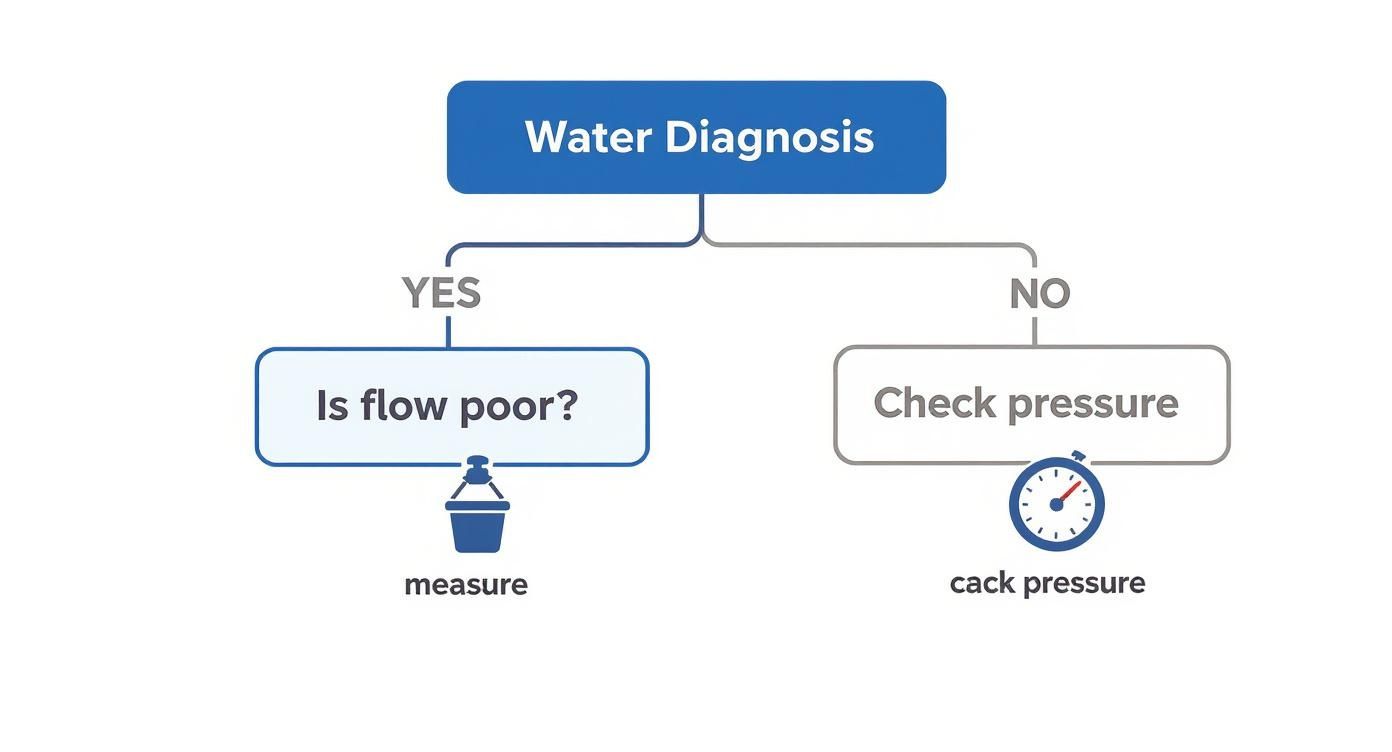
As you can see, getting that initial diagnosis right is absolutely crucial before you commit to a solution like a mains booster.
Upgrading Your Combi Boiler
What if your mains pressure is perfectly fine, but the shower is still pathetically weak? This almost always points to one culprit: your combi boiler's hot water flow rate. An older or undersized boiler might only manage to heat 9-10 litres per minute. Frankly, that’s just not enough for a proper, invigorating shower.
In this situation, the best long-term investment is often to upgrade to a modern combi boiler with a much beefier Domestic Hot Water (DHW) flow rate. A new boiler that can kick out 15 litres per minute or more will completely transform your shower from a trickle to a torrent. It's a move we often recommend for growing families in places like Polegate, where the demand from multiple bathrooms makes a powerful boiler a necessity.
For a large family home with very high hot water demand—maybe you've got a couple of teenagers who love long showers—it might even be time to look at an alternative system. An unvented cylinder, for example, stores a large volume of hot water under pressure, ready to go. It delivers ultimate performance but is a much bigger installation project.
Comparing Your Combi Shower Upgrade Options
Choosing the right path involves weighing up the cost against the performance boost you'll get. To make it clearer, here’s a quick comparison of the main options we’ve discussed.
Solution | Typical Cost (Eastbourne) | Installation Complexity | Performance Boost | Ideal Scenario |
|---|---|---|---|---|
High-Performance Shower Head | £30 - £100 | DIY / Very Low | Minor to Moderate | A quick, low-cost experiment for borderline cases. |
Mains Booster Pump | £400 - £800 | Moderate (Pro install) | Significant (Whole house) | Confirmed low incoming mains water pressure. |
New High-Flow Combi Boiler | £2,000 - £4,500+ | High (Pro install) | Major (Transformative) | Good mains pressure but boiler can't keep up. |
Unvented Cylinder System | £3,000 - £6,000+ | Very High (Pro install) | Ultimate Performance | Large homes with multiple bathrooms and very high demand. |
This table should give you a good sense of where each solution fits. A new shower head is a low-risk punt, while a mains booster is a targeted fix. A new boiler is a serious upgrade, but it solves flow rate problems for good and boosts your home’s efficiency at the same time.
Each route has its place, and understanding the trade-offs is key. For more detailed advice, have a look at our guide on choosing the best shower for a combi boiler, which gets into the nitty-gritty of matching shower types to your system. Getting this right is the final step to ensuring you get that fantastic shower you’ve been dreaming of.
Understanding Costs, Safety, and Regulations
Making any changes to your plumbing isn't just about fitting new parts and pipes; it’s about making sure your home is safe and compliant with UK law. This is absolutely critical when the job involves a power shower from combi boiler setup, because you’re dealing with both the gas and water systems.
At Harrlie Plumbing and Heating, we always stress that some jobs are strictly for the professionals. Sure, changing a shower head is a quick DIY win, but anything that touches your boiler or the mains water supply is a completely different ball game.
Realistic Costs in Eastbourne
Knowing what to budget is a vital first step, and costs here in Eastbourne can vary depending on the route you take. Here’s a rough idea of what to expect for the solutions we've covered:
High-Performance Shower Head: A simple swap like this will set you back anywhere from £30 to £100. It's a quick, affordable fix that can make a noticeable difference.
Mains Booster Pump Installation: To have a professional supply and fit a quality pump, you should budget between £400 and £800. This is a great solution that boosts pressure for your entire home, not just the shower.
New High-Flow Combi Boiler: This is the most significant investment, with costs typically starting from £2,000 upwards. While it’s a bigger outlay, it permanently solves low flow rate issues and often improves your home’s overall energy efficiency.
The European combi boiler market was valued at a massive USD 29 billion in 2024, which just shows how essential these units are to modern homes. The UK makes up a huge part of that, and it's still growing as more homeowners invest in efficient heating. You can find more detail on the European combi boiler market trends over on Market Data Forecast.
The Non-Negotiable Need for a Gas Safe Engineer
Let's be crystal clear: any work that involves your combi boiler, including altering its pipework for better flow, legally must be carried out by a Gas Safe registered engineer. This isn't just a friendly recommendation; it's the law. It’s there to prevent catastrophic issues like gas leaks, carbon monoxide poisoning, and even explosions.
Whenever one of our engineers from Harrlie Plumbing and Heating visits a home in Eastbourne, the very first thing they’ll do is show you their Gas Safe ID card. It’s your peace of mind, your guarantee of their qualifications, and your family’s safety.
At Harrlie Plumbing and Heating, our commitment to these standards is absolute. We always say, 'Never attempt to install a pump or modify boiler pipework yourself. Always use a certified professional.' This ensures the job is done right and your home is kept safe.
On top of that, all plumbing fittings connected to the mains water supply must be WRAS (Water Regulations Advisory Scheme) approved. This vital regulation stops contaminants from getting back into the public drinking water, protecting both your household and the wider community. Every single component we install, from the smallest pipe to a new pump, meets this critical standard.
Why a Professional Survey is Your Best First Step
So, you've seen the options for coaxing a proper, powerful shower out of your combi boiler. But how do you pick the right one for your home without crossing your fingers and hoping for the best? The single most valuable thing you can do is get a professional survey. Honestly, it saves so much time, money, and guesswork down the line.
Think of it as getting a proper diagnosis before you start the treatment. It’s the difference between a shot in the dark and a smart, informed investment. An experienced engineer will spot underlying issues that a quick DIY check would almost certainly miss.
What an Expert Assessment Really Involves
When one of our Harrlie Plumbing and Heating engineers pops round to your home in Eastbourne, Pevensey Bay, or the surrounding villages, we do a lot more than just have a quick glance. Our process is methodical, designed to find the perfect, long-term fix for your low-flow frustrations.
Here’s what our on-site assessment covers:
Precise Water Tests: We don’t guess. We use calibrated gauges to measure your exact incoming static water pressure and then run a flow rate test to see precisely how many litres per minute your system is kicking out at the tap.
System Health Check: We’ll give your existing combi boiler a thorough once-over, checking its age, general condition, and, crucially, its manufacturer-stated hot water flow rate.
Pipework Evaluation: Our team will assess the diameter and condition of your pipework. We’re looking for any restrictions or potential bottlenecks that might be throttling your shower’s performance before the water even gets there.
This detailed, on-site assessment is what allows us to recommend a solution that's not just effective today, but is also a sensible, cost-efficient investment for your home's future. It’s the difference between guessing and knowing.
Most importantly, we have a proper chat. We’ll talk about your family’s daily hot water habits, what annoys you most about the current setup, and what your budget looks like. After all, a family in a lovely old Victorian flat in Meads with thick walls and ancient pipes has completely different needs to someone in a newer build over in Willingdon.
This comprehensive approach means we can confidently recommend the ideal power shower from combi boiler solution that is genuinely tailored to your property and your lifestyle.
Frequently Asked Questions
Here are some quick answers to the questions we hear most often from homeowners across Eastbourne about getting a better shower from their combi boiler.
Can I Fit a Standard Power Shower to My Combi Boiler?
No, and this is the most critical point to understand. A traditional power shower has its own built-in pump. If you try to connect one to a pressurised combi boiler, it’s like trying to force water back upstream—it will push pressurised water into the boiler, causing serious and very expensive damage.
It’s a common mix-up we come across in homes from Langney to Meads, but the answer is always a firm no. The right way forward is to boost your system's performance, either by improving the mains supply or making sure your boiler can actually heat water fast enough for the shower you want.
My Water Pressure is Good, So Why is My Shower Still Weak?
This is a classic head-scratcher. You've done the bucket test, and the mains pressure seems fine, but the shower is still just a trickle. The bottleneck is almost certainly your combi boiler's hot water flow rate.
An older or smaller boiler might only be able to heat 10 or 11 litres of water per minute. If your fancy new shower head is designed to chuck out more than that, the flow will feel weak because the boiler simply can’t keep up.
An experienced engineer from Harrlie Plumbing and Heating can spot this issue straight away during a home survey. If needed, we can recommend a new combi boiler with a higher Domestic Hot Water (DHW) output—often the best long-term fix.
For many older homes in Eastbourne, the boiler itself is the limiting factor. Upgrading to a modern combi that can deliver 15+ litres per minute is often the single most effective way to get that powerful, hotel-style shower you're after.
How Much Does a Better Combi Boiler Shower Cost in Eastbourne?
The cost really depends on which route you take, so it’s vital to get a proper quote tailored to your home. As a rough guide, here’s what you might expect for local pricing:
A high-flow shower head: This is the cheapest and easiest starting point, usually costing between £30 and £80.
Installing a mains booster pump: For a professional supply and fit, you’re typically looking at a range of £400 to £700.
A new, high-performance combi boiler: This is the biggest investment, with new installations often starting from £2,000 upwards.
We always provide a detailed, fixed-price quote after a proper home survey, so you know exactly what to expect with no nasty surprises.
Will Installing a Mains Booster Pump be Noisy?
Not at all. Modern mains booster pumps, especially models from top brands like Salamander, are incredibly quiet. In fact, many have received the 'Quiet Mark' award for their low-noise operation.
When we install one, we make sure it's mounted securely on anti-vibration fittings. This completely eliminates any humming or rattling, so you’ll barely even notice it’s there.
Ready to finally transform that weak dribble into a powerful, refreshing shower? Contact Harrlie Plumbing and Heating today for a no-obligation survey and let's find the perfect solution for your Eastbourne home. Book your appointment now at https://www.harrlieplumbing.co.uk.

Comments