How to Clean Radiator Sludge and Restore Your Heating
- Luke Yeates
- Jan 13
- 13 min read

That black, gritty water you might find when you bleed a radiator isn't just a bit of dirt—it's what we in the trade call radiator sludge. Think of it as a thick, muddy mixture of rust and debris that's slowly but surely clogging up your central heating system. It's the hidden culprit behind those frustrating cold spots, strange boiler noises, and unexpectedly high energy bills. Getting to grips with how to clean it out is one of the best things you can do for an efficient home.
What is Radiator Sludge and Why Should I Care?
If you've ever cranked up the thermostat on a chilly Eastbourne evening, only to find a radiator that's warm at the top but stone-cold at the bottom, you've already seen the effects of sludge. This is the textbook sign that this gunk has settled and is stopping hot water from circulating properly. For homeowners around here, especially in areas with older properties like Meads or Old Town, it’s a problem we at Harrlie Plumbing and Heating see time and time again.
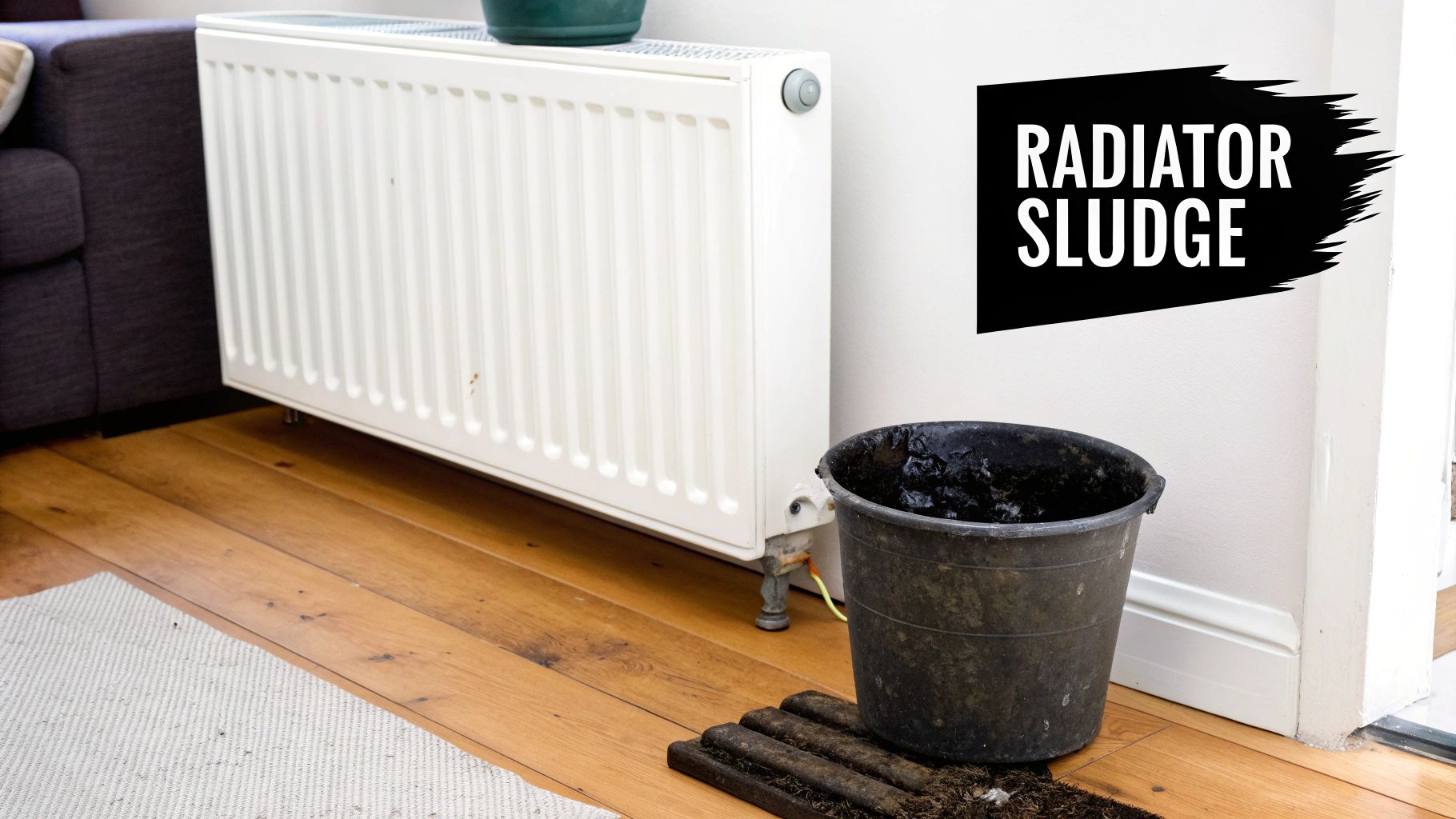
So where does it come from? It’s simply a natural process. Over time, the water inside your heating system reacts with the metal parts—your steel radiators, copper pipes, and so on. This slow-burn corrosion creates tiny particles of rust and other bits of debris that eventually clump together and settle right where you don't want them: the bottom of your radiators and deep inside your pipework.
The Real Cost of Ignoring Sludge
Left to its own devices, sludge does more than just make your rooms feel cold. It puts an enormous amount of strain on your boiler and pump. Your system has to work so much harder to force water through what are essentially clogged arteries. At Harrlie Plumbing and Heating, we're often called out to jobs across Eastbourne and Bexhill where this has led to some serious, and preventable, problems.
Here’s what we typically see:
Cold Spots on Radiators: This is the big one. The bottom half of the radiator stays cold because the sludge is so dense it physically blocks the hot water from getting through.
Sky-High Heating Bills: Your boiler is burning through more gas just to try and get your rooms up to temperature, which means you're paying more for less heat.
A Noisy, Unhappy System: Have you heard banging, gurgling, or a 'kettling' sound from your boiler? That's often the sound of it struggling against the blockages.
Serious Wear and Tear: All that extra strain can drastically shorten the lifespan of crucial components, including the boiler itself, leading to premature failure.
Getting a handle on sludge is a huge part of improving your home's efficiency and is central to most HVAC energy saving tips. In fact, official research has shown that sludge can slash a system's performance by up to 15%. That's a massive drop, especially during an Eastbourne winter where January temperatures average a brisk 5°C.
How to Diagnose Sludge in Your Radiators
Before you start reaching for spanners or draining your system, it’s vital to confirm that sludge is the real culprit behind your heating woes. Jumping to conclusions can lead to a lot of wasted time and effort on a fix that doesn’t solve the problem.
Luckily, you don’t need to be a heating engineer to get a good idea of what’s going on. A few simple checks will tell you almost everything you need to know.
The first and easiest method is the simple touch test. With your heating on, carefully run your hand over the entire surface of a radiator you think is underperforming. Do you feel distinct cold patches, especially along the bottom half, while the top is nice and warm?
That’s the classic signature of sludge. The heavy, metallic gunk has settled at the bottom and is physically blocking the hot water from getting through.
Listening and Looking for Clues
Beyond just feeling for cold spots, your own eyes and ears are fantastic diagnostic tools. A healthy heating system should tick along fairly quietly, but one struggling with sludge will often make its presence known.
Listen closely to your boiler and pipework. Is your boiler making a persistent kettling sound (a bit like a kettle boiling), or can you hear loud gurgling noises coming from the pipes? These are common red flags. It often means the water flow is restricted, forcing the pump and boiler to work much harder to push water through the clogged system. We at Harrlie Plumbing and Heating have heard this countless times in homes across Eastbourne, from modern builds in Sovereign Harbour to older terraced houses in Roselands.
Another definitive check is to bleed a radiator. Pop an old towel down and use a radiator key to slowly release some water into a container. If the water that trickles out is dark, murky, or looks gritty and black, you've just confirmed the presence of sludge. Clean, clear water suggests the problem is more likely trapped air.
Expert Tip: Don't just check one radiator. If you bleed a radiator in the living room and find sludge, it's a good idea to check one upstairs too. Widespread murky water suggests a system-wide problem that a single radiator flush won't solve.
Radiator Problem Diagnostic Checklist
To help you figure out what’s going on, here’s a quick checklist. It’s designed to help you confidently tell the difference between the most common radiator problems—sludge, trapped air, or a valve issue—before you decide what to do next.
Symptom | Likely Cause Is Trapped Air | Likely Cause Is Sludge Buildup | Likely Cause Is A Valve Issue |
|---|---|---|---|
Radiator is cold at the top | ✔️ High Probability | ❌ Unlikely | ❌ Unlikely |
Radiator is cold at the bottom | ❌ Unlikely | ✔️ High Probability | ❌ Unlikely |
Entire radiator is cold | ❌ Unlikely | ❌ Unlikely | ✔️ High Probability |
Bleed water is black/murky | ❌ Unlikely | ✔️ High Probability | ❌ Unlikely |
Boiler is making loud noises | ❌ Unlikely | ✔️ High Probability | ❌ Unlikely |
Hopefully, this table points you in the right direction. A cold top usually means air, a cold bottom points to sludge, and an entirely cold radiator often signals a problem with the valve, assuming other radiators are working fine.
Flushing a Single Radiator: A DIY Approach
So, you've done the diagnostic checks and pinpointed the sludge problem to just one or two radiators. Good news! A targeted DIY flush can be a brilliant, cost-effective fix. This approach saves you from the hassle of draining the entire system and gets that rogue radiator back in action. It's a perfectly manageable weekend job, and as your local Eastbourne experts, Harrlie Plumbing and Heating can walk you through it.
Before you even think about touching a valve, preparation is everything. This process involves wrestling with a radiator full of mucky water, so protecting your flooring is non-negotiable. Get some old towels, dust sheets, or even plastic sheeting down around your workspace. You’ll also want at least two buckets—one to catch the water and another for good measure.
Gathering Your Tools and Isolating the Radiator
With your area protected, it's time to gather your gear. You don't need a professional's toolkit, but having the right items on hand will make the job much smoother.
Adjustable spanners: You'll need two of these to get a good grip on the radiator valve nuts.
Radiator bleed key: Absolutely essential for releasing trapped air when you refill.
Old towels and buckets: As I said, you really can't have too many of these.
Hosepipe with a jubilee clip or strong tape: This is for the main event—the flushing itself.
Once you have your tools, you need to isolate the problematic radiator from the rest of your central heating system. This means closing both valves at either end. One is the Thermostatic Radiator Valve (TRV), which you can just turn clockwise until it stops at the 'off' or '0' setting. The other is the lockshield valve, which usually hides under a plastic cap. Pop the cap off and use a spanner to turn the valve spindle fully clockwise. Make sure to count the number of turns—you'll need this to open it back to the exact same position later.
The infographic below recaps the initial diagnostic steps you should have already taken to confirm sludge is the culprit.
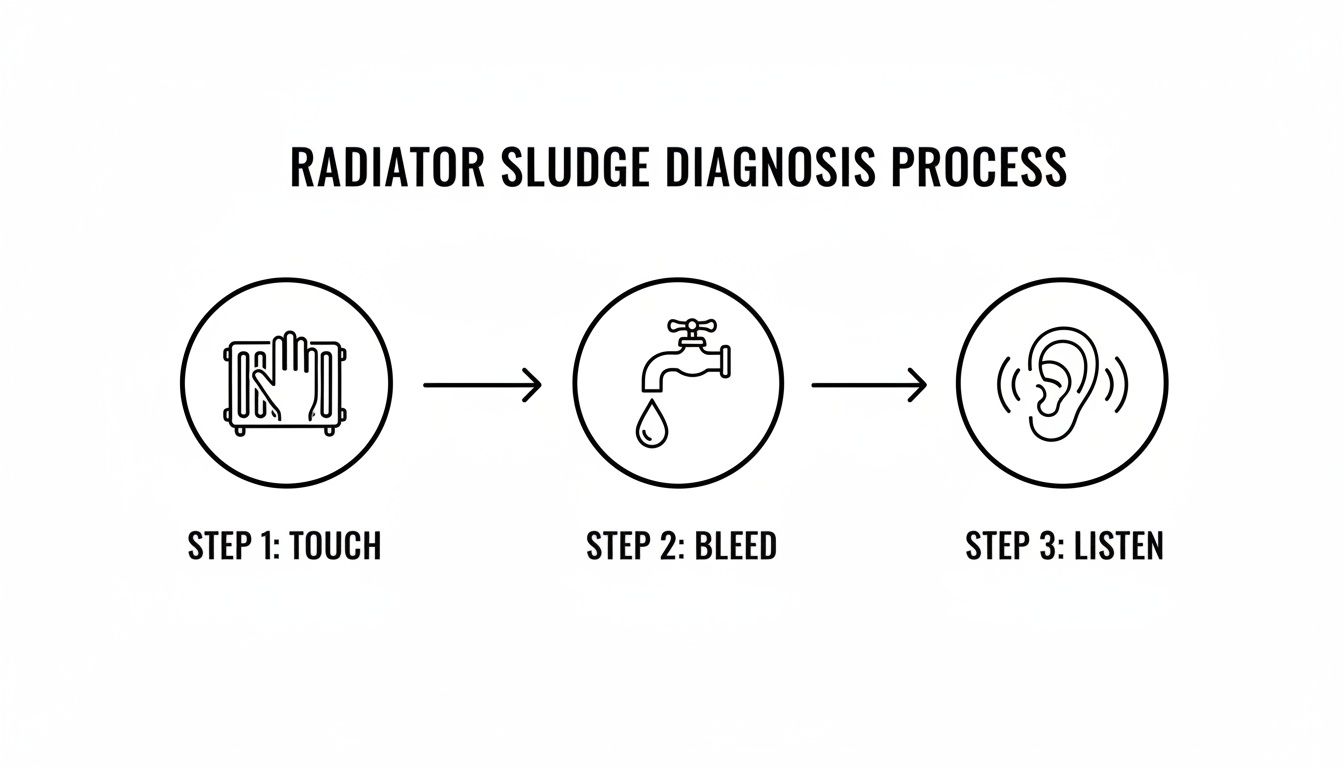
This simple touch, bleed, and listen process is a quick way to figure out if you're dealing with sludge, trapped air, or another issue entirely.
The Flushing Process, Step-by-Step
With the valves shut tight, place a bucket under the TRV. Now, using your two spanners for grip and leverage, carefully loosen the large nut (often called the union nut) that connects the valve to the radiator. Water will start to trickle out.
To speed things up, open the bleed valve at the top with your radiator key. This lets air in and helps the water drain faster. Once the flow stops, tighten the union nut and repeat the process on the lockshield valve side.
Now for the heavy lifting. We at Harrlie Plumbing and Heating often hear from homeowners in Eastbourne who've tried this alone—trust me, it’s always easier with a friend. Carefully lift the radiator off its wall brackets, tilting it to drain any last bits of water into your bucket, and carry it outside.
Harrlie's Pro Tip: Be careful where you empty that radiator. The black water inside can easily stain patios and paths. We recommend flushing it directly onto a lawn or gravel area where it can soak away without leaving a mess.
Connect your hosepipe securely to one of the valve inlets and turn the water on full blast. You’ll see a torrent of black, sludgy water pour out of the other end. Keep this going until the water runs completely clear.
If you have some really stubborn blockages, try tapping the radiator gently with a rubber mallet to dislodge any compacted sludge. It’s also a good time to brush up on how to bleed a radiator, as this is a vital skill for getting the system refilled properly afterwards.
Reconnecting is just the reverse of removal. Make sure all the nuts are tight before you slowly reopen the valves to let the radiator refill, and don't forget to bleed out any trapped air.
DIY Chemical Cleaners vs Professional Power Flushing
So, you've realised the sludge isn't just a one-radiator problem but is probably lurking throughout your entire heating system. At this stage, a simple radiator bleed and flush just won't cut it. You’re now looking at two main strategies: trying an off-the-shelf chemical cleaner yourself, or calling in the professionals for a full power flush.
The right choice really boils down to how bad the problem is, what your budget looks like, and how permanent you want the solution to be.
The DIY Chemical Cleaner Route
A DIY chemical cleaner is a liquid you pour directly into your heating system, usually through a radiator filling loop or by taking a radiator off the wall. The idea is simple: as your heating runs, the chemical mixes with the water, circulating through the pipes and radiators to slowly dissolve light sludge and scale over a few weeks.
This approach definitely has its perks:
Low Cost: A bottle of a decent cleaner is relatively inexpensive, certainly cheaper than a call-out.
Minimal Disruption: You can add it to your system without needing to drain everything down or book an engineer.
Good for Light Contamination: It can be quite effective if you're only dealing with the very early stages of sludge build-up.
However, it's crucial to understand the limitations. For the kind of stubborn, compacted sludge we often find in older Eastbourne properties with original pipework, these cleaners are frankly not powerful enough. They might loosen some of the surface grime, but they’ll barely touch the heavy, hardened deposits that cause major blockages and those frustrating cold spots on your radiators.
Professional Power Flushing: The Definitive Solution
On the other hand, a professional power flush is a much more robust and immediate fix for radiator sludge. At Harrlie Plumbing and Heating, we use a high-velocity pumping machine that we connect directly to your heating circuit. This machine blasts water and powerful, professional-grade cleaning chemicals through your entire system at a far higher flow rate than your boiler's own pump could ever manage.
This process is designed to forcefully dislodge even the most stubborn, hardened sludge from every single radiator, pipe, and even the tiny waterways inside your boiler's heat exchanger. All that dirty, sludge-filled water is then flushed out of the system, leaving it completely clean inside.
Think of it like this: a chemical cleaner is like taking a daily supplement for your arteries, whereas a power flush is the major procedure that removes years of build-up in one go, restoring flow and vitality to the entire system.
While the upfront cost is higher, the results are immediate and dramatic. UK homeowners often find that radiator sludge is a silent efficiency killer. A professional clean can cost between £350-£700 for an average three-bedroom house, but it blasts away moderate to severe blockages in just 6-10 hours.
After a power flush, homeowners can see fuel savings of up to 15%. On a typical £1,200 annual heating bill, that’s £180 right back in your pocket each year. You can dig into more data on the cost-effectiveness of radiator sludge removal on Powderflush.co.uk.
Ultimately, a power flush is a long-term fix that saves you money on energy bills and helps prevent future damage. If your boiler is already groaning under the strain, this deep clean can prevent a complete breakdown and save you from a much bigger bill. Of course, if the sludge has already caused a component to fail, you can learn more about our professional boiler repairs in Eastbourne to get your system back in fighting fit condition.
Knowing When to Call a Heating Engineer
While tackling a single sludged-up radiator can be a satisfying DIY win, it’s vital to recognise when the problem is bigger than one component. If your DIY flush hasn't solved the issue, or if the symptoms are system-wide, it's time to put down the spanners and call in a professional. Ignoring widespread sludge is a fast track to boiler failure and emergency call-outs, especially during a cold Eastbourne winter.
There are a few red flags that tell you the sludge has moved beyond a simple blockage and is now compromising your entire heating network. Don't brush these off, as they point to a deeper problem that a localised flush just can't fix.
You should be concerned if:
Multiple radiators are cold. If cold spots aren't just in one room but are popping up across your home, sludge is almost certainly circulating throughout the pipework.
The whole house takes ages to warm up. This is a classic sign that your boiler is struggling to push water through a restricted system, which absolutely hammers its efficiency.
Your boiler is making a racket. Loud banging or 'kettling' sounds mean the water inside the boiler's heat exchanger is boiling because of poor circulation—a serious symptom of sludge buildup.
The Power Flush: A Definitive Solution
When these issues arise, the most effective and lasting solution is a professional power flush. For homeowners, landlords, and businesses in Eastbourne, Hastings, and Bexhill, this is the gold standard for cleaning out radiator sludge for good. At Harrlie Plumbing and Heating, our Gas Safe registered engineers use specialised equipment to pump water and cleaning agents through your system at high velocity, dislodging and flushing out years of compacted debris.
This process cleans everything—the pipes, every single radiator, and the small, critical waterways within the boiler itself. It’s a comprehensive system overhaul that brings your heating's performance and efficiency right back to where it should be.
A pivotal study from AERCO really put a number on sludge's impact, showing that just under 8kg of sludge spread across five radiators caused a 15% drop in heat transfer. For our clients in Hastings and Bexhill, this translates directly to uneven heating and higher energy bills. A professional power flush not only fixes this but can extend your boiler's life by 5-10 years.
This is particularly important for landlords who need annual Gas Safe certificates. A clean, efficient system is far more likely to pass inspections and help you avoid costly, unexpected repairs. You can get more details on the costs and benefits of a power flush over at AbsolutePlumbingLtd.co.uk.
Why Professional Expertise Matters
Trying to do a full system drain-down without the right experience can quickly lead to airlocks, leaks, or even damage to your boiler. It’s not worth the risk. Our team at Harrlie Plumbing and Heating has the expertise to perform the job safely and correctly, giving you complete peace of mind.
If sludge has already caused boiler issues, we can diagnose and fix them properly. You can explore our expert services for boiler repair and servicing in Hastings to ensure your system runs smoothly for the long haul.
How to Prevent Sludge From Coming Back
Once you've gone to the trouble of flushing out all that nasty radiator sludge, the very last thing you want is for it to creep back in.
Thankfully, preventing it is a whole lot easier than removing it. A few smart, proactive measures will keep your central heating running like a dream for years to come, making sure you don't face the same cold spots and high bills all over again.
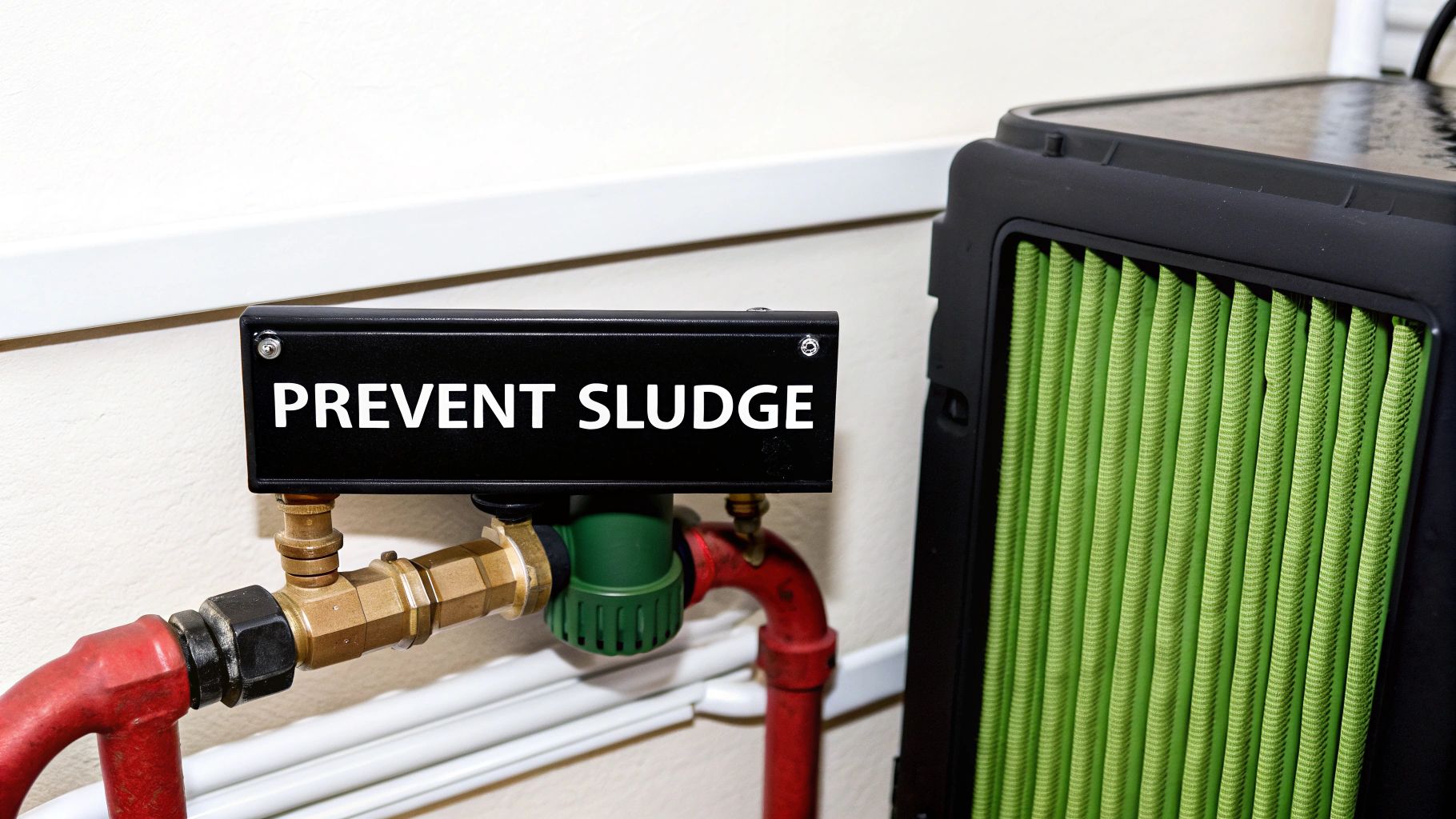
The single most effective weapon in the fight against sludge is a magnetic system filter. We at Harrlie Plumbing and Heating fit these for customers all the time, from modern apartments down at the Sovereign Harbour to older Victorian homes in the Meads area of Eastbourne. This clever bit of kit is fitted onto your pipework—usually near the boiler—where it works quietly around the clock.
As water circulates through your system, the filter’s powerful magnet grabs any metallic debris. These are the very same particles that clump together to form sludge. It's a simple, fit-and-forget solution that stops sludge from ever getting a foothold.
The Role of Chemical Inhibitors
Another absolutely essential step is adding a chemical inhibitor to your system's water right after a flush. Think of it as a liquid bodyguard for the inside of your heating system.
This stuff works by coating the metal surfaces of your pipes and radiators, which stops the corrosive chemical reaction between water and metal from happening in the first place. That reaction is the root cause of all sludge.
Without an inhibitor, it's not a question of if sludge will return, but when. The hard water we get here in the Eastbourne area can actually speed this corrosion up, making an inhibitor even more critical for long-term protection.
Harrlie's Pro Tip: Inhibitor isn't a one-and-done job. The levels deplete over time and need to be checked—and likely topped up—every year to stay effective. Skipping this simple check can completely undo all the good work of a power flush.
Annual Servicing: Your Best Defence
Finally, never, ever underestimate the value of a proper, professional boiler service each year. This isn't just about ticking a box for your warranty; it's a complete health check for your entire central heating system. During a service, a certified engineer from Harrlie Plumbing and Heating will carry out several key preventative checks.
We can professionally test the inhibitor concentration in your system to make sure it’s still doing its job. We’ll also clean out your magnetic filter, and you’ll be amazed at how much gunk it has captured over the year. Catching these things early protects your investment and guarantees you have a warm, reliable home when you need it most.
For more heating maintenance advice, feel free to explore our Eastbourne plumber blog.
Is your heating system overdue for a health check? Don’t wait for sludge to cause a breakdown. Contact Harrlie Plumbing and Heating for a professional power flush or an annual service to keep your home warm and efficient. Visit our website to get your free quote today!

Comments