Emergency Heating Engineer Near Me in Eastbourne
- Luke Yeates
- Nov 24, 2025
- 13 min read

It’s a feeling every Eastbourne homeowner dreads: that sudden, unnerving silence when the heating cuts out on a bitter night. Before you even think about searching for an "emergency heating engineer near me," taking a few immediate actions can secure your home, prevent further damage, and sometimes even fix the issue without needing a call-out at all.
Knowing what to do in those first crucial moments puts you back in control.
Your First Steps When the Heating Fails
Panic is a natural reaction when your home suddenly goes cold, but a calm assessment can often get to the root of the problem. Your absolute first priority is always safety, followed by a few simple checks that could save you a world of time and money. This isn't about attempting complicated repairs yourself—that’s a job for the pros and can be dangerous—but about getting a clear picture of what’s gone wrong.
For example, one of the most common issues we see at Harrlie Plumbing and Heating is a boiler that has simply lost pressure. It can happen for a number of reasons and usually throws up a specific error code on the boiler's display. We've seen this happen in family homes from Old Town to Willingdon. We’ve actually put together a resource on this, and you can learn more about what causes a boiler to lose pressure in our quick homeowner guide.
Initial Safety and System Checks
Before you touch a single thing, trust your senses—specifically, your sense of smell. Do you smell gas? That faint, rotten-egg odour is a serious red flag and needs immediate action.
If you smell gas: Don't touch any light switches, unplug appliances, or even use your phone inside the house. Get windows and doors open to air the place out, and if you know how, turn off the gas at the meter. Evacuate everyone from the property straight away. Once you're a safe distance away, call the National Gas Emergency Service on 0800 111 999. In a situation like this, an emergency gas line repair safety guide is an invaluable resource for understanding the necessary precautions.
If there's no gas smell: The next thing to look for is water. A leak from a radiator, a pipe, or the boiler itself can cause massive damage to your floors, ceilings, and belongings. For instance, a small radiator leak in a Meads property can quickly become a serious issue. If you spot a leak, grab some old towels and a bucket to contain the drip and, if you can, shut off the water supply to the system.
Simple Troubleshooting You Can Do
Right, so there are no immediate signs of danger like gas or water leaks. Phew. Now, you can do a few simple checks. Let's say you're in your Old Town, Eastbourne home on a chilly evening, and the radiators have gone cold. Before picking up the phone to call us at Harrlie Plumbing and Heating, just check these three things:
The Thermostat: It sounds almost too simple, but is it actually switched on and set correctly? A surprising number of modern thermostats are battery-powered, and a dead battery is a very common culprit.
The Fuse Box: Has a switch tripped? Find your consumer unit (or fuse box) and see if the switch for the "Boiler" or "Heating" has flipped into the 'off' position.
The Boiler Display: Take a look at the boiler itself. Are there any lights on? Is it showing an error code? Making a note of this is incredibly helpful information to pass on to an engineer.
This simple decision tree can help you visualise those first crucial steps.
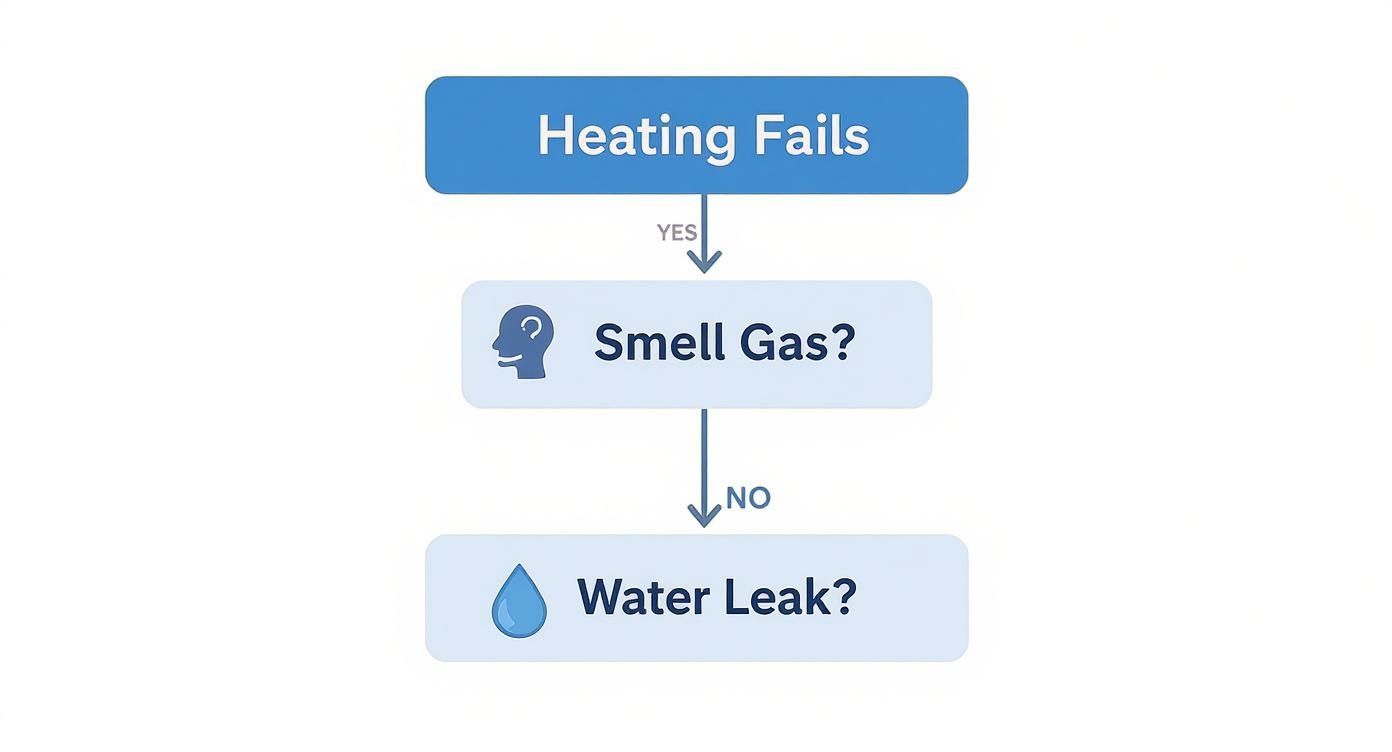
As the flowchart shows, checking for a gas smell or a water leak are the two most critical first actions. These will tell you whether to call for emergency help immediately or move on to simpler checks you can do yourself.
Finding a Trusted Local Engineer Fast
When your heating gives up the ghost, the pressure to find an "emergency heating engineer near me" can feel immense. You need someone reliable, qualified, and local—and you need them now. The good news is that with a clear head, you can quickly separate the true professionals from the rest.
Your first port of call will likely be an online search. Look for local companies in Eastbourne with a professional website and clear contact details. A credible company will always have their Gas Safe registration number front and centre. You absolutely must verify this number on the official Gas Safe Register website; it’s a non-negotiable step that confirms they are legally qualified to touch your gas boiler.
Vetting Potential Engineers in Eastbourne
Once you’ve found a couple of potential candidates, it’s time for a quick check. Don’t just rely on the testimonials on their own website; look for independent reviews on platforms like Google. What are other Eastbourne residents saying about their response times and workmanship?
At Harrlie Plumbing and Heating, we know that trust is built on transparency. That’s why we encourage feedback and make sure our contact information and qualifications are easy to find. When you call us, you’re speaking directly to a local expert who knows the area, from the seaside flats to the family homes in Willingdon.
A rapid response is the cornerstone of emergency service. When your home is cold, every minute counts. The goal should be to have a qualified engineer on their way as quickly as possible, providing you with a clear estimated time of arrival to manage your expectations and reduce stress.
Key Questions to Ask Before You Commit
Before you agree to a call-out, have a short list of questions ready. This quick conversation will tell you a lot about the company’s professionalism and help you avoid any nasty surprises later on.
Here’s what we at Harrlie Plumbing and Heating always recommend asking:
What is your call-out fee? Understanding the initial cost is crucial. It’s also smart to ask how their pricing is structured for any follow-up work that might be needed.
What is your estimated arrival time? A genuinely local Eastbourne engineer should be able to give you a reasonably accurate timeframe.
Are you experienced with my boiler model? Mention the make (e.g., Worcester Bosch, Vaillant) to ensure they have the right expertise.
Finding a good engineer quickly involves more than just a search; it requires a few minutes of careful vetting. For more detailed advice, check out our guide on the essential tips for finding the right plumber or heating engineer in Eastbourne.
Remember, demand for qualified engineers soars during cold snaps. Research shows that November and December are the busiest months, with the average emergency call-out fee in the UK sitting around £117.55. Given that not all engineers offer emergency services, finding a responsive one is key.
What a Professional Call-Out Looks Like
When your heating fails, calling an "emergency heating engineer near me" can feel like a shot in the dark. You’re stressed, cold, and just want it fixed. But knowing what a professional visit should look like can bring a lot of peace of mind. It’s not just about a quick fix; it’s about a clear, reassuring process from the moment we step through your door.
When a Harrlie Plumbing and Heating engineer arrives at your home in Eastbourne, our first job is to introduce ourselves properly. We'll be in uniform and always carry ID, so you know exactly who you’re letting into your home. A quick safety check of the area is always our first priority.
Diagnosis Without the Jargon
Once we’re inside, we want to hear from you. You know your home best, so tell us what’s been happening—any strange noises, leaks, or error codes flashing on the boiler's display. This conversation is genuinely one of the most important parts of the visit, giving us vital clues before we even touch the system.
Let’s imagine a real-world scenario: your boiler keeps losing pressure in a modern apartment down at Sovereign Harbour. Instead of immediately dismantling things, a methodical approach is crucial. We’d start with a visual inspection of the boiler and any pipework we can see, hunting for obvious signs of a leak.
From there, we move into a series of diagnostic tests:
Pressure Checks: We use a calibrated pressure gauge to get an accurate reading of the system's status.
System Analysis: We’ll check key components like the pressure relief valve and the expansion vessel, and inspect radiators for any hidden leaks.
Boiler Diagnostics: We can access the boiler’s internal computer to check for stored fault codes, which often point us directly to the problem.
Throughout this process, our Harrlie Plumbing and Heating engineers make a point of explaining what we’re doing in plain English. We’ll show you exactly what we find, whether it’s a faulty valve or the source of a tiny weep, making sure you understand the issue completely. This level of detail and safety is the same structured approach we take for official inspections. You can get a feel for our thoroughness in our guide on how long a gas safety check takes.
Clear Quoting and Upfront Communication
After we’ve pinpointed the fault, the next step is to give you a clear, upfront quote for the repair. A true professional will never begin work without your full agreement.
The quote should break everything down for you: the cost of any parts needed and the labour involved. There should be absolutely no hidden fees or vague estimates. This transparency is key—it allows you to make an informed decision without feeling rushed or pressured.
Going back to our Sovereign Harbour example, let's say we found a pinhole leak in a radiator. We would explain your options clearly. We'd discuss the cost to repair it versus replacing the radiator entirely, even checking on parts availability with local suppliers in Eastbourne to give you a realistic timeframe. Only after you've agreed on a solution and a fixed price do we pick up our tools.
The entire process, from arrival to diagnosis and quoting, is built on respect, safety, and transparency. It takes the mystery out of the call-out and sets the standard for the professional service you should always expect.
Emergency Call Checklist
To help your engineer get to the root of the problem even faster, it’s a great idea to have some key information ready before you call. Jotting down these details can make a huge difference.
Information to Note | Why It's Important | Example Note for Your Engineer |
|---|---|---|
Boiler Make & Model | Allows the engineer to check for common faults and bring potential spare parts. | "It's a Worcester Bosch Greenstar 30i." |
Error Codes | These codes are the boiler's way of telling us exactly what it thinks is wrong. | "The display is flashing an F.22 error code." |
Symptoms You've Noticed | Strange noises, leaks, or smells provide critical clues for diagnosis. | "There's a constant dripping sound, and we found a small puddle under a radiator in the lounge." |
When the Problem Started | Helps determine if it's a sudden failure or a gradually worsening issue. | "The heating was working fine this morning but cut out around lunchtime." |
Having these simple notes ready saves valuable time on site and helps us at Harrlie Plumbing and Heating prepare for the job before we even arrive at your door.
Navigating Emergency Repair Costs in East Sussex
The moment your heating gives up, that sinking feeling is often followed by a single, nagging question: "How much is this going to cost me?" It’s completely normal. The fear of an eye-watering, unpredictable bill is a huge source of stress for any homeowner facing a cold house.
Getting a handle on the factors that shape the final price for an emergency heating engineer can put you back in control.
Here in Eastbourne and across East Sussex, repair costs are generally broken down into a few key areas. It's well worth understanding these before you give anyone the go-ahead.
Understanding Call-Out Fees and Hourly Rates
Most emergency engineers will structure their pricing around either a fixed call-out fee or a simple hourly rate. A fixed call-out fee is quite common and typically covers the engineer's travel and the first hour of investigation work. This gives you a clear, upfront cost just to get an expert through your door.
An hourly rate, on the other hand, starts ticking the moment the engineer arrives and starts working. At Harrlie Plumbing and Heating, we believe in being completely upfront. We’ll always explain our pricing structure clearly when you call so there are absolutely no nasty surprises later on.
The time of your call makes a huge difference. An out-of-hours call—late at night, over the weekend, or on a bank holiday—will naturally cost more. It’s only fair, given the unsociable hours. Always ask to confirm if you're being charged a standard or a premium rate.
The Impact of Parts and Labour
Once the engineer has diagnosed the problem, the cost of any new parts and the time needed to fit them come into play. A straightforward fix, like repressurising your system, is going to be a lot cheaper than having to replace a major component like a seized pump or a broken fan.
The make and model of your boiler can also affect the price. Sourcing a specific part for a premium Worcester Bosch or Vaillant boiler, for instance, might cost a bit more than a more generic component.
Any professional quote should clearly separate these costs for you:
Labour: The time required for the actual hands-on repair.
Parts: The cost of any new components your system needs.
VAT: A final price with the tax included, so you know the total.
Let's say the heat exchanger has failed in your Langney home. A detailed quote from us at Harrlie Plumbing and Heating would show you the exact price for the new heat exchanger, the estimated labour time to install it, and the total cost including VAT. This honest approach means you know exactly what you’re paying for—a guaranteed, professional repair that gets the warmth back on, without any hidden fees.
Right, the engineer’s gone, the radiators are warming up, and you can finally feel your toes again. Once that wave of relief washes over you, the next thought is usually, “How do I stop that from ever happening again?”
Preventing your next heating nightmare is less about crossing your fingers and more about some simple, proactive care. A bit of forward-thinking now can save you from another frantic, late-night search for an "emergency heating engineer near me".
The single best thing you can do? Get an annual boiler service booked in the diary. Think of it as an MOT for your central heating. A qualified engineer isn't just there to tick a few boxes; they give the whole system a deep clean and run a series of diagnostic checks designed to spot tiny issues before they snowball into catastrophic failures.
Why Annual Servicing is a Non-Negotiable
Here at Harrlie Plumbing and Heating, we see countless emergency call-outs across Eastbourne that were completely avoidable. During a routine service, we spot the little things—a seal that’s starting to wear, a slow drop in pressure, or the first signs of corrosion on a vital component.
Fixing these minor gremlins during a planned visit is far cheaper and a world away from the stress of a full-blown breakdown in the middle of a winter cold snap.
An annual service isn't an expense; it's an investment in reliability. It ensures your boiler is running safely and efficiently, which not only prevents breakdowns but can also trim your energy bills. It’s the ultimate peace of mind.
Your Simple Homeowner Maintenance Checklist
On top of the professional service, there are a few quick checks you can do yourself every couple of months. They only take a few minutes but can make a surprising difference in keeping your system happy.
Check the Pressure Gauge: Your boiler has a pressure gauge on the front, usually with green and red zones. You want it sitting happily in the green, typically around 1-1.5 bar. If it’s dropped into the red, the system probably needs topping up with water.
Bleed Your Radiators: Are the tops of your radiators cold but the bottoms are warm? That’s trapped air. Bleeding them is a simple job that releases the air, letting hot water circulate properly and making your heating much more effective.
Keep Vents Clear: Take a quick look outside where your boiler’s flue or vent is. Make sure it isn't getting blocked up by overgrown plants, fallen leaves, or anything else that could obstruct it.
Lastly, just listen to your system. Has it started making strange clanking or gurgling sounds? Do you find that certain rooms, like the conservatory in your Polegate home, are taking an age to warm up? These are often the first whispers of a system that’s getting tired. Catching these early warning signs gives you the power to plan for a replacement on your own terms, not in a desperate rush when the heating gives up for good.
Your Questions on Heating Emergencies Answered

When the heating suddenly cuts out, your mind can start racing with questions. In a moment of stress like that, you need clear, straightforward answers you can rely on. We’ve pulled together some of the most common questions we hear from homeowners across Eastbourne to give you that clarity.
This section gets right to the point, answering those urgent queries and reinforcing some of the key advice we’ve already shared. It's all about helping you navigate a heating emergency with confidence.
How Quickly Can an Emergency Engineer Get to My Home in Eastbourne?
This is usually the first thing everyone wants to know. Response times can vary, especially during a widespread cold snap when everyone's boiler decides to give up at once, but a genuinely local company will always treat emergencies as a priority. Proximity is everything when you're searching for an "emergency heating engineer near me."
At Harrlie Plumbing and Heating, our engineers are based right here in and around Eastbourne. This local focus means we're not trekking from miles away and can usually aim to be with you within a few hours of your call. We'll always give you a clear estimated time of arrival, so you're not left in the dark, just waiting and wondering.
Is It Safe to Stay in My House if I Smell Gas?
Let me be crystal clear: the answer is an absolute no. That distinct smell of gas—often described like rotten eggs or sulphur—is a critical warning that demands immediate action. You cannot take any risks here.
Your immediate safety plan should look like this:
Open all windows and doors right away to get fresh air circulating.
Do not touch any electrical switches, unplug anything, or use your phone inside the house. A tiny spark is all it takes.
Put out any naked flames, like candles or pilot lights you can safely get to.
Get everyone out of the property immediately. Don't stop to grab anything.
From a safe distance—a neighbour’s house or further down the street—call the National Gas Emergency Service on 0800 111 999. They are the official service for gas emergencies and will tell you exactly what to do next.
Your safety, and that of your family, is the only thing that matters in this situation. A boiler can be fixed, but a gas leak is a serious, immediate threat. Always evacuate first and call for help second.
Can I Fix a Minor Boiler Issue Myself?
It’s tempting to have a go yourself, especially with so many tutorials online, but you have to know where to draw the line. The simple checks we mentioned earlier? Absolutely. Things like checking the thermostat is on, looking at the boiler's pressure gauge, and hitting the reset button are all fine.
However, you must never attempt to remove the boiler casing or fiddle with any of the internal parts. Not only is it incredibly dangerous, but it's also illegal for anyone who isn’t on the Gas Safe register. Messing about with gas appliances can lead to gas leaks, carbon monoxide poisoning, or worse. For anything beyond the most basic checks, you need to call a qualified engineer like one of our team at Harrlie Plumbing and Heating.
When a heating emergency hits, you need a local expert you can trust to get there fast and work safely. At Harrlie Plumbing and Heating, we deliver a rapid, reliable service across Eastbourne and the surrounding areas, 24/7. For a professional, guaranteed repair with honest pricing, get in touch with us today at https://www.harrlieplumbing.co.uk.

Comments