Combi boilers and power showers: Can they work together for stronger showers?

Let's settle the big question straight away: can you use a power shower with a combi boiler?
The short and simple answer is no. In fact, trying to pair them can cause serious, expensive damage to your heating system. It’s a common myth we at Harrlie Plumbing and Heating often find ourselves debunking for homeowners in Eastbourne, and understanding why they don’t mix is the first step to getting the powerful shower you actually want, safely.
Why Combi Boilers and Power Showers Are Incompatible
Think of it like this: the whole point of a power shower is to boost water pressure in an old, low-pressure system, like a traditional gravity-fed setup with a hot water tank in the airing cupboard and a cold one in the loft. It uses an internal pump to artificially increase the force of the water flowing to the showerhead. We still see these systems in some of the older Victorian properties around Eastbourne's town centre.
A combi boiler, on the other hand, is already a high-pressure system. It takes water directly from the cold mains supply, heats it instantly, and sends it to your taps and shower at mains pressure. Trying to connect a power shower to a combi is like using a megaphone to amplify someone who is already shouting—it’s not only unnecessary but creates a conflict that can wreck the boiler’s sensitive internal parts.
Understanding the Core Conflict
The fundamental issue is that you're forcing a pump (the power shower) to fight against an already pressurised system (the combi boiler). This mismatch can lead to a host of problems that our engineers at Harrlie Plumbing and Heating have seen firsthand across Eastbourne. For example, a client in the Roselands area recently called us after their boiler failed, only for us to discover an incorrectly fitted power shower had caused irreversible damage.
Potential Boiler Damage: The extra pressure can strain or even break the boiler’s seals, heat exchanger, and diverter valve.
Voided Warranty: Boiler manufacturers will almost always void your warranty if the damage is caused by an incorrectly installed and incompatible appliance like a power shower.
Safety Risks: Over-pressurising any part of your plumbing can lead to leaks, burst pipes, and serious water damage inside your home.
Before we dive into what does work, this table breaks down the key differences.
Combi Boiler vs Power Shower System Compatibility
Feature | Combi Boiler System | Traditional Power Shower System |
|---|---|---|
Water Source | Directly from the high-pressure mains supply. | From low-pressure hot and cold water tanks (gravity-fed). |
Pressure Mechanism | Relies on the natural pressure from the mains water. | Uses an integrated pump to artificially boost low pressure. |
System Type | High-pressure, unvented system. | Designed for low-pressure, gravity-fed systems. |
Compatibility | Incompatible with external pumps like power showers. | Incompatible with high-pressure mains-fed systems. |
As you can see, they are two completely different systems designed to solve opposite problems. Trying to force them together is a recipe for disaster.
The Popularity of Combi Boilers in the UK
It’s no surprise this question comes up so often. Combi boilers are incredibly popular, especially in UK homes where space is often at a premium. They are the go-to choice for their efficiency and compact design, getting rid of the need for bulky hot water cylinders.
In fact, combi boilers make up roughly 80% of all annual boiler sales in the UK, a testament to their practicality in modern homes. You can find more details about UK boiler trends in this report from greenmatch.co.uk.
At Harrlie Plumbing and Heating, one of the most frequent questions we hear from Eastbourne homeowners is about improving their shower pressure. The good news is, while a power shower is off the table, there are excellent, safe alternatives to achieve that luxurious, high-pressure experience you're looking for with a combi boiler.
This guide will walk you through the correct and effective solutions, ensuring you get the best performance from your system without risking costly repairs.
Measuring Your Home's Water Pressure and Flow Rate
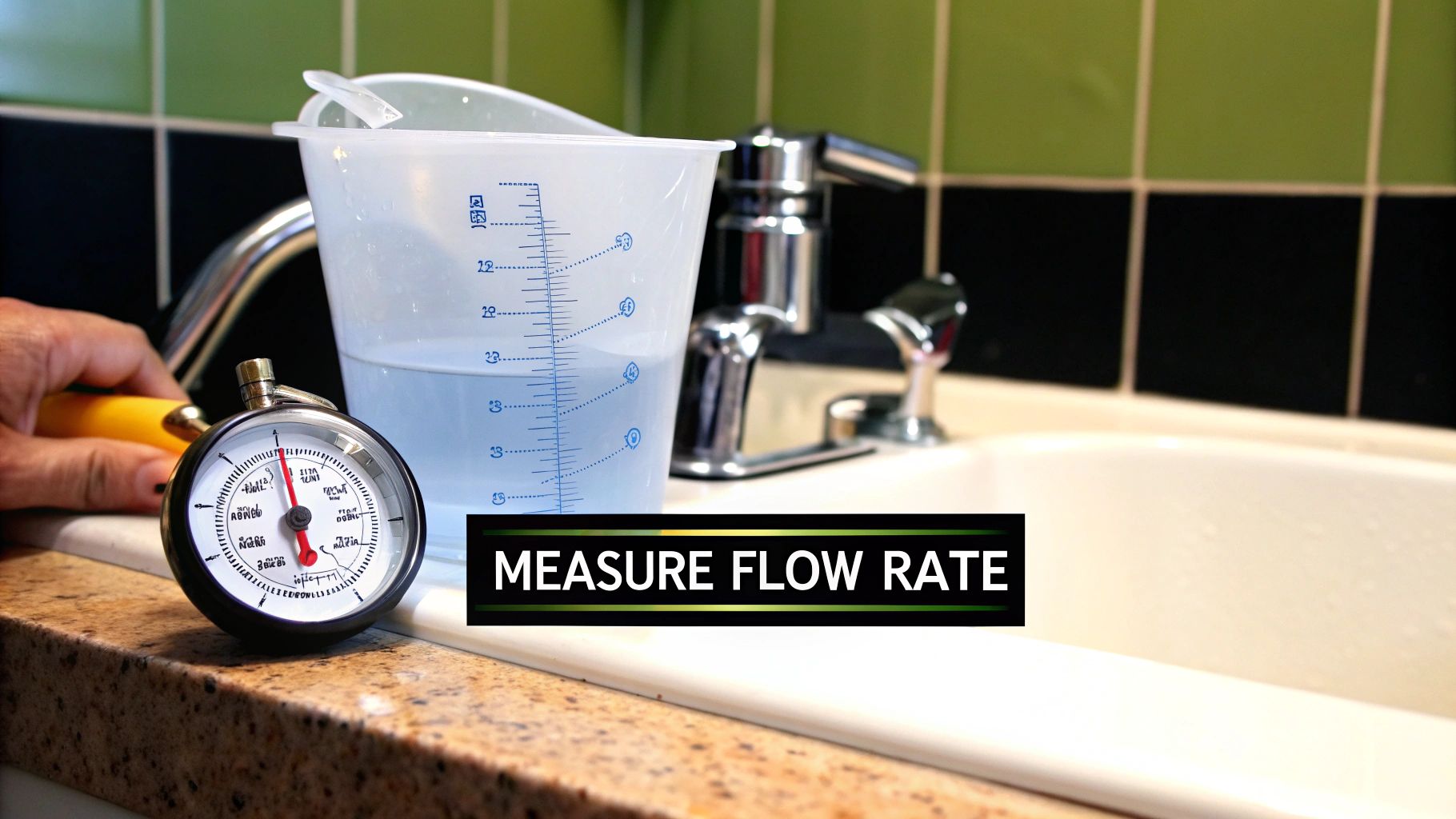
Before you can fix a weak shower, you need to play detective and understand your home's unique setup. We're looking at two key clues: water pressure (the force) and flow rate (the volume).
Think of it like a garden hose. Pressure is how hard the water blasts out, while flow rate is how quickly you can fill a bucket.
A combi boiler is brilliant at heating water on demand, but it can only work with the water it’s given. It can’t magically create pressure that isn't already there. This is why our first port of call at Harrlie Plumbing and Heating is always the tap, not the boiler.
Getting a handle on these two things is the first real step toward that powerful shower you're dreaming of. Without these numbers, you’re just guessing.
How to Measure Your Flow Rate
Measuring your flow rate is surprisingly simple, and you can probably do it right now with a couple of things from the kitchen. This quick test gives you a clear number that tells you exactly what your system is capable of, which is incredibly useful when you talk to a heating engineer.
Here’s a quick, step-by-step guide:
Grab a large measuring jug (at least 2 litres) and get a timer ready on your phone.
Head to the tap closest to your boiler – this is usually the one in your kitchen.
Turn the cold tap on full blast and start your timer for exactly 6 seconds.
As soon as the timer starts, stick the jug under the tap to catch all the water. When 6 seconds are up, whip it out and turn the tap off.
Look at the amount of water you collected in litres, then multiply that number by 10. This simple sum gives you your flow rate in litres per minute (LPM).
For instance, if you collected 1 litre of water in those 6 seconds, your flow rate is 10 LPM. For a decent, invigorating shower, you really want a flow rate of at least 10-15 LPM. If you're getting less than 10 LPM, we've likely found the culprit behind your disappointing shower.
A low flow rate is the most common reason for a weak shower in homes with combi boilers. Knowing this number helps us at Harrlie Plumbing and Heating diagnose the problem accurately and recommend the right solution, saving you time and money.
Local Factors Affecting Your Water Pressure in Eastbourne
Your home’s water pressure isn’t just down to your internal plumbing; your postcode here in Eastbourne plays a big part too. We often find that factors outside your front door have a massive impact on the mains pressure reaching your property.
Property Elevation: Homes on higher ground, like in parts of Meads or Upperton, can naturally have lower mains pressure than those in the flatter areas of town. Gravity is working against you!
Age of Pipework: In some of Eastbourne's lovely older neighbourhoods, like Old Town, the original mains pipework can be narrower, restricting the amount of water that can flow into your home at any one time.
Time of Day: During peak hours, like the morning rush when everyone is getting ready for work and school, the demand on the local network can cause a temporary dip in pressure for the whole street. We see this a lot in densely populated areas like Hampden Park.
Our team at Harrlie Plumbing and Heating always considers these local factors during a call-out. If low mains pressure is the root of the problem, don’t worry, there are effective solutions. To get a head start, check out our guide on how to increase water pressure in your UK home. It’ll walk you through the options for finally getting that weak shower sorted.
Why Power Showers and Combi Boilers Don't Mix
To get our heads around why combi boilers and power showers are such a bad match, we need to look at what each one was designed to do. The truth is, they were built to solve completely opposite problems, which makes them fundamentally incompatible from the get-go.
Think of it this way: a combi boiler is a high-pressure system. It takes cold water straight from your mains, heats it on demand, and pushes it out to your taps and shower at full mains pressure. There are no tanks in the loft or airing cupboard; it’s a direct, powerful, and very efficient way of getting hot water.
A power shower, on the other hand, is a relic from the days of old-school, low-pressure gravity-fed systems. We're talking about the classic setup with a cold water tank up in the loft and a hot water cylinder tucked away. A power shower has its own pump built-in for one reason only: to boost that naturally weak, gravity-driven flow and turn a dribble into a proper drenching.
The Technical Conflict
Here's where it all goes wrong. The core problem is painfully simple: you just can't connect a pump (the power shower) to a system that's already under high pressure (the combi boiler). When you do, you're forcing the power shower's pump to fight against the strong pressure coming directly from the mains. It’s a battle happening right inside your pipework.
This constant struggle puts an incredible amount of strain on your boiler's most delicate—and expensive—parts. Here at Harrlie Plumbing and Heating, we’ve seen the aftermath of this mistake in homes across Eastbourne, and believe me, the damage can be catastrophic.
Connecting a power shower to a combi boiler is a recipe for disaster. It can cause irreversible damage to the boiler's heat exchanger and diverter valve, leading to costly repairs that could have been easily avoided. As our engineers at Harrlie Plumbing and Heating often say, it's the fastest way to turn a simple shower upgrade into a full boiler replacement.
It’s not just your boiler at risk, either. This kind of setup will almost certainly void your manufacturer's warranty. If an engineer finds that the fault was caused by an incompatible appliance, you'll be footing a very hefty bill. In some instances, it might even breach UK water bylaws, which are there to protect the public mains supply.
A Growing Market and a Common Mistake
Combi boilers are more popular than ever, and it’s easy to see why. They're efficient, compact, and save a ton of space. In fact, the UK combi boiler market has seen consistent growth and is projected to have a compound annual growth rate of around 3.9% through 2035. This is all driven by homeowners wanting smarter, more compact heating solutions. You can dig deeper into these market trends in this Future Market Insights report.
As more and more of us upgrade to combis, it's crucial to understand how they work. While they’re brilliant at delivering high-pressure hot water, they aren’t a one-size-fits-all fix for every home's existing plumbing. For anyone interested in other high-pressure systems that do use a storage cylinder, you might find our guide on what a Megaflow system is helpful. The main takeaway is this: your choice of shower must match your water system.
So, we've established that trying to pair a combi boiler with a power shower is a bit like mixing oil and water—it just doesn't work. But that absolutely doesn't mean you're stuck with a disappointing dribble. The great news is you can get that fantastic, high-pressure shower experience with a combi boiler. You just need the right approach.
Instead of trying to force two incompatible pieces of kit together, the secret lies in working with your combi system, not against it.
There are really two main paths you can take to get that powerful shower you're dreaming of. The first, and often the most straightforward, is making sure you have a modern combi boiler that can deliver a seriously impressive hot water flow rate. The second is for homes where low incoming mains pressure is the real culprit—and for that, a mains booster pump is the perfect partner for your boiler.
Option 1: Upgrading to a High Flow Rate Combi Boiler
Sometimes the most direct solution is the best one. Modern combi boilers are engineered for incredible performance, capable of pumping out hot water at flow rates that can easily match, or even beat, the old pumped systems you might be used to.
If your current combi is getting on a bit or was never quite right for your home's needs, it could be the true bottleneck in your system. By upgrading to a newer model with a high Domestic Hot Water (DHW) flow rate—we're talking 15 litres per minute or more—you can single-handedly transform a lacklustre trickle into an invigorating downpour. This tactic solves the problem right at the source, ensuring your entire system is perfectly optimised. A recent installation we completed for a family in the Sovereign Harbour area of Eastbourne involved upgrading their old boiler to a high-flow model, and the feedback on their new shower performance was immediate and fantastic.
Thinking of a bigger bathroom project to get the perfect shower? You might find some great ideas in this ultimate guide to a stress-free bathroom remodel.
This little decision tree gives you a good idea of which way to go based on your home's water pressure.
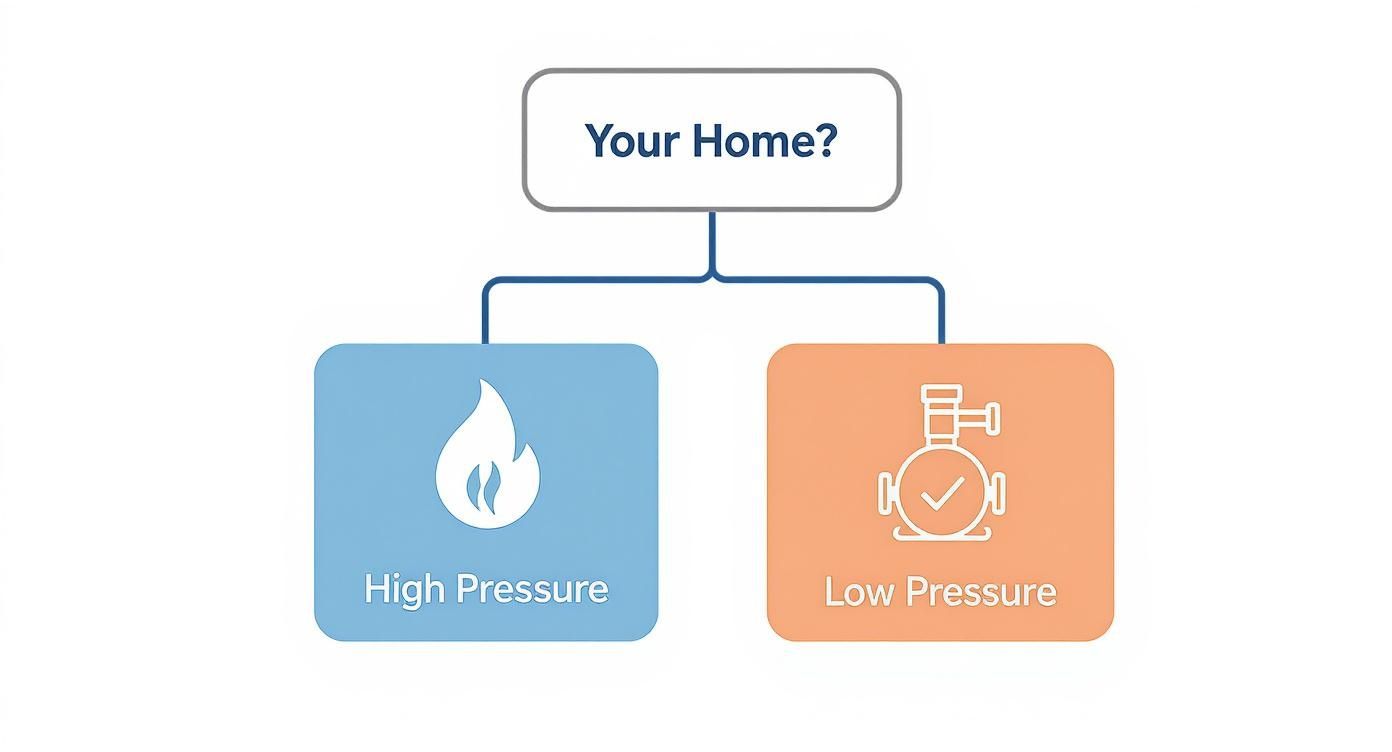
As you can see, your home's existing pressure is the real decider, pointing you towards either a boiler upgrade or a helping hand from a booster pump.
Option 2: Installing a Mains Booster Pump
But what if your boiler is working just fine, and it's the mains pressure coming into your house that's letting you down? This is a really common situation in many Eastbourne properties, especially older homes or those built on higher ground. In this case, the answer is a mains booster pump.
Now, it’s really important not to get this confused with a standard shower pump. A mains booster is installed right where the water main enters your property, before it even reaches your combi boiler.
A mains booster pump gives the water pressure a lift for your entire home. It feeds your combi boiler with higher-pressure water, which the boiler then heats and sends on to your shower. The result is a powerful, consistent flow every time.
This is a completely safe and compatible solution. Here at Harrlie Plumbing and Heating, it's something we often recommend for homes in Eastbourne where we know a new boiler alone won't fix the underlying problem of low pressure. It’s a brilliant way to get the shower you want without having to replace a boiler that’s still got plenty of life left in it.
To get the most out of your improved system, have a look at our guide with top tips for the best shower for a combi boiler to help you choose the perfect shower head and fittings.
Let's break down these two options side-by-side to make the decision a bit clearer.
Solutions for a Better Combi Boiler Shower Experience
Solution | How It Works | Best For | Estimated Cost |
|---|---|---|---|
Upgrade Combi Boiler | Replaces an old or undersized boiler with a new model capable of a higher hot water flow rate (e.g., 15+ L/min). | Homes where the boiler is the weak link in the system, and the incoming mains pressure is already decent. | £2,000 - £4,500+ |
Install Mains Booster Pump | A pump fitted to the incoming water main boosts pressure for the whole house before the water gets to the boiler. | Homes with a perfectly good boiler but low incoming mains water pressure from the street. | £400 - £800+ |
By choosing one of these two routes, you can finally get that powerful, reliable shower you’ve been missing—all while keeping your combi boiler happy, safe, and your warranty firmly intact.
Choosing the Right Combi Boiler for Your Eastbourne Home
Picking out a new combi boiler isn't just about keeping your radiators warm. It’s about making sure you get a powerful, reliable shower every single time you step in. To get it right, there are two key terms you need to get to grips with: kW output and DHW flow rate.
The kW (kilowatt) output is mostly about your central heating – it’s linked to how many radiators you have and the overall size of your house. But the DHW (Domestic Hot Water) flow rate? That’s the magic number for your shower. It tells you exactly how many litres of hot water the boiler can deliver per minute (LPM).
Understanding Flow Rate and Your Household Needs
A higher DHW flow rate means your boiler can handle sending hot water to more than one tap at a time without the pressure dropping off a cliff. If you live alone in a small flat in Eastbourne's town centre, a boiler that puts out 10-12 LPM will probably do you just fine.
But for a family in a typical three-bedroom house in Eastbourne's Old Town with a couple of bathrooms, the story is very different. In that situation, we at Harrlie Plumbing and Heating would always point you towards a boiler that delivers at least 14-16 LPM. This is what ensures that someone running the kitchen tap doesn’t suddenly turn your lovely hot shower into a lukewarm trickle.
Selecting a boiler with an adequate DHW flow rate is the single most important decision for achieving a powerful shower with a combi boiler. It’s the difference between a frustrating dribble and a luxurious, high-pressure experience.
Local Expertise and Brand Reliability in Eastbourne
Living and working right here in Eastbourne gives us a proper understanding of which boiler brands can handle our local water conditions. The hard water in our area can be pretty tough on heating systems, so choosing a robust unit is vital for its long-term health and your peace of mind.
From what we see out on the job at Harrlie Plumbing and Heating, brands like Worcester Bosch and Vaillant consistently prove their worth. They are known for a few key things:
Excellent build quality that stands up well to hard water.
Strong manufacturer warranties, often covering you for up to 10 years.
High-performance DHW flow rates that are perfect for that invigorating shower you're after.
It's interesting to note that while power showers are a no-go with combi boilers, they are still found in many UK homes, typically boosting pressure in older gravity-fed systems. The continued demand for that powerful shower feel has definitely pushed manufacturers to engineer high-efficiency combi boilers with fantastic flow rates, giving homeowners what they want without needing extra pumps. You can read more about the healthy growth in the UK boiler market over at Installer Online.
Ultimately, putting your money into the right boiler from the very beginning is the surest way to guarantee your home always has all the hot water it needs.
Your Combi Boiler and Shower Questions Answered
We’ve covered a lot of ground, but it's natural to still have a few questions rattling around. Here at Harrlie Plumbing and Heating, our engineers are always happy to clear things up for Eastbourne homeowners. Let's tackle some of the most common queries we hear about combi boilers and power showers.
Our goal is to give you the confidence to make the right choice for your home’s heating and hot water.
What Types of Showers Work Best with a Combi Boiler?
The great news is that most modern showers are a perfect match for a combi boiler. Because combis deliver hot water straight from the mains at high pressure, they pair beautifully with showers designed to handle that strong flow.
Your best options usually include:
Thermostatic Mixer Showers: These are often our top recommendation at Harrlie Plumbing and Heating. They brilliantly keep the water temperature steady, even if someone flushes a toilet or runs a tap elsewhere in your Eastbourne home. That built-in safety feature makes them ideal for families.
Digital Showers: Offering pinpoint temperature control and often featuring clever, programmable settings, these are a fantastic modern choice. They work seamlessly with a combi's powerful flow.
Manual Mixer Showers: A simple and effective option that blends hot and cold water to your liking, making full use of the excellent mains pressure your combi provides.
There's only one type you absolutely must avoid: a power shower. Its own internal pump will literally fight against your boiler's pressure, which can lead to serious damage.
Will a New Combi Boiler Fix My Weak Shower Pressure?
This is a really important point to understand. A combi boiler is fantastic at heating the water it receives, but it can't magically increase your home's incoming mains pressure. If the water pressure coming in from the street is low, even the most powerful boiler will still give you a weak shower.
At Harrlie Plumbing and Heating, the first thing we do on any job like this in Eastbourne is test the mains pressure. A new boiler might be part of the solution, but if low pressure is the root of the problem, the boiler alone won't fix it.
In these situations, a mains booster pump is often the real hero. It works in harmony with your boiler to give you that powerful, invigorating shower you've been dreaming of.
What Is the Difference Between a Shower Pump and a Mains Booster Pump?
It's easy to get these two mixed up, but the difference is critical. A shower pump is specifically designed for old, low-pressure, gravity-fed systems—the kind with a big water tank in the loft. Its job is to boost water flow to a single shower. You should never, ever use one with a combi boiler.
A mains booster pump, on the other hand, is installed right on your incoming water pipe. It increases the water pressure for your entire home. It works with your combi boiler, not against it, improving flow to all your taps and showers. When you're thinking about a full bathroom overhaul to go with your new, efficient shower system, checking out some top bathroom remodel shower ideas can give you some great inspiration for the finished look.
Ready to get that perfect, powerful shower experience in your Eastbourne home? Contact Harrlie Plumbing and Heating today for expert advice and a free, no-obligation quote. Let our certified engineers find the right solution for you. https://www.harrlieplumbing.co.uk

Comments